Africa
Reflections on Trump’s Geopolitics, African Ambitions and Future Prospects -By Kestér Kenn Klomegâh
Trump has announced new tariffs, beginning from Aug 1, on 14 countries, including Algeria, Libya, and South Africa. This cast a shadow over Africa’s economic outlook, paralysing business afresh in those countries. But at the same time, there are also clear indications Trump administration is, most possibly with truth of commitment, normalizing relations and expanding economic partnerships and that would ensure renewed waves across the continent. While there are still some doubts over patching up the growing complications and complexities in the entire U.S.-Africa relations, the White House’s report hinted at holding an expanded Africa leaders summit in September with United States under the patronage of Donald Trump.

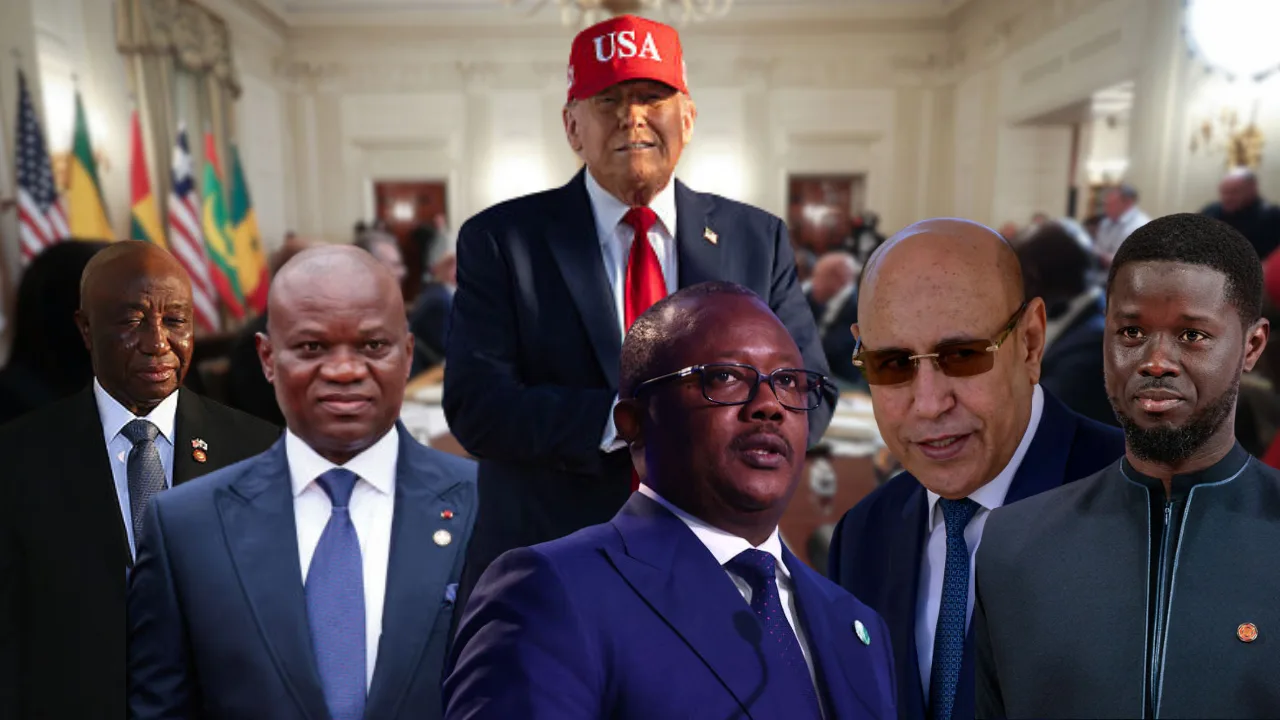
United States President Donald Trump’s unexpected invitation of five West African leaders from Gabon, Guinea-Bissau, Liberia, Mauritania and Senegal for extraordinary multilateral meeting in Washington was primarily to review and reshape the U.S. relationship with Africa. According to White House official documents, the key areas of cooperation also included economic development, security, infrastructure and democracy. The meeting was attended by the presidents of Gabon (Brice Clotaire Oligui Nguema), Guinea-Bissau (Umaro Sissoco Embaló), Liberia (Joseph Nyuma Boakai), Mauritania (Mohamed Ould Ghazouani), and Senegal (Bassirou Diomaye Faye).
The multilateral dialogue has both high-valued significance and geopolitical implications. The White House explicitly indicated the July meeting aimed at fostering an open dialogue and get familiar with rising concerns and priorities, and possibly with the goal of promoting private sector investment and deeper economic partnerships. Some policy experts have weighed in too. At the height of United States deteriorating relations with Africa and, particularly with new rules and regulations relating to trade, President of the African Development Bank, Dr Akinwumi A. Adesina, proposed concerted efforts to change the narrative on Africa in the United States in order to attract increased investments into the continent. “Africa is no longer a continent that can be ignored,” he said, pointing further to emerging economic investment opportunities for institutional investors in Africa and those from the United States.
“This is the time to change the investment narrative on Africa in the United States,” he stressed, and explained several developing strategic alliances and partnerships, taking advantage of the new outlook of new U.S. administration. Adesina spoke about the need to change the mindset, and creating more opportunities to attract greater U.S. investment in Africa and within the context of the African Continental Free Trade Area (AfCFTA). Many African countries consider the African Continental Free Trade Area (AfCFTA) as a historic opportunity to deepen economic ties, first with regional and continental neighbours, and further to expand market access for their respective goods and services abroad. Notably, this intra-African trade remains the starting-point of strength, especially with the AfCFTA creating a single consumer-market of an estimated 1.4 billion people.
South African President Cyril Ramaphosa has faced resonating criticisms from South African entrepreneurs, politicians, and the middle class for turning and twisting its spinal bone to the United States. For decades, many other African countries, including Ethiopia, Egypt and South Africa have had excellent trade ties and investment relations with the United States, especially through the African Growth and Opportunity Act (AGOA). While some African countries, since Donald Trump’s ascension to the presidency, have been trying to adjust to change U.S. trade and economic relations with Africa, uncertainty largely remains on the landscape. Egypt has had its share over the war between Israel and Palestine, and South Africa over the alleged white genocide.
Interesting to remind here that the relations between South Africa and the United States have sharply declined since Donald Trump returned to the White House in January 2025. Tensions escalated after the U.S. president expelled South Africa’s ambassador and cut financial aid, citing objections to South Africa’s land reform policies and its decision to pursue a genocide case against U.S. ally Israel at the International Court of Justice. In response, the South African government defended its stance, calling the land reform effort a constitutional measure aimed at addressing historical racial inequalities in land ownership dating back to apartheid. Officials also stressed that no land expropriations have taken place.
Nevertheless, U.S.-Africa business conference hosted by Angola in late June 2025, adopted measures to sustain at least existing long-term trade ties between U.S. and Africa, tactful agreements were reached to push for the extension of African Growth and Opportunity Act (AGOA) which offer the huge chance for African products and service to reach U.S. market, and for eligible African countries to earn revenue for the budget. Undeniably, the African and Afro-American diaspora invariably form an important actors in the U.S.-Africa economic partnership and key vectors of commercial exchanges on the African and U.S. directions.
In practical reality, the AGOA and the AfCFTA are currently working together on mechanisms to promote trade between the two regions. This represents the strongest bridge connecting U.S. and Africa, in addition to financial remittances (US$58 billion, World Bank and IMF reports 2024) by Africans whose labour supports the American economy and the aggregate productivity. These are stark realities that are getting increasingly hard to ignore in the current geopolitical context.
While the swift turns and tweets continues featuring in U.S. relations with Africa, Donald Trump’s multilateral ‘mini-summit’ with leaders of Gabon, Guinea-Bissau, Liberia, Mauritania and Senegal raised eye-brows around the world. Reports monitored and thoroughly studied by this article author indicated that Trump’s strategically aimed at striking smart-partnership involving the exploitation of critical mineral resources and also questions over trade and support for economic development. That however, critics say the five leaders represent a small fraction of the U.S-Africa trade, but possess untapped natural resources.
In their speeches, African leaders adopted a kind of flattering chorus. Gabon, Guinea-Bissau, Liberia, Mauritania and Senegal have shown skyline interest, an opportunity to sustain bilateral relations but with new twists and in new formats. Nowadays, African countries are prepared to export semi-processed resources, such as Senegalese natural resources, including manganese — a key mineral in the production of stainless steel and batteries — iron ore, gold, diamonds, lithium and cobalt; Gabon’s manganese and uranium, and those other mineral resources particularly in Guinea-Bissau, that have drawn Washington’s strategic interest.
On one side, Liberia’s President Joseph Nyuma Boakai in a statement “expressed optimism about the outcomes of the summit, reaffirming Liberia’s commitment to regional stability, democratic governance, and inclusive economic growth.” On the other side, Guinea-Bissau’s president, Umaro Sissoco Embalo, called the visit “very important” – citing hopes for economic support. Gabonese officials also cited industrial development as a key interest.
Reports littered up on social media, offered insights into the assertive exchanges and discussions by Senegalese President Bassirou Diomaye Faye with Donald Trump. During the meeting, Bassirou Faye lavished praises on and further complimented Trump’s leadership skills — and his golf game — and pitched a potential Trump-branded golf course in Senegal. “I was wondering what your secret was for resolving all these complex crises?” Faye flatteringly asked Trump. “And I know you are a tremendous golf player. Golf requires concentration and precision, qualities that also make for a great leader.”
Trump appeared noticeably pleased with Mauritania President Mohamed Ould Ghazouani, together with the four presidents. United States anticipated to strike contentious mineral exploration deals. “We have a great deal of resources,” said Mohamed Ould Ghazouani, president of Mauritania, listing rare earths, as well as manganese, uranium and possibly lithium. “We have a lot of opportunities to offer in terms of investment.”
In a typically direct, combative, and unique style, Trump told the African leaders Washington’s ambitious plans to build new economic cooperation, and the desire to boost substantial package of trade ties with the aforementioned African leaders. Trump encouraged the leaders to make greater investments in defence, hopefully, of course, buying U.S. equipment, the best defense equipment which was proved the best in the Republic of Iran.
In all that, Trump suggested serious trade, which perhaps means that Washington would be hesitant to impose large tariffs on their countries. At least, Trump even thought it necessary to crack jokes, asked Liberia’s president where he learnt to speak English so well. “Such good English, where did you learn to speak so beautifully? I have people at this table who can’t speak nearly as well,” Trump asked after complimenting Liberian President Joseph Boakai on his English that Liberia has been a longtime friend of the United States and the possibility of the policy for making America great again in the geopolitical context.
“We have closed the USAID group to eliminate waste, fraud and abuse,” Trump said. “And we’re working tirelessly to forge new economic opportunities involving both the United States and many African nations.” West African countries are among the hardest hit by the dissolution of USAID. The U.S. support in Liberia amounted to 2.6% of the country’s gross national income, the highest percentage anywhere in the world, according to the Center for Global Development.
Trump has announced new tariffs, beginning from Aug 1, on 14 countries, including Algeria, Libya, and South Africa. This cast a shadow over Africa’s economic outlook, paralysing business afresh in those countries. But at the same time, there are also clear indications Trump administration is, most possibly with truth of commitment, normalizing relations and expanding economic partnerships and that would ensure renewed waves across the continent. While there are still some doubts over patching up the growing complications and complexities in the entire U.S.-Africa relations, the White House’s report hinted at holding an expanded Africa leaders summit in September with United States under the patronage of Donald Trump.
*Kestér Kenn Klomegâh has a diverse work experience in the field of business intelligence and consultancy. His focused research interest includes geopolitical changes, foreign relations and economic development related questions in Africa with external countries. Klomegâh has media publications, policy monographs and e-handbooks.