Opinion
Russia’s Increasing Trade With Egypt, by Kestér Kenn Klomegâh

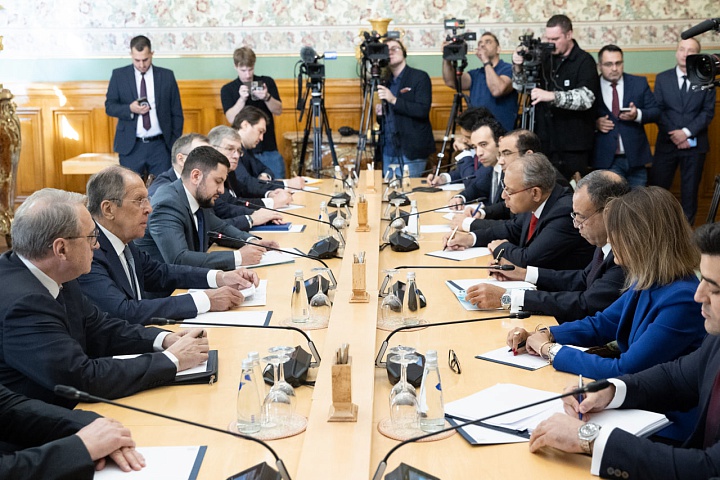
During their first meeting in Moscow, Foreign Minister Sergei Lavrov and his colleague, Egyptian Foreign Minister Badr Abdelatty, noted publicly that bilateral trade between Russia and Egypt has grown significantly over the past year, and Moscow and Cairo are determined to maintain this trend in the subsequent years.
“The positive dynamics of our trade and economic interaction is quite encouraging, as the volume of bilateral trade totaled over $7 billion last year, exceeding significantly the previous year’s figures. It is our common determination to do all we can for this positive trend to continue and strengthen. We attached special significance to supplies of Russian grain products to the Egyptian market and noted their stability,” Lavrov said at a press conference following negotiations with Egyptian Foreign Minister Badr Abdelatty in Moscow.
While on his official working visit in Moscow, Abdelatty met with Russian Trade and Industry Minister Anton Alikhanov, who co-chairs the intergovernmental commission on the Russian side. The intergovernmental commission has been meeting regularly and has the task of promoting both ways. The parties highly praised the work of the Russian-Egyptian intergovernmental commission, Lavrov said.
It was noted similarly that Egypt remains Russia’s major trade partner in Africa. “Despite external challenges and the situation in the world, trade turnover between Russia and Egypt has been demonstrating solid growth in recent years. Last year it grew by 16%. This year positive dynamics has persisted as turnover gained one third in the first half of the year. Meanwhile Russian business shows high interest in expanding presence on the Egyptian market,” Minister Anton Alikhanov was quoted as saying following a meeting with Egyptian Foreign Minister Badr Abdelatty.
With other aspects of bilateral relations, particularly transfer of nuclear technology, the two foreign ministers also discussed the El Dabaa nuclear power plant project in Egypt and the establishment of a Russian industrial zone in the country’s Suez Canal area. The agreement on the NPP, El Dabaa signed in November 2015, but construction began only in 2023 after the second Russia-Africa summit held in St. Petersburg.
The project costs $28.75 billion of which Russia agreed to finance 85% as a state loan of $25 billion, while Egypt provides the remaining 15% in the form of installments. The Russian loan has a repayment period of 22 years, with an annual interest rate of 3% According the estimated plan, the construction is expected to be completed by 2028-2029.
Sergei Lavrov and Badr Abdelatty also discussed the full spectrum of bilateral relations, in line with the Comprehensive Partnership and Strategic Cooperation Agreement that came into effect in 2021. As always, both ministers focused on international and regional issues, including the situation in the Gaza Strip, Syria, Libya, Sudan, and the Horn of Africa.
Egypt voted in favor of the United Nations resolution condemning Russia’s invasion of Ukraine and calling for a withdrawal of Russia’s forces from the country. During the 2023 Russia–Africa summit, Egyptian President Abdel Fattah el-Sisi urged Vladimir Putin to renew the grain deal and allow Ukraine to export grain via the Black Sea route. Despite these differences, Egypt remains the best tourism destination in North Africa.
On 23 August 2023, at the 15th BRICS summit, Russia along with the other members of BRICS formally invited Egypt to join the association. In strict adherence of its guidelines, and ‘common concensus’ reached by the association, Egypt alongside with Ethiopia, Iran, Saudi Arabia and the United Arab Emirates, became a full member starting 1 January 2024.
Diplomatic relations between the two countries is rapidly consolidating, after the first historic Russia-Africa summit in 2019. Russia and Egypt has excellent relations, even during the Soviet era. But that was slackened after the Soviet’s collapse in 1991. At approximately 100 million inhabitants, the Arab Republic of Egypt, is a transcontinental country spanning the northeast corner of Africa and the Sinai Peninsula in the southwest corner of Asia.