Africa
Tinubu’s Pardon: A Presidential Endorsement of Crime -By Jeff Okoroafor
President Tinubu’s pardon of murderers & drug traffickers like Maryam Sanda undermines justice & fuels Nigeria’s insecurity crisis. This op-ed analyzes a grave misstep.


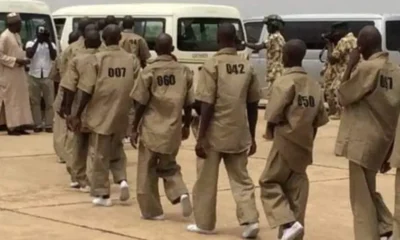
In the grim theatre of Nigerian politics, where the lines between tragedy and farce are often blurred, President Bola Tinubu has staged a performance that will be remembered as a definitive act of moral abdication. His recent granting of presidential pardon to 175 convicts, including murderers and drug traffickers, is not merely a misstep; it is a conscious, deliberate sabotage of the very fabric of justice and security he swore to uphold. This move, draped in the legalistic language of “prerogative of mercy,” is in reality a stark declaration that this administration is not in the business of fighting insecurity and criminality, but of enabling it.
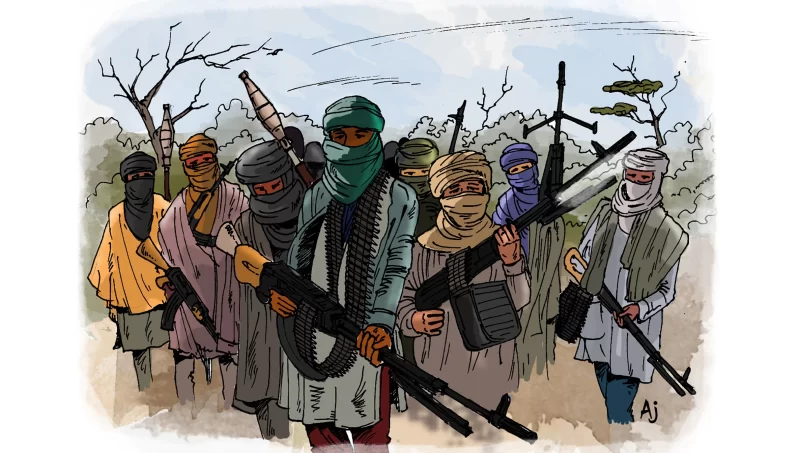
When a nation is brought to its knees by a multi-front war—terrorism in the North, banditry in the Middle Belt, secessionist violence in the Southeast, and a nationwide epidemic of kidnapping and drug-fueled crimes—one expects a leader to wield the instruments of state with resolve and moral clarity. Instead, President Tinubu has chosen to wield the axe on the already crumbling pillars of the justice system.
Consider the case of Maryam Sanda. For the sake of clarity, let us state the facts unflinchingly: Maryam Sanda was convicted by a court of law for the murder of her husband, Bilyaminu Bello. The evidence was graphic and compelling, detailing a crime of passion that ended in a brutal stabbing. The court found her guilty of taking a human life. The sentence was death, later commuted to life imprisonment. This was the justice system working, however slowly, to affirm a fundamental societal principle: that life is sacred and those who wilfully take it must face the consequences.
President Tinubu, in his infinite and questionable wisdom, has now wiped that slate clean. He has told every Nigerian trapped in an abusive relationship, every family grieving a lost loved one to violence, that the ultimate price for murder can be negotiated away by presidential fiat. What message does this send to a country where life is already cheapened by daily headlines of mass killings? It signals that the state lacks the will to enforce its own most serious laws. It emboldens would-be offenders and pours salt on the wounds of victims’ families. If a convicted murderer can walk free, what exactly are our security agents dying for in the bushes of Sambisa or the villages of Plateau?
Even more egregious, and personally damning for the President, is the pardon granted to individuals convicted for drug trafficking. The Presidency’s own statement confirms that a significant portion of the pardoned—reportedly 29.2%—were jailed for drug offences. At a time when the National Drug Law Enforcement Agency (NDLEA) is waging a desperate war against a methamphetamine and cannabis epidemic that is fueling youth addiction, violence, and instability, the Commander-in-Chief opens the prison gates for those who profited from this poison.
This is not just poor judgment; it is a profound national insult. Nigerian communities are being torn apart by substance abuse. Criminal gangs, funded by drug money, are terrorizing citizens. Yet, the President’s priority is to offer state-sanctioned reprieve to the kingpins and traffickers of this destruction.
The moral stench of this decision is overwhelming when viewed through the lens of the President’s own history. This is a leader whose past is permanently shadowed by the 1993 forfeiture of $460,000 to the United States government, funds alleged by American authorities to be the proceeds of narcotics trafficking. While his supporters have offered various explanations, the fact remains: a U.S. court found sufficient evidence to seize those funds in a drug-related case. For such a figure to now pardon convicted drug traffickers is not an act of mercy; it is an act of grotesque hypocrisy. It suggests a disturbing kinship with the very criminal enterprises the state is supposed to be dismantling. It is as if a fire chief is caught pouring gasoline on a blaze.
This pardon fiasco is not an isolated incident but part of a broader pattern of actions and inactions that enable insecurity and demonstrate a profound contempt for the rule of law.
The most glaring evidence of this contempt is the continued illegal detention of Nnamdi Kanu, the leader of the Indigenous People of Biafra (IPOB). It is a stunning paradox that underscores the administration’s selective and politically motivated application of justice. While President Tinubu eagerly signs pardons for convicted murderers and drug lords, he simultaneously disregards a direct order from a court of law. The Court of Appeal, on October 13, 2022, discharged and acquitted Nnamdi Kanu, ruling that his extraordinary rendition from Kenya was an egregious violation of international law and a flagrant abuse of process. The court mandated his immediate and unconditional release. Yet, Kanu remains in the custody of the Department of State Services (DSS), denied not only his freedom but also, by numerous accounts, adequate medical care. This is not law and order; it is lawlessness from the top. It reveals a government that respects court judgments only when they are politically convenient, and brazenly ignores them when they are not. This double standard is the very definition of impunity and a primary driver of the alienation and anger fueling insecurity in the Southeast.
Furthermore, the government’s approach to the rampant banditry in the Northwest has been tepid, often seeming to prioritize negotiation with terrorists over their decisive defeat. Pardoning common criminals while terrorists hold swathes of territory creates a perverse incentive structure: commit the most heinous crimes, and you might just get a seat at the negotiating table. Commit a lesser, but still grave, crime, and you might get a presidential pardon. By including those convicted of corruption and fraud in the pardon, Tinubu also undermines the already weak fight against graft. He tells every public official tempted to loot the treasury that there is a safety net—a political get-out-of-jail-free card that can be played when the right connections are made. This directly fuels insecurity, as corruption is the oxygen that feeds the fire of terrorism and banditry.
The presidential power of pardon is a sacred trust. It is designed for the marginal cases—the wrongly convicted, the reformed inmate who has demonstrated profound remorse, the individual sentenced under a draconian law. It was never intended to be a mass amnesty for those convicted of the most violent and socially destructive crimes, especially while a man judicially declared free, Nnamdi Kanu, wastes away in chains.
By using it in this manner, President Tinubu has betrayed that trust. He has shown a blatant disregard for the victims of crime, for the integrity of the judiciary, and for the morale of law enforcement agencies. He has effectively declared that in his Nigeria, crime can indeed pay, and court orders can be ignored, provided you have the right connections or your case fits a political narrative.
This op-ed is not just a criticism; it is a warning. A government that trivializes justice and selectively obeys the law loses its moral authority to govern. When the shepherd starts fraternizing with the wolves while caging the lambs the court has freed, the flock is left defenseless. Nigeria is bleeding, and instead of applying a tourniquet, President Tinubu has chosen to widen the wound. History, and the long-suffering Nigerian people, will not judge this act kindly.
Jeff Okoroafor is a social accountability advocate and a political commentator focused on governance, accountability, and social justice in West Africa.