Middle East War
UNGA at 80: A Step Towards Peace and Conflict Resolution -By Isah Aliyu Chiroma
Several nations, including France, Malta, San Marino, Australia, Britain and Canada have recognized Palestinian statehood. This acknowledgment from various countries signifies a vital step toward resolving the conflict; the “New York Call” issued by 15 countries articulated recognition of Palestine as essential to peace.

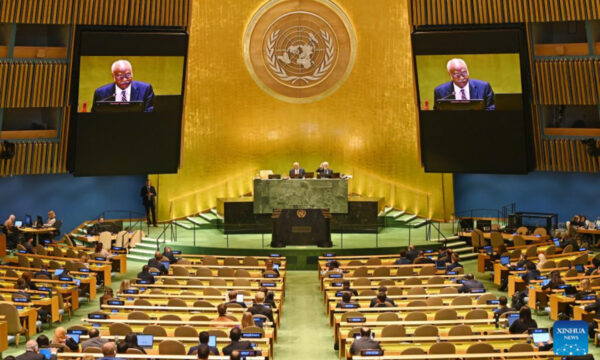
As we find ourselves navigating the complexities of the Palestinian-Israeli conflict, the discussions surrounding a two-state solution become increasingly urgent. This discourse is not only a matter of national pride for both Palestinians and Israelis but also a test of humanity’s collective resolve to protect human dignity. The recent statements from world leaders emphasize an emerging consensus: the ongoing actions of Israel, often viewed as heartless and unilateral, must cease. This unified call for humanity transcends national interests and reinforces the idea that the international community cannot remain passive in the face of human suffering.
As the United Nations marks its eightieth anniversary, it is essential to introspect on its founding principles. The UN was born from the ashes of a world ravaged by war, with the aim of fostering cooperation to tackle global challenges that individual nations are ill-equipped to address alone. History has shown us that only through collective action can we mitigate crises that leave millions disenfranchised. The plight of the Palestinian people serves as a reminder that when unity prevails among nations, solutions can emerge even to the most intractable conflicts.
Reflection back to the roots of the Palestinian-Israeli conflict reveals layers of historical grievances, territorial disputes, and identity struggles. The metaphor of a tenant and landlord can elucidate the dynamics at play: one party has taken residence while the other claims ownership, leading to an existential standoff that has persisted for decades. This situation cannot be resolved by mere negotiations among the parties involved; it requires a concerted effort from the international community to redefine the narrative and promote a sustainable future.
Recently, the Secretary-General António Guterres of the United Nations remark during the United Nations General Assembly (UNGA 80) underscore the critical importance of moving toward a two-state solution as the pathway to peace in the Middle East. Without a framework that enables two sovereign states to coexist, the prospects for enduring peace remain bleak.
The international community recognized the gravity of this situation when, in December 2024, a UN General Assembly resolution garnered overwhelming support, with a vote of 157 to 7. This was a reflection of global awareness that dialogue alone will not suffice; tangible actions must follow. The subsequent international conference held in New York from July 28 to July 30, 2025, focused on essential issues, including disarming Hamas, securing the release of hostages in Gaza, and reforming the Palestinian Authority (PA). At its heart, the gathering aimed to lay the groundwork for a new era—a sovereign Palestinian state.
The resulting New York Declaration offers a roadmap toward a demilitarized state under the PA’s governance. Over the next 15 months, a temporary UN peacekeeping mission will provide necessary security during this transitional phase. The establishment of a 19-member oversight committee, co-chaired by France and Saudi Arabia, demonstrates a serious commitment to monitor the implementation of these critical initiatives. However, discussions surrounding recognition of Palestinian statehood remain contentious, illustrating that while progress has been made, significant challenges still lie ahead.
Several nations, including France, Malta, San Marino, Australia, Britain and Canada have recognized Palestinian statehood. This acknowledgment from various countries signifies a vital step toward resolving the conflict; the “New York Call” issued by 15 countries articulated recognition of Palestine as essential to peace.
One of the glaring shortcomings of the current situation is the absence of key players like the United States and Israel, who opted to boycott the recent talks citing a rejection of unilateral recognition of Palestine. Their participation is essential, not only for their influence but also for the legitimacy that their involvement would confer on any agreement reached. Their absence raises questions about commitment to a two-state framework and the level of international support it will receive.
The urgency of action cannot be overstated; leaders around the world must recognize that the enduring conflict perpetuates human suffering, destabilizes the region, and challenges the ideals upon which the UN was founded. In light of this, the time has come for a bold stance: if Israel continues to disregard the principles of humanity and international law, world leaders must be prepared to employ diplomatic tools, including sanctions.
Sanctions should not be wielded as a weapon of retribution but as an instrumental strategy for accountability and as a means to compel compliance with established international norms. By using economic pressures judiciously, world leaders can send a clear signal that violations of human rights, aggression, and the perpetuation of conflict will not be tolerated. This approach must be rooted in a commitment to dialogue, aiming for a negotiated settlement that respects the rights and aspirations of both Israelis and Palestinians.
Emphasizing the necessity of the two-state solution should come with specific actions: increased diplomatic engagement, stronger international coordination, and capacity-building support for Palestinian institutions. Moreover, parallel efforts should address the underlying issues such as settlement expansion, violence, and the humanitarian crisis in Gaza. The international community must facilitate open channels for constructive dialogue, ensuring that all voices are heard, particularly those of the marginalized communities.
As we stand at this critical juncture in history, it is imperative that world leaders prioritize a coherent and unified strategy for achieving a two-state solution. The path toward peace will not be easy, nor will it be without pain, but it is the only way forward that honors the rights and dignity of all people involved. A significant global response is needed—one that refuses to accept the status quo and is willing to take the bold steps necessary to restore hope and build a future where both Israelis and Palestinians can thrive side by side in peace. The time for action is now; the world is watching, and history will remember the choices we make today.