Africa
Why Nigeria’s Battle Over Electronic Transmission Is Really About Trust -By Isaac Asabor
In the end, the uproar is not noise. It is evidence of democratic consciousness asserting itself. Citizens are demanding that power reflect participation without distortion. They are insisting that the journey from ballot to result be as transparent as the act of voting itself.

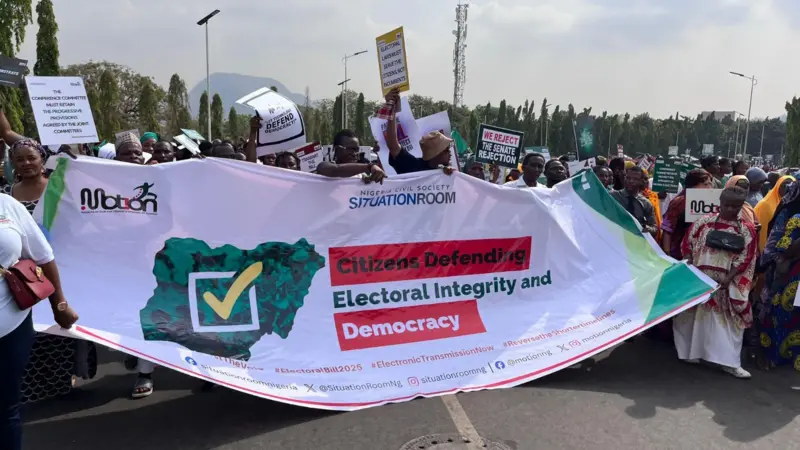
The fierce national reaction to the Senate’s handling of electronic transmission in the Electoral Act amendment is not a dispute about technical procedure. It is a confrontation over credibility. The controversy now unfolding around Clause 60(3), discretionary language, and the rejection of mandatory real-time uploads is not simply legislative disagreement; it is a public referendum on whether Nigeria’s electoral system can be trusted to carry the will of voters intact from polling units to final declaration.
Recent developments have sharpened that question dramatically. Labour unions threaten mass action and election boycotts. Civil society organizations demand investigations into alleged procedural irregularities. Political coalitions warn of risks to electoral integrity. Youth groups speak of deepening disillusionment. Even within the Senate itself, reports of confusion and internal dissent reveal an institution struggling to align its actions with public expectations. The intensity of these reactions confirms a central truth: electronic transmission has become the most visible measure of whether Nigerian democracy is moving toward transparency or retreating into ambiguity.
At the heart of the dispute is not whether electronic transmission exists in law. It does. The conflict lies in whether it should be mandatory and immediate or discretionary and conditional. That distinction is not semantic. It defines the difference between a system designed to guarantee transparency and one that merely permits it.
Supporters of mandatory real-time transmission argue that leaving the process to administrative discretion creates vulnerability at the precise point where electoral credibility has historically been weakest, the collation stage. This concern is neither abstract nor speculative. Nigeria’s electoral controversies have rarely emerged from the act of voting itself. They arise in the transition from polling unit results to aggregated outcomes. It is this transitional space that citizens seek to close through compulsory digital transmission.
Opponents of mandatory provisions frame their stance as continuity rather than regression. By retaining the wording that results are transmitted “in a manner as prescribed by the Commission,” they argue that flexibility is preserved. Yet critics interpret that same flexibility as institutionalized uncertainty. Where lawmakers see administrative latitude, citizens see a loophole. Where officials speak of procedural options, the public hears permission for selective compliance.
The Nigeria Labour Congress’s threat of mass action captures the emotional charge surrounding the issue. Its warning that elections without real-time electronic transmission could face boycott is not merely a political tactic; it reflects a growing belief that participation without verifiable transparency risks legitimizing outcomes that cannot be independently trusted. The Congress’s insistence that votes must not only be counted but seen to be counted encapsulates the broader public sentiment.
Civil society reactions further illustrate how the debate has shifted from policy to principle. Organizations have not limited their concerns to legislative wording; they question process integrity itself. Petitions demanding investigation into alleged removal of provisions signal anxiety that procedural opacity is not accidental but systemic. When lawmaking itself becomes contested terrain, the credibility of the laws it produces inevitably suffers.
Political organizations across ideological and regional lines have converged on a similar warning: discretionary transmission preserves the very vulnerabilities reform was meant to eliminate. Whether expressed by opposition coalitions, regional socio-political groups, or electoral reform advocates, the argument is consistent; ambiguity in result transmission invites contestation of outcomes. And when outcomes are contested, governance itself becomes unstable.
Perhaps the most revealing dimension of the controversy is generational. Youth organizations have framed the debate not as a technical dispute but as a test of democratic sincerity. Nigeria’s young population constitutes the largest voting demographic. Their engagement is driven not by nostalgia for past processes but by expectation of institutional evolution. When reforms perceived as minimum standards of transparency appear diluted, disengagement becomes rational rather than apathetic. A democracy that cannot convince its youngest participants of procedural integrity risks eroding its own future legitimacy.
The Senate’s emergency session, convened to approve votes and proceedings necessary for legislative harmonization, therefore carries symbolic significance beyond procedural necessity. It represents an institutional moment of choice: whether to reaffirm public confidence or deepen suspicion. Reports of internal divisions and confusion about what was actually passed only intensify public unease. A legislative body uncertain about its own decisions cannot easily reassure a skeptical electorate.
Underlying the entire controversy is a profound struggle over narrative authority. Electoral bodies traditionally define legitimacy through compliance with legal frameworks. Citizens, however, increasingly define legitimacy through transparency of process. These perspectives are not inherently incompatible, but they diverge when legal compliance does not produce visible accountability. Electronic transmission bridges that gap by transforming procedural compliance into observable action.
The warnings that the controversy could affect the credibility of the 2027 general elections are not rhetorical exaggerations. Electoral legitimacy is cumulative. Each unresolved controversy compounds skepticism. Each perceived retreat from transparency amplifies doubt. By the time ballots are cast, public confidence may already be predetermined by how reforms were handled years earlier. Trust is not built on Election Day; it is constructed in the legislative and administrative decisions that precede it.
Critically, the national response demonstrates that Nigerians no longer interpret electoral reform as a matter reserved for political elites. The breadth of stakeholders now engaged, labour unions, civil society, regional organizations, youth coalitions, opposition figures, and policy advocates, signals that electoral transparency has become a shared civic priority. This convergence is itself a democratic development. It reflects a society increasingly unwilling to delegate the credibility of its political system to institutional assurances alone.
Electronic transmission has thus evolved into a metaphor for a deeper democratic aspiration. It represents the desire for a system where results are not only accurate but verifiable, not only lawful but observable, not only declared but demonstrable. In this sense, the controversy is not about technology but about the architecture of trust.
It would be misleading to suggest that mandatory electronic transmission alone can resolve Nigeria’s electoral challenges. Technology does not eliminate political contestation, nor does it guarantee institutional integrity. However, institutional design shapes opportunity. Systems that reduce discretion at critical points reduce the scope for dispute. Systems that prioritize transparency encourage acceptance even among those who lose.
The resistance to mandatory provisions, therefore, is interpreted by many Nigerians not as caution but as reluctance to fully close avenues for post-voting intervention. Whether that interpretation is fair or not is secondary to its political consequence: perception becomes reality in matters of legitimacy.
The language used by critics, phrases such as “weaponization of ambiguity” or warnings of democratic erosion, may appear dramatic, but they reflect a broader public frustration with processes perceived as perpetually inconclusive. Nigerians are not demanding perfection. They are demanding clarity.
The unfolding debate ultimately reveals a country negotiating the terms of its democratic future. The question is no longer whether elections will occur, but whether outcomes will command belief. Electronic transmission has become the visible battleground where that question is being fought.
Trust cannot be legislated into existence, but it can be undermined by ambiguity and strengthened by transparency. The Senate’s decision on whether to retain discretionary language or mandate real-time transmission is therefore not merely a technical choice. It is a declaration of how Nigeria intends to reconcile institutional authority with public expectation.
In the end, the uproar is not noise. It is evidence of democratic consciousness asserting itself. Citizens are demanding that power reflect participation without distortion. They are insisting that the journey from ballot to result be as transparent as the act of voting itself.
Nigeria’s battle over electronic transmission is, fundamentally, a struggle over whether democracy will be something citizens are asked to trust, or something they are enabled to verify.