Breaking News
2026 Budget Under Pressure as N16.8tn Legacy Capital Projects Remain Unimplemented
The 2026 capital budget may face another roll-over as funding delays, procurement bottlenecks and outstanding 2024–2025 obligations slow implementation.

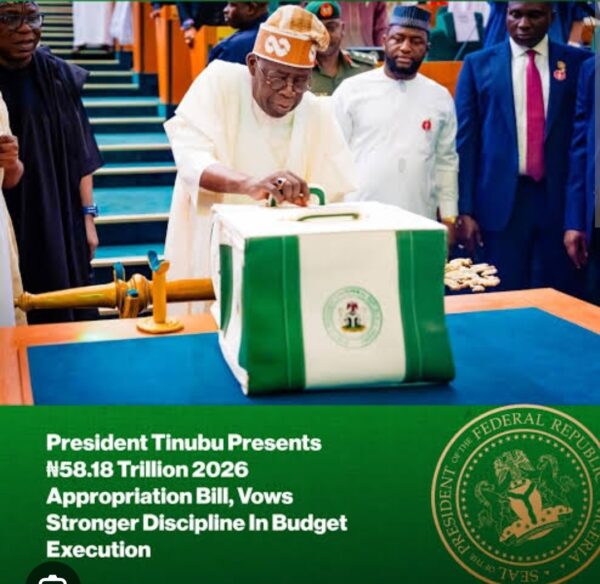
The Federal Government’s 2026 capital budget is facing another implementation challenge, with a large portion of the year’s allocation already tied to outstanding capital projects from 2024 and 2025.
The development raises the possibility that some of the capital provisions for 2026 may again be carried into another fiscal year.
A senior official of the Budget Office of the Federation (BOF), who spoke to Financial Vanguard in Lagos last weekend, acknowledged the possibility of another extension, saying, “it will be rolled over, it is normal.”
Investigations across ministries, departments and agencies indicate that many MDAs are still working with outstanding capital allocations from 2024 and 2025, with releases in several cases remaining below 50 per cent.
The situation has created a backlog that has already resulted in two extensions of previous capital budgets.
About N16.8 trillion appropriated for capital expenditure in the 2024 and 2025 budgets was rolled into the 2026 fiscal year, initially until June. With substantial implementation still outstanding, the deadline was subsequently extended to September 30, 2026.
The N16.8 trillion represents more than half of the N32.3 trillion 2026 capital budget. Consequently, only about N15.5 trillion of the capital provision represents funds intended for 2026 projects, according to Vanguard findings.
N16.765tn Rolled Over Over Funding Constraints
The House of Representatives Committee on Appropriations has been at the centre of efforts to determine why capital funds have remained largely unreleased.
Its chairman, Abubakar Bichi, disclosed that N16.765 trillion had been removed from the earlier capital allocation and rolled over into 2026 “due to funding constraints.”
The committee had met with former Finance Minister Wale Edun, Budget and Economic Planning Minister Atiku Bagudu and Budget Office Director-General Tanimu Yakubu to establish why the funds were yet to be released.
The problem persisted into the consideration of the 2026 budget.
As the National Assembly worked on the N68.323 trillion 2026 budget in April, the Appropriations Committee said about N32 trillion was earmarked for capital expenditure through the Development Fund.
Part of the increase over the Executive’s original N58.47 trillion proposal was intended to “regularise” outstanding capital obligations inherited from 2025, with the objective of ensuring that “contractors and developers are paid for completed works.”
In practical terms, the figures show that the 2026 budget was partly designed to settle unfinished obligations from previous budgets.
House Extends 2025 Capital Budget Again
By June, the issue had returned to the floor of the House.
Majority Leader Julius Ihonvbere said “substantial funds released to Ministries, Departments, and Agencies (MDAs) remained unspent due to administrative bottlenecks, procurement delays and implementation challenges.”
He made the statement while moving for an extension of the 2025 capital budget from June 30 to September 30.
Speaker Tajudeen Abbas also backed the extension, saying “from the records we received from the Chairman, Appropriations, and other relevant quarters, it has yet to be fully implemented.”
The repeated extensions have therefore become a major feature of the Federal Government’s recent capital-budget implementation.
Health Sector Provides a Clear Example
The Federal Ministry of Health and Social Welfare provides one of the clearest examples of the gap between appropriation and actual release.
During the ministry’s 2026 budget defence before the House Committee on Healthcare Services, Minister Muhammad Ali Pate disclosed that only N36 million had been released out of the N218 billion appropriated for its 2025 capital projects.
The minister attributed the shortfall largely to the “Bottom-Up Cash Plan” operated by the Office of the Accountant-General of the Federation.
He also pointed to delays in Nigeria’s counterpart contributions, which affected the ministry’s ability to access some donor-supported financing.
Pate described 2025 as “an unusual budget year” and said implementation delays were caused by circumstances beyond the ministry’s control.
The House committee, however, sought additional information. Its chairman, Amos Gwamna Magaji, directed the minister to submit documentation covering donor funds received by the ministry and how the money had been utilised.
Public Accounts Committee Targets Non-Compliance
While the Appropriations Committee has focused largely on releases and implementation, the House Committee on Public Accounts has turned attention to financial accountability.
The committee, led by Bamidele Salam, recommended that 22 MDAs be excluded from the 2026 budget process following an investigative hearing in February.
The agencies included the Nigerian Meteorological Agency, Federal Housing Authority, Standards Organisation of Nigeria, National Insurance Commission and National Business and Technical Examinations Board.
According to Salam, the decision followed “repeated invitations and directives” that were allegedly ignored by the affected agencies.
Some of the agencies had also failed to submit audited financial statements for periods ranging from three to five years or more.
The committee cited the Financial Regulations 2009 and the constitutional oversight powers of the National Assembly in support of its recommendation.
Agricultural Funds Investigation Adds to Concerns
A separate ad-hoc committee investigating agricultural subsidies, intervention funds, aid and grant programmes between 2015 and 2025 has encountered another aspect of the problem.
Its investigation has included instances of government agencies and financial institutions failing to appear before lawmakers.
The development has added to concerns over the ability of the National Assembly to establish how public funds were released, spent and accounted for.
The Problem Predates 2026
The difficulties confronting the 2026 capital budget are not entirely new.
President Bola Tinubu told the National Assembly that by the third quarter of 2025, only N3.10 trillion, or about 17.7 per cent of the 2025 capital budget, had been released.
At the time, government attention was still focused on completing outstanding 2024 capital projects, for which N2.23 trillion had been released as of June 2025 under an extension that ran to December.
Capital Releases Remain Low Across Key Ministries
The scale of the shortfall became clearer during the 2026 budget defence sessions.
The Ministry of Women Affairs received N394.8 million out of N89.8 billion allocated for capital expenditure.
Marine and Blue Economy received N202 million from N353 billion, while Transportation received N2.5 billion from N256.7 billion.
Housing and Urban Development received N2 billion from N100 billion; Water Resources received N1 billion from N80 billion; while Agriculture and Food Security received N3 billion from N120 billion.
Across eight ministries reviewed, only N9.13 billion of N1.218 trillion in capital allocations had reportedly been released — about 1.3 per cent.
Why the Funds Are Not Moving
The explanations emerging from the various committee hearings point to several interconnected factors.
The Executive has cited the “Bottom-Up Cash Plan”, which links disbursement to confirmed revenue availability. Delays in counterpart contributions, debt-service obligations, procurement procedures and administrative bottlenecks have also been identified as factors affecting implementation.
Minister of State for Finance Doris Uzoka-Anite told the Senate Appropriations Committee in February that payments for outstanding 2024 capital obligations were only beginning.
She said the government’s financial management system was “back online” and that MDAs had been directed to upload their cash plans before disbursements could be made.
The repeated roll-overs therefore point to a wider gap between what Parliament appropriates and what government agencies ultimately receive and spend.
With N16.8 trillion in previous capital obligations already carried into 2026, and implementation of those obligations still incomplete, the pressure on the current year’s capital budget remains substantial.
Unless the outstanding releases are accelerated and implementation bottlenecks addressed, the 2026 capital budget could end the year carrying unfinished obligations from previous fiscal years into yet another budget cycle.
Africans Angle News