Global Issues
Ghana’s Foreign Minister and IAS Director Discuss Bilateral Cooperation -By Kestér Kenn Klomegâh
Professor Abramova and her colleagues for their wonderful hospitality and for the substantive, intellectually stimulating discussions. The Institute for African Studies of the Russian Academy of Sciences expressed sincere gratitude to the Ministry of Foreign Affairs of the Republic of Ghana for the special attention paid to the development of Russian-Ghanaian.

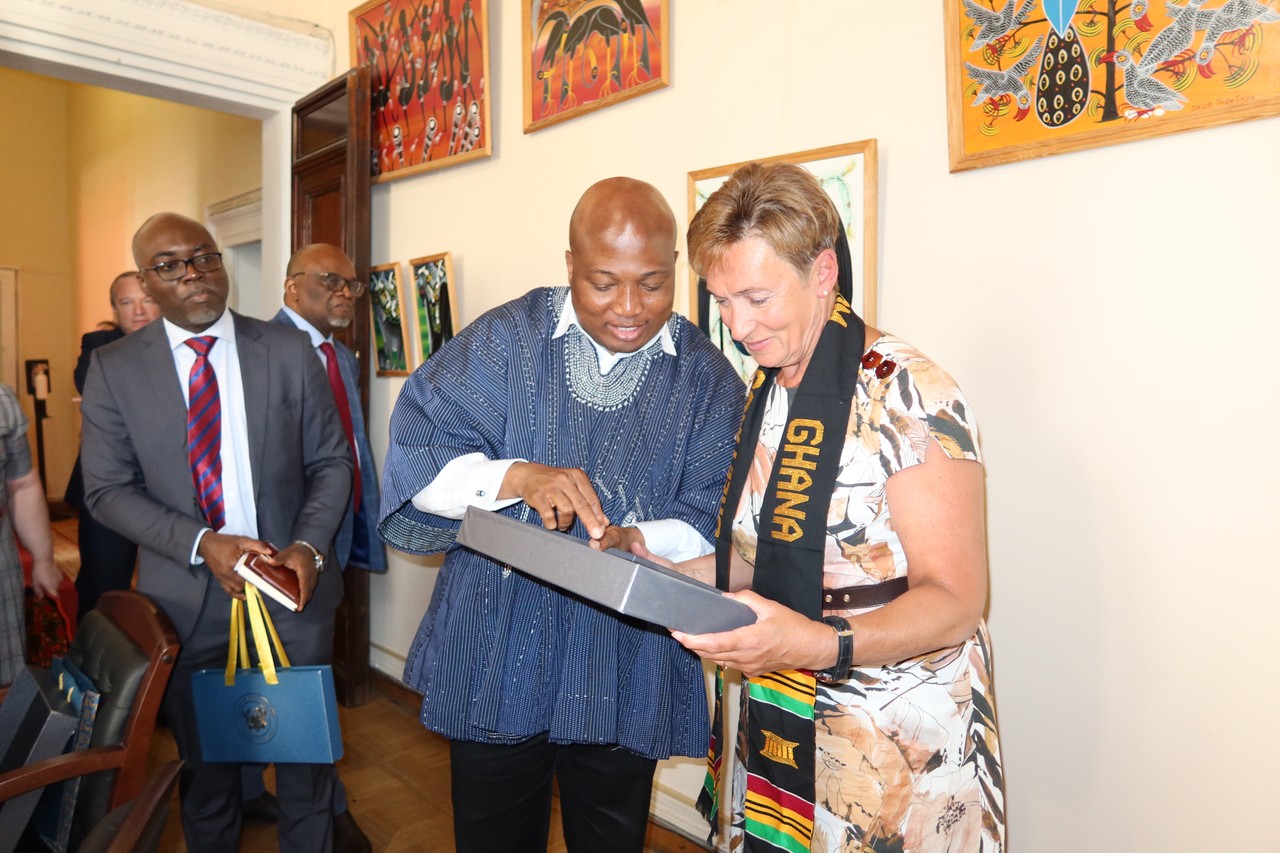
Developing economic investments, scientific and educational cooperation within the framework of Russia-Ghana’s bilateral relations, formed the main discussions held by Ghana’s delegation, headed by Foreign Minister Samuel Okudzeto Ablakwa, with the Institute for African Studies under the Russian Academy of Sciences (RAS), during the delegation’s visit in mid-August, 2026. The meeting also discussed prospects of Russia’s investment in Ghana’s economic development, and particularly in the energy sector.
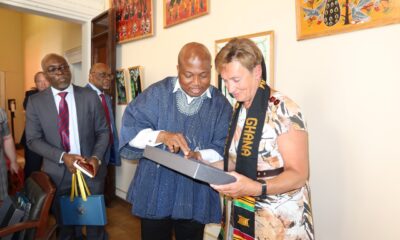
Prior to the meeting, the Minister was shown an exhibition featuring key works by Soviet and Russian Africanists regarding the history and contemporary development of Ghana. A prominent place in the display was given to Russian translations of works by Ghana’s first President, Kwame Nkrumah, and the current head of state, John Dramani Mahama, as well as works on Ghana by I.I. Potekhin, the Institute’s first director.
Samuel Okudzeto Ablakwa, highly, praised the exhibition and noted the importance of the work done by Russian researchers to preserve the historical memory of Ghana. Ablakwa emphasized the special role of Kwame Nkrumah, who demonstrated to African nations that liberation was achievable and played a pivotal role in the formation of modern Ghana. The Minister noted that President John Mahama continues to build upon Nkrumah’s ideas and is implementing initiatives aimed at the country’s steady socio-economic development. Ablakwa further expressed his gratitude to the Russian researchers for their interest in Ghana’s history and for preserving the memory of its distinguished statesmen.
Professor Irina Abramova—Director of the Institute for African Studies of the RAS, member of the RAS Presidium, Corresponding Member of the RAS, presented the delegation with an overview of the Institute’s history, its long-standing experience in cooperating with African nations, and its current research areas. She emphasized the readiness of Russian scholars to further expand practical cooperation with Ghana across a wide range of fields. Abramova highlighted that, as early as the turn of the 21st century, staff at the Institute for African Studies of the Russian Academy of Sciences (RAS) had drawn attention to Africa’s growing global role, repeatedly emphasizing that it would become the continent of the 21st century.
In his remarks, Ghana’s Foreign Minister highly commended the Institute’s long-standing work and its consistent approach to studying the continent. Ablakwa noted that, for a long time, Africa had been viewed through the lens of persistent negative stereotypes—often characterized as a continent of war, conflict, and crisis. According to Ablakwa, Russian Africanists did not succumb to this false narrative; instead, they consistently sought to view Africa as it truly is: a continent of ideas, opportunities, and the future. The Minister emphasized the need to overcome such stereotypes and expressed gratitude to the Institute for its contribution to fostering an objective understanding of Africa.
The meeting also focused significantly on Ghana’s current foreign and domestic policy priorities. Samuel Okudzeto Ablakwa stressed that the ideas of Kwame Nkrumah remain vital to the country’s political course. At the same time, the current administration of John Dramani Mahama places special emphasis on youth policy, social development, and creating conditions for economic growth.
The Minister highlighted the historic nature of Russian-Ghanaian relations, acknowledged the contributions made by both the Soviet Union and modern Russia in supporting Ghana, further noting that the Ghanaian side remains mindful of Russia’s support at the United Nations regarding resolutions of importance to the country. According to Ablakwa, Russia has remained a reliable partner for Ghana—one country could always count on—for decades.
Issues regarding Ghana’s economic development featured prominently in the Minister’s address. Ablakwa emphasized that the country is a leading gold producer in Africa, ranks second on the continent in cocoa production, and possesses significant reserves of lithium, bauxite, oil, and other natural resources. According to him, Ghana should not be viewed as a country lacking economic opportunities. In the minister’s view, the main challenge lies in the continued reliance on raw material exports and the insufficient share of value-added generated domestically. Ablakwa stated that the Ghanaian government aims to phase out the export of unprocessed raw materials by 2030 and transition to a model based on the production and export of high-value-added goods. He identified the domestic processing of the country’s oil and gas as a key priority. The minister noted an interest in cooperating with Russia, which possesses extensive experience and technology in oil and gold extraction, as well as other sectors.
Ablakwa highlighted nuclear energy as a promising area for cooperation. He noted that Soviet specialists had worked in Ghana during the Soviet era, contributing to the establishment of the country’s nuclear agency.
Ablakwa identified nuclear energy as another promising area for cooperation. The Minister noted that Soviet specialists had worked in Ghana during the Soviet era, helping to establish the country’s atomic agency, though those plans did not come to fruition at the time. Currently, Ghana views the development of nuclear energy as a component of its long-term strategy to diversify its energy mix. Consequently, the Ghanaian side has expressed interest in collaborating with Russian scientific and specialized organizations.
Particular attention was paid to the issue of reparatory justice. Samuel Okudzeto Ablakwa expressed his gratitude to the Institute for African Studies of the Russian Academy of Sciences for bringing this topic to the forefront of academic and public discourse. He emphasized that the concept of reparations should not be reduced solely to financial compensation for the consequences of slavery. In his view, the restitution of cultural artifacts removed from the African continent during the colonial era is also a crucial component.
Ablakwa announced Ghana’s plans to organize an exhibition showcasing the origins of African artifacts and their current locations in foreign museums. Specifically, the exhibition would focus on cultural treasures associated with the Ashanti and Benin empires, as well as Ancient Egypt. According to the Minister, such objects hold not only material value but also profound symbolic and historical-cultural significance for African societies.
The Minister underscored the need for further scholarly study regarding the impact of the transatlantic slave trade and colonialism, grounded in facts and documentary evidence. “We want to build scientific cooperation based on facts and evidence, rather than emotion,” Ablakwa noted. He then expressed concern over the spread of narratives portraying the transatlantic slave trade as a purely commercial enterprise from which African societies supposedly derived significant benefits. The Minister emphasized the need to counter such distorted interpretations and to preserve the historical memory of the scale of human losses.
A significant part of the Ghanaian Minister’s address was dedicated to the issue of preserving the memory of the crimes of slavery and colonialism. Ablakwa noted the need to establish memorials and other forms of historical commemoration that would enable the younger generation to understand the consequences of such tragedies and prevent their recurrence. He stressed that claims suggesting Africans sold themselves into slavery are offensive.
During the meeting, the parties discussed prospects for expanding direct scientific and educational contacts. The Minister expressed his readiness to facilitate the signing of memoranda of understanding (MoUs) between the Institute for African Studies of the Russian Academy of Sciences and relevant research institutions in Ghana. Particular attention was paid to the need to create mechanisms for internships and academic exchanges, including the training of Ghanaian postgraduate students in Russia and Russian researchers in Ghana.
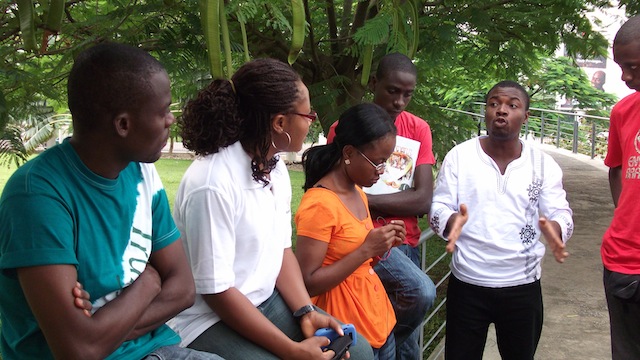
At the conclusion of the meeting, Samuel Okudzeto Ablakwa answered questions from young staff members of the Institute for African Studies. The discussion covered a wide range of topics related to Ghana’s modern development, its foreign policy priorities, Russian-Ghanaian cooperation, and prospects for collaboration in the scientific, educational, and economic spheres.
It is particularly gratifying to note that Ghana is the only African country whose two presidents—Kwame Nkrumah and H.E. John Dramani Mahama—have had their literary works translated into Russian by the Russian Academy of Sciences and become bestsellers. It is worth emphasizing that Ghana and the Russian Academy of Sciences have agreed to collaborate on realizing President Mahama’s vision for industrialization and value addition, as Ghana aims to cease the export of raw materials by 2030.
Professor Abramova and her colleagues for their wonderful hospitality and for the substantive, intellectually stimulating discussions. The Institute for African Studies of the Russian Academy of Sciences expressed sincere gratitude to the Ministry of Foreign Affairs of the Republic of Ghana for the special attention paid to the development of Russian-Ghanaian.