Forgotten Dairies
Beyond the Pulpit: How Rt. Rev. Ndubuisi Obi Is Expanding the Mission of Nnewi Diocese Through Faith, Enterprise, and Human Development -By Daniel Nduka Okonkwo
Every bishop eventually leaves office. Every administration becomes history. Every speech becomes an archive. What survives is the institution, the people educated, the young people equipped, the families assisted, the opportunities created and the systems capable of functioning beyond the personality of the leader.

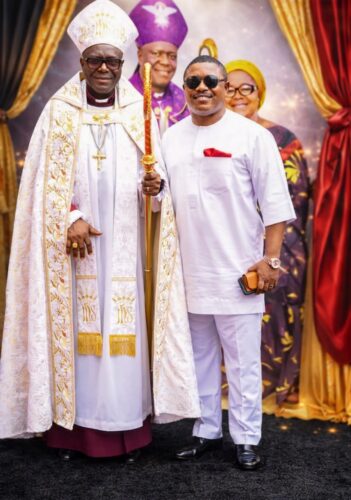
Leadership is ultimately measured not by the grandeur of ceremonies, the eloquence of speeches, or the titles attached to an office, but by the lives it changes and the institutions it leaves behind.
That question came sharply into focus at the 2026 Annual Synod of the Diocese of Nnewi, where discussions extended beyond matters of faith and pastoral administration to education, enterprise, youth development, humanitarian intervention, and community development. At the centre of those discussions was the Bishop of the Diocese, Rt. Rev. Ndubuisi Obi.
The Synod, held under the theme “Be Strong and of Good Courage,” drawn from Joshua 1:9, provided the setting for reflections on the direction of the Diocese under Bishop Obi. According to Sir Ifeanyi Ejiofor, Esq., KSC, Dunu-Ezeugosinachi, who participated in the Synod as a Standing Bishop Nominee, the Bishop’s address on September 5 highlighted a range of initiatives and investments extending beyond conventional ecclesiastical responsibilities.
Ejiofor specifically cited activities in agriculture, oil and gas, food security, education, manpower development, humanitarian services, youth training, and social interventions. His assessment presents the Diocese as an institution attempting to connect spiritual ministry with practical responses to economic and social challenges.
That proposition raises a larger question for contemporary Nigeria: what should the responsibility of a major religious institution look like in a society confronting unemployment, poverty, rising living costs, limited opportunities for young people, and gaps in social services?
For generations, episcopal leadership has largely been associated with preaching, pastoral care, administration, and the spiritual direction of congregations. But the realities confronting Nigerian communities increasingly demand a broader conversation about institutional responsibility. A sermon may inspire. An educational institution can shape a generation. A skills programme can alter a young person’s economic prospects. Agricultural investment can create productive opportunities. Humanitarian intervention can provide relief when families are under pressure.
The significance of the Nnewi example, therefore, lies not simply in the number of activities attributed to the Diocese, but in the philosophy behind them: whether a religious institution can use its networks, resources, and influence to address some of the practical difficulties facing the people within its community.
Ejiofor’s account suggests that this is the direction in which Bishop Obi’s administration has been moving. His description of the Diocese’s activities includes economic ventures as well as programmes relating to education, youth development, and humanitarian assistance. These claims are significant, but they also require the same standard of scrutiny that should apply to any institution managing substantial resources.
Praise, after all, is easy. Evidence is harder.
The long-term significance of the Diocese’s reported projects will ultimately depend on their scale, sustainability, governance, beneficiaries, and measurable outcomes. How many people have benefited? How many jobs or economic opportunities have been created? What educational institutions or programmes have been strengthened? What has been invested, and what has been generated? Which initiatives can survive leadership changes?
Those questions are not intended to diminish the achievements being celebrated. They are necessary precisely because lasting achievements deserve documentation. If a project has transformed lives, evidence strengthens the story. If an investment has created sustainable opportunities, measurable results give it credibility. And if an institution has developed systems capable of surviving its current leadership, that may prove to be the most important achievement of all.
There is also a natural connection between this conversation and the character of Nnewi itself.
Nnewi has long been associated with entrepreneurship, manufacturing, commerce, and private enterprise. Its economic reputation was built over generations through investment, ingenuity, and a culture of enterprise. Against that backdrop, the Diocese’s reported involvement in agriculture, economic activity, education, and youth development presents an interesting intersection between faith and the entrepreneurial environment in which it operates.
The question is whether such initiatives can evolve from individual projects into durable institutions.
That distinction is crucial. Leaders can launch programmes, but institutions must create systems. Leaders can inspire people, but institutions must preserve opportunities. And leaders eventually leave office. The strength of their leadership is therefore partly determined by whether what they build can continue after they are gone.
Another dimension of Bishop Obi’s ministry highlighted by Ejiofor is the Diocese’s online morning prayer programme, which he said is conducted from 6:00 a.m. to 7:00 a.m., Monday through Friday. Ejiofor also recounted an encounter involving a Catholic friend’s mother who regularly participates in the prayers and encouraged her children to support the Synod.
The anecdote is modest, but it illustrates how technology has changed the reach of religious leadership. A bishop’s influence is no longer necessarily confined to the physical boundaries of a diocese or even a denomination. Digital platforms allow religious engagement to reach people who may never physically attend the institution’s services.
But the broader lesson from Nnewi is not simply about online evangelism or the expansion of church activities. It is about the changing expectations placed on institutions with significant social capital.
Nigeria’s churches possess extensive networks of congregations, volunteers, educational institutions, professionals, and community leaders. They cannot replace government, nor should they become substitutes for public institutions. But they can contribute to the development conversation by deploying some of their resources towards education, skills, humanitarian assistance, and productive enterprise.
That is why the developments being reported in Nnewi deserve attention beyond the boundaries of the Diocese.
The 2026 Synod brought together the spiritual and institutional dimensions of that conversation. Ejiofor’s assessment was unequivocal: he regarded the period under Bishop Obi as one of significant development and described the initiatives presented at the Synod as evidence of a leadership model that seeks to combine ecclesiastical responsibility with practical social and economic intervention.
Yet history will eventually ask a more demanding question than whether the Bishop received praise at a Synod.
It will ask what remains.
Every bishop eventually leaves office. Every administration becomes history. Every speech becomes an archive. What survives is the institution, the people educated, the young people equipped, the families assisted, the opportunities created and the systems capable of functioning beyond the personality of the leader.
That is the real test of institutional leadership.
If the initiatives attributed to Bishop Ndubuisi Obi continue to produce measurable and sustainable benefits for the people of Nnewi and beyond, his episcopacy may ultimately be remembered for more than ecclesiastical administration. It may become an example of how a religious institution can translate its spiritual influence into practical engagement with the economic and social realities of its community.
The pulpit can inspire. But institutions can transform.
And sometimes, the most enduring sermons are not delivered from a pulpit at all. They are built through education, enterprise, service, and opportunity, and left behind for history to judge.
Daniel Nduka Okonkwo is an investigative journalist, human rights advocate, and publisher, and the founder of Profiles International Human Rights Advocate, PIHRA. His work focuses on governance, accountability, and the protection of fundamental rights across Nigeria and Africa. His reporting has appeared in Vanguard, Daily Trust, Sahara Reporters, African Defence Forum, Opinion Nigeria, and Daily Intel, among others.
Read more of his work on the PIHRA blog: https://profilesinternationalhumanrightsadv.blogspot.com
For tips, feedback, or collaboration, reach him at dan.okonkwo.73@gmail.com