Connect with us

Africa

Russia’s Lukoil Losses Strategic Influence Across Africa -By Kestér Kenn Klomegâh

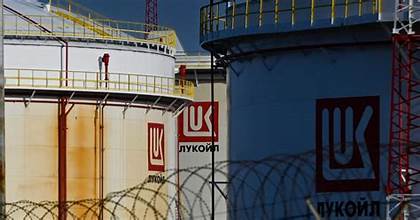
United States sanctions has hit Lukoil, one of the Russia’s biggest oil companies, like many other Russian companies, that has had a long history shuttling forth and back with declaration of business intentions or mere interests in tapping into oil and gas resources in Africa.

Published

on

Russia's Lukoil

Lukoil, Russia’s energy giant, has seriously lost its grounds across Africa, due to United States sanctions. Sanctions have complicated the company’s potential continuity in operating its largest oil field projects, grappling its investment particularly in Republic of Ghana, Democratic Republic of Congo, and Federal Republic of Nigeria.

Reports indicated the sanctions are further dismantling most of Lukoil’s operations, causing significant staff layoffs in its offices worldwide. For instance, Lukoil’s significant upstream operations in the Middle East include a 75% stake in Iraq’s West Qurna 2 oilfield and a 60% stake in Iraq’s Block 10 development. In Egypt, the company holds stakes in various oilfields alongside local partners.

Lukoil has until December 13, 2025, to negotiate the sale of most of its international assets, including those in Asia, Africa and Latin America. It has already terminated several important agreements that were signed with international partners due to difficulties in circumventing the sanctions.

Reports said calculated efforts to diversify exploration business relations is turning extremely complex, and current at the cross-roads, Lukoil will have to ultimately give up existing contracts and agreements it had signed with external countries.

Lukoil’s website reports pointed to reasons for abandoning oil and gas exploration and drilling project that it began in Sierra Leone. According to those reports, Lukoil could withdraw from almost all of the projects in West Africa.

Advertisement

In addition to geopolitical sanctions, technical and geographical hitches, Lukoil noted on its website, an additional obstacles that “the African leadership and government policies always pose serious problems to operations in the region.” Similarly, the Kremlin-controlled Rosneft abandoned its interest in the southern Africa oil pipeline construction, negatively impacted on Angola, Mozambique, South Africa and Zimbabwe.

United States sanctions has hit Lukoil, one of the Russia’s biggest oil companies, like many other Russian companies, that has had a long history shuttling forth and back with declaration of business intentions or mere interests in tapping into oil and gas resources in Africa.


Continue Reading
Advertisement
Click to comment

Leave a Reply

Your email address will not be published. Required fields are marked *

Trending Contents

Topical Issues

Matthew Ma Matthew Ma
Africa2 hours ago

Gbadamosi Oluwatosin Gold: Her Story that Deserves the Headline –By Matthew Ma

Ms. Gold’s story highlights the significant role of language in fostering empathy and collaboration in multicultural environments. Her experience demonstrates...

Bala Mohammed Bala Mohammed
Africa3 hours ago

Awards Without Impact: Rethinking ‘Good Governance’ In Bauchi State -By Yasir Shehu Adam

Take education for instance, across many public schools, learning conditions remain poor. Classrooms are overcrowded, roofs leak during the rainy...

Unemployment-in-Nigeria Unemployment-in-Nigeria
Forgotten Dairies13 hours ago

Effects of Unemployment in the Society -By Abdulkadir Dan Zazzau

Unemployment also leads to serious social problems. Some unemployed youths may turn to crime, drug abuse, or other illegal activities...

Africa22 hours ago

The Law Exists To Serve Society, Not To Oppress It – Barrister Abiodun Ogundare -By Isaac Asabor

Ogundare’s conclusion is blunt and unsentimental: democracy is not sustained by ballots alone. It is sustained by believable justice. When...

Hardship-poor-poverty-insecurity-woman Hardship-poor-poverty-insecurity-woman
National Issues22 hours ago

Insecurity and Terrorism: Will Nigeria Finally Take Action to End its Longstanding Problem of Insecurity and Terrorism -By Justina Udeh

The causes of insecurity and terrorism in Nigeria are: Poor governace, poverty and climate change. In many instances, the rising...

Tinted Glass and vehicle permit Tinted Glass and vehicle permit
Africa22 hours ago

Tinted Glass Permit Enforcement: A Timely Step Toward Restoring Public Safety -By Adewole Kehinde

As citizens, we also have a role to play. Genuine vehicle owners who require tinted glass for medical, security, or...

Jeff Okoroafor new photo Jeff Okoroafor new photo
Africa1 day ago

Nigeria’s Supreme Court is Now the Greatest Threat to Its Own Democracy -By Jeff Okoroafor

The inconsistency between the local government judgment and this emergency powers judgment is not a minor legal discrepancy. It is...

Justice Kudirat Kekere-Ekun Justice Kudirat Kekere-Ekun
Africa1 day ago

USELESS AND MEANINGLESS JUDGEMENT: The Speed of Impunity vs. The Slowness of Justice in the Rivers State Emergency Declaration Case -By Prof. John Egbeazien Oshodi

The ruling performed no restraining function. It restored no democratic balance. It reversed no abuse. Instead, it confirmed a dangerous...

Africa2 days ago

Tax Reform or Financial Exclusion? The Trouble with Mandatory TINs -By Blaise Udunze

Most operate bank accounts not because they run formal businesses, but because those accounts are essential to modern financial life:...

Soldiers Soldiers
National Issues2 days ago

Hiring More Security Forces: Nigeria’s Risky Gamble -By Adamu Ahmad Umar

Nigeria’s insecurity cannot be solved by just adding more officers while the system remains broken. Recruiting without addressing training, equipment,...