Forgotten Dairies
The Dirt Economy: Why Illegal Mining Thrives Where Law Pretends to Exist -By Fransiscus Nanga Roka
A world that tolerates extraction without accountability cannot argue for the rule of law. Instead, it plays out the show. In this spectacle, legality grows a mask one that masks a world economy constructed not on justice or anything resembling cleanliness.

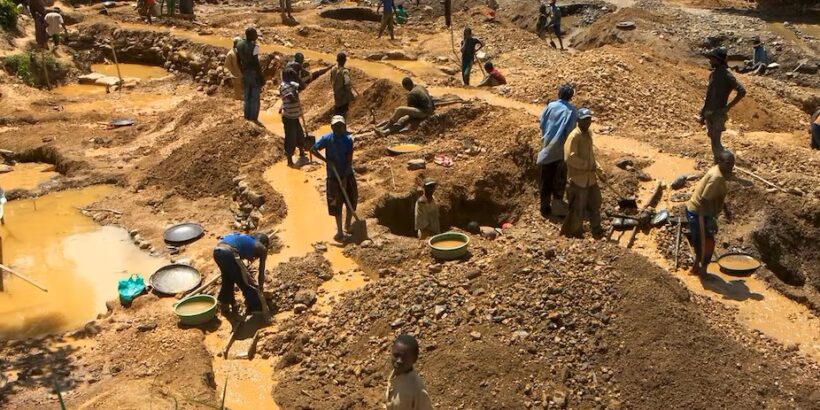
As long as the global community refuses to face the truth, the fact remains: illegal mining is not a failure of law, but rather the creation of a system which appears to be legal, but enables extraction without accountability. Under covers of regulation, sustainability, and governance, however, lies much murkier reality: a thriving “dirt economy” where states serve legality, corporations export risks and vulnerable communities pay the price.
Illegal mining is typically represented as the work of criminals and non-state actors; syndicates engaged in remote jungle operations, beyond reach of States or authority. This narrative is not only misleading but convenient. It brushes over the inconvenient truth that illegal mining best flourishes not in the absence of law, but environments where legal frameworks are heavily suzerain, or manipulated things that are selectively enforced. In these spaces law never vanishes, it changes.
Across Latin America, Sub-Saharan Africa and Southeast Asia, illegal mining has become a shadow form of governance. Main routes for the precious metal gold are controlled by armed groups. Local elites capture mining license approvals, then “outsource” it downstream to nomadic tribes and border peoples. Often security forces, the very units assigned to enforce these rules and watch over things themselves inextricably tied into networks they are supposed to dismantle. What results is not chaos; it is an alternative order: one where law is bargained, not enforced.
The results are catastrophic. Forests are denuded with industrial precision. Rivers deadened by mining wastewater filled with mercury and cyanide. Indigenous territories invaded under the pretext of “informal extraction.” Whole communities are stuck in spirals of exploitation, working under conditions which meet any reasonable definition of forced or under coercion. And yet global markets continue to soak up the outputs of this system, shipping them out refined, repackaged – and often invisibly.
That is what makes the dirt trade such a paragon of hypocrisy: the selfsame world markets that condemn illegal raw materials simply could not function without them. Gold originating in makeshift production sites rather than recognized mines gets onto formal markets through channels of alleviated laundering that have reached the status of routine. CSOs that are often touted as guardians are full of holes that allow demonsterably losing track on third floors whilst hooping reasonable-sounding arguments around weighty Documents on Nowhere Shelf 1 to Ban gold from being used to purchase weapons of war. In essence, in this context legality has become a kind of administrative performance. More concerned with documentation than justice.
Therefore the problem is not just one of smelly regulation. It is regulation that leads to exploitation, a structure tilted towards certain outcomes. In many resource-rich nations licensing systems are opaque, discretionary and vulnerable to capture. Environmental protections exist but are poorly enforced, or made to serve a few at the expense of the many. Anti-corruption regimes are embraced with much fanfare, only to crumble when pitted against established vested interests.
This is where the language of “illegality” runs the risk of becoming seriously misleading. It implies a sharp line between what is legal and what is not a line that in fact is systematically smudged. When one can buy licenses, dodge inspections, and get forebearance for breaches, illegality is no longer the exception but the rule.
In international law the situation has not been much better. Despite decades of commitments to sustainable development and human rights, there is as yet no globally binding framework for controlling either the extraction or marketing of minerals produced through illegal mining. Instead the terrain is dominated by voluntary arrangements, allowing states and corporations to declare compliance without fundamentally altering behaviour. The net effect is an environment where responsibility is dispersed, accountability rare, and harm becomes accepted as normal.
For a better comprehension of illegal mining, abandon any hope that stronger laws alone will eliminate the problem. To combat illegal mining a new approach must erase its economic base in politics. It is from this that illegal mining has continued in existence –because somebody finds it profitable, not only those who operate under the shadow of law but even actors embedded within formal systems. It continues to prosper now because the benefits for whomsoever are concentrated right up at top, but risks pushed or handed downwards. That second approach is necessary if the international community is finally to buckle down and deal with this crisis. It means even more stringent responsible business practices for corporations whose supply chains originate in murky areas. It means an internationally binding framework of rules based on full and fair competition that treats environmental destruction or exploitation as human rights abuses, not mere violations of regulation. And it means something else altogether, too putting an end to rather than forcing into illegality, the communities and those working on their behalf.
Most important of all, it shows a truth that is as embarrassing as it is ominous: illegal mining is not a collapse of the system; it’s the typical process of being done according to design where there is nothing but performative law and unchecked power in place to obstruct its operation.
A world that tolerates extraction without accountability cannot argue for the rule of law. Instead, it plays out the show. In this spectacle, legality grows a mask one that masks a world economy constructed not on justice or anything resembling cleanliness.
Fransiscus Nanga Roka
Faculty of Law University 17 August 1945 Surabaya Indonesia