
Forgotten Dairies
The Eurasian Charter of Diversity and Multipolarity in the 21st Century -By Kestér Kenn Klomegâh
On September 25, participating countries, on the sidelines of the High-Level Week of the 81st session of the United Nations General Assembly, included Belarus, Vietnam, Iran, Kazakhstan, the Kyrgyzstan Republic, Lao People’s Democratic Republic, Union of Myanmar, Russia, and Tajikistan.

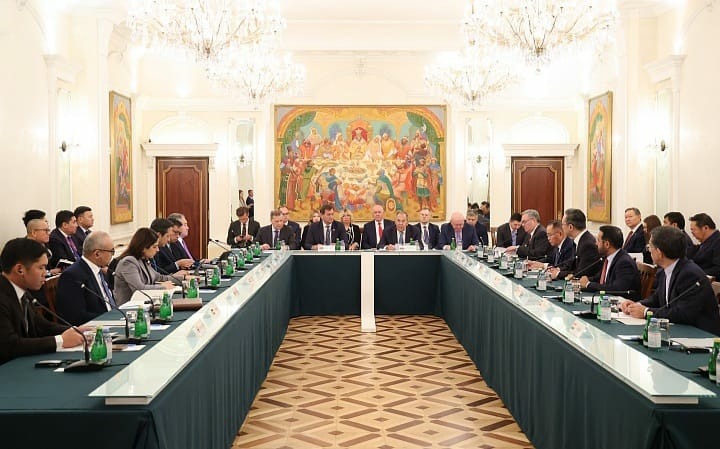
While global leaders expressed serious concern over lack of reforms at the multilateral organizations and institutions, highlighted persistent conflicts in Africa, Asia and Latin America, with dominating speeches on Russia-Ukraine crisis and the complex situation in the Middle East at the 81st UN General Assembly late September, Russian Foreign Minister, Sergei Lavrov, used the platform to strengthen the project titled “Eurasian Charter of Diversity and Multipolarity in the 21st Century.”
The drafting of the entire document has began, but Lavrov, on the sideline of the 81st UN General Assembly in New York, convened Asian and Eurasian leaders, to discuss the “Eurasian Charter of Diversity and Multipolarity in the 21st Century” and what further steps are planned towards its implementation.
In practical terms, the collective decision to pursue the project, which is already in progress, primarily due to the diversity in geopolitics and emerging multipolarity. An official statement was published—announcing the creation of an expert group, comprising a “core” of countries that have expressed their readiness to participate in drafting the document. It is an open-ended group, meaning other interested parties can join at later stages. The first meeting for expert-level discussions scheduled in Minsk by the end of 2026.
The session was co-chaired by the Minister of Foreign Affairs of the Russian Federation, Sergey Lavrov, and the Minister of Foreign Affairs of the Republic of Belarus, Maxim Ryzhenkov. In their remarks, the foreign ministers of Belarus and Russia emphasized that the aim is to strengthen economic cooperation and connectivity, develop humanitarian ties, support a dialogue among civilizations, and establish mechanisms for equitable decision-making in the interests of Eurasian countries and peoples.
Primary Purpose and Structure
The group has not fixed any artificial deadlines. According to Lavrov’s explanation, the Eurasian continent is in great need of a pan-continental structure—one open to all the continent’s countries and organizations without exception, and free from external interference. Such pan-continental structures exist in Africa and Latin America; while both regions have numerous sub-regional organizations, they also possess pan-continental ones.
In Eurasia, however, there are many sub-regional organizations but no overarching “umbrella” structure—or even just a platform—where all the continent’s countries and organizations, without exception, could regularly exchange views.
Chairmanship: Belarus, as one of the two initial co-authors (alongside the Russian Federation) of the Eurasian Charter concept, will assume the role of Chair in the negotiation process to draft the Charter, with the option of appointing two co-chairs. Should no other Eurasian state express a willingness to assume these functions, Belarus will exercise the position alone.
The initiating states and the Chairing party shall not enjoy any privileges or exclusive powers regarding the determination of the document’s content.
Participation: Negotiations will be open to all Eurasian states participating in the official launch of the process.
Participation in the negotiation process does not prejudice the rights and obligations of participating states arising from the UN Charter or other international agreements and arrangements to which they are party.
Participation in the negotiation process does not prejudge the states’ positions regarding the Charter’s content, nor does it impose obligations regarding its subsequent support, adoption, or signing. Each state independently determines its position on the final document and reserves the right to withdraw from the negotiation process at any stage.
Should other Eurasian states decide to join the negotiations at a later stage, they must notify the Chair(s) of such intention. In such an event, the Chair(s) shall inform the signatories of the Joint Statement of the respective requests; absent any objections, the requesting state may participate in the negotiation process.
To ensure the equal participation of all states in the negotiation process, states joining at a later stage shall have the right to propose amendments or additions to the draft Charter text, including to provisions previously discussed during earlier rounds of negotiations.
Level of participation: each participating state has the right to determine the level and composition of its delegation at its own discretion. Delegations may include experts from capitals and/or diplomats accredited to the host country of the negotiation round.
Venues: negotiation rounds will be held on a rotating basis in the capitals of the interested Eurasian states. Belarus will host the first round before the end of 2026. Participating states are encouraged to inform the chair(s) in advance of their intention to host specific rounds of negotiations.
Responsibilities of the host: The host state is responsible for providing the necessary logistics for the negotiation round (e.g., providing a meeting room, screens, etc.). In addition, the host state is encouraged to provide other forms of material support to the delegations of participating states (e.g., catering).
Conduct of negotiations: The Chair(s) will conduct negotiations in an open, transparent, and inclusive manner with the aim of developing a document based on consensus. Negotiations and drafting sessions will be held in person. The working language will be English.
Text: The Chair(s) will transmit the “zero draft” text of the Charter to participating states shortly after the launch of the negotiation process in New York, to allow time for its review prior to the first round of negotiations. Drafting will take place only during the negotiations. After each round, the Chair(s) will circulate the latest version of the text to participating states.
Participating states may submit their comments and proposals regarding the draft Charter text to the Chair(s) during the intervals between negotiation rounds.
Negotiation schedule: The negotiation process will consist of approximately four to five rounds (or more, if necessary), each lasting up to three working days. The schedule of rounds will be developed by the Chair(s) in consultation with participating states as soon as possible.
Objective of the negotiation process: To agree on the text of the Charter, ideally by October 2027, as the text becomes ready. Adoption of the Charter: The Eurasian Charter is to be adopted by the leaders of Eurasian states at a summit tentatively scheduled to be held in Minsk (Belarus), once the document has been finalized by the states participating in the negotiation process.
Joint Statement Declared During the Session.
The aim of this process is to develop a political document that defines principles of cooperation, reaffirms commitment to international law, and outlines common approaches to ensuring equal and indivisible security across the Eurasian space, developing economic partnerships, strengthening cultural and humanitarian ties, and facilitating civilizational exchanges in a multipolar era.
The participating members recalled the concept of the Eurasian Charter of Diversity and Multipolarity in the 21st Century, which was first articulated at the International Conference on Eurasian Security in Minsk in October 2023, while noting the subsequent discussions regarding the Charter held since then in various forums and formats, seeking to establish, on the basis of this concept, a political foundation for pan-Eurasian cooperation.
On September 25, participating countries, on the sidelines of the High-Level Week of the 81st session of the United Nations General Assembly, included Belarus, Vietnam, Iran, Kazakhstan, the Kyrgyzstan Republic, Lao People’s Democratic Republic, Union of Myanmar, Russia, and Tajikistan.


















You must be logged in to post a comment Login