
Breaking News
2027 Elections: Igbo Leaders Seek Restructuring Before Polls, Propose 10 Regions
Igbo leaders propose a 10-region political structure, demand restructuring before May 2027 and call for Nnamdi Kanu’s unconditional release.

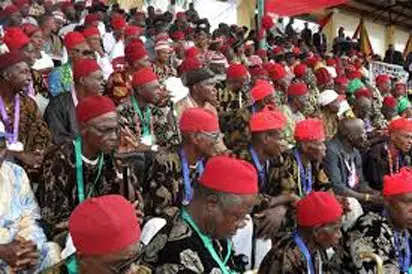
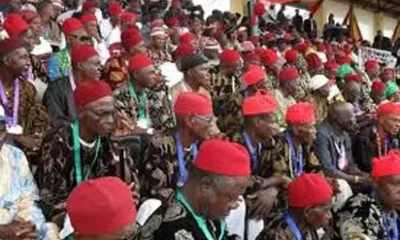
ABUJA — The Igbo Leaders of Thought (ILT) have called for the suspension of Nigeria’s 2027 general elections until the country completes a comprehensive restructuring exercise.
The group, which rejected the communiqué produced at the August 20, 2026 Abuja restructuring conference, said the process should be concluded before May 2027, with elections conducted thereafter under a new constitutional arrangement.
The leaders also proposed replacing Nigeria’s current state, local government and geopolitical zone structure with 10 regions.
Their position was contained in a statement titled ‘Igbo Position on the Restructuring of Nigeria,’ dated September 16, 2026, and signed by Emeritus Prof. Elochukwu Amucheazi, Senator John Azuta-Mbata, Prof. Dozie Chukwuokolo, Ambassador Uche Ajulu-Okeke, Dr Katchi Ononuju and Prof. Obasi Igwe.
The group argued that Nigeria’s restructuring was necessary because of what it described as fundamental flaws arising from the 1914 amalgamation.
According to the leaders, “By 2014 many had come to the understanding that the problem is foundational: that the non-consensual nature of the ‘union’ would continue to make it a violent, shaky and largely unproductive experiment; that with an anachronistic basis the superstructure would sooner or later eventually collapse.”
They said a sustainable political arrangement should be developed from the constituent peoples rather than imposed from the centre.
“Instead of the exercise in futility that inheres in building from the top, it is more rational to build from below, so as to have a better and stable constitutive union of the people than an imposed arrangement from above benefiting only a few,” the statement said.
Polls to wait for restructuring
The ILT proposed that the restructuring process be completed before May 2027 and that the elections be placed on hold until a new political and constitutional framework is established.
Its proposal states: “Duration of restructuring exercise should conclude before May 2027, with elections temporarily put on hold by an act of necessity, and resumed on post-restructuring principles.”
The group said Nigerians should have the opportunity to determine their preferred political structure through regional or nationwide referendums conducted by an independent body.
It also backed “the right to self-determination for Nigeria’s ethnic nationalities, regardless of size,” and proposed that regions be based on “ethno-linguistic civilizations or groupings thereof.”
Demand for Nnamdi Kanu’s release
The Igbo leaders also renewed their demand for the unconditional release of IPOB leader Nnamdi Kanu.
They called for his long-delayed case to be listed for accelerated hearing, arguing that the release and rehabilitation of political prisoners would contribute to confidence in negotiations over Nigeria’s future.
The statement said: “The Igbo see in the unconditional release and rehabilitation of all political prisoners, above all Mazi Nnamdi Kanu and his colleagues, as maintained by the Igbo delegation at the recent Abuja Conference, as a gateway to mutual trust and confidence in discussions on the future of Nigeria.”
Proposed united Igbo Region
The ILT proposed a united Igbo Region extending to the Atlantic coast.
Under the proposal, the region would comprise Abia, Anambra, Ebonyi, Enugu, Imo, prospective Anioma and Rivers State, alongside Igbo communities in parts of Akwa Ibom, Bayelsa, Benue, Cross River, Edo and Kogi states.
The group said its wider 10-region model would comprise five coastal regions in the South and five riparian regions in the North.
It stated: “Regions based on single-ethnic or consenting multi-ethnic nationalities, to replace States, LGAS, Geopolitical Zones, North, South, East, West, etc paradigms. 5 coastal Regions in the South and 5 riparian Regions in the North are proposed by the Igbo, with relevant maps.”
Regions to control resources
On resource control, the leaders proposed that regions should own and control resources while contributing agreed funding to the Federal Government.
“Resource ownership and control reverts to the Regions, which would fund the centre on agreed terms,” they stated.
They also advocated a reorganisation of Nigeria’s military and security architecture, arguing that regional police should form part of a broader security arrangement.
The ILT stated: “Military-security reorganization to achieve security balance between Regions, of which Regional police is only one element.”
The group further proposed abolishing the concurrent legislative list, leaving exclusive powers with the Federal Government and residual powers with the regions.
It advocated a mixed private-public free-enterprise economy and a secular political system separating religion from state and political affairs.
The leaders also said southern regions should have contiguous access to the coast and retain their traditional coastal ports, while northern regions should border either the Niger or Benue rivers.
They proposed that the three Middle Belt regions could be consolidated into one or two, while some southern areas could merge with the proposed Igbo or Yoruba regions to form larger eastern or western regions and reduce the total number of regions.
Africans Angle News



















You must be logged in to post a comment Login