Forgotten Dairies
The Psychopathology of the Gavel: Justice Mohammed Umar, President Tinubu, the Sowore Trial, and the Dangerous Return of the Kneeling Command -By Prof. John Egbeazien Oshodi
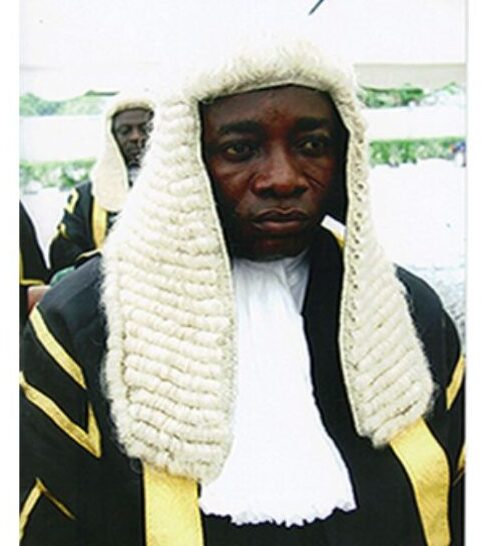
My Lord acted as though he was in a setting where personal authority overrides everything—even beyond the structured limits of sharia courts—forgetting that in Nigeria the Constitution stands above any judge’s command.

How It All Began: When Power Learned to Bend the Human Body
Before Nigeria existed as a nation, before courts spoke in constitutional language, before robes carried authority, power had already mastered one simple technique:
Control the body, and you control the person.
Kneel.
Bow.
Lower yourself.
That was the earliest language of authority.
It did not ask for agreement.
It did not require reasoning.
It required posture.
Kings demanded it.
Slave masters enforced it.
Colonial officers institutionalized it.
Kneeling was never respect.
It was a declaration:
You are beneath me.
And once that lesson enters a society, it does not disappear easily.
It mutates. It hides. It survives.
The Colonial Residue That Still Speaks: “My Lord”
Nigeria inherited not only systems, but symbols of power.
One of them still echoes daily in courtrooms:
“My Lord.”
A phrase imported from British monarchical tradition, where judges symbolically represented the Crown.
But here is the danger:
When a symbolic title is repeated without critical understanding, it begins to reshape identity.
A judge is called “My Lord.”
Then begins to feel elevated.
Then begins to expect deference.
Then begins—sometimes—to demand it.
And when that shift happens, something subtle but dangerous occurs:
The law becomes secondary to the personality of the one wearing it.
The First Training Ground: The Humiliated Child
Before a judge ever sits on the bench, he was once a child in a system.
And in many classrooms, that system taught:
Kneel down.
Stay there.
Do not speak.
Do not move.
Not to teach discipline.
But to enforce submission.
A child forgets homework → kneel.
A child questions authority → kneel.
A child struggles → kneel.
What is learned is not responsibility.
What is learned is this:
Power means you can control another person’s body.
That lesson does not fade.
It waits.
And one day, under pressure, it returns.
The Sowore Case: When Speech Becomes a Threat to Power
Now place this psychological inheritance into the present moment.
Omoyele Sowore is standing trial for referring to President Bola Ahmed Tinubu as a “criminal.”
Let us pause here—deeply and honestly.
In functioning democracies:
Presidents are insulted.
Prime ministers are mocked.
Leaders are called far worse names—daily.
And the system absorbs it.
Why?
Because democracy understands a fundamental truth:
Public office is not sacred. It is accountable.
But when a system reacts to speech with prosecution, something shifts.
Criticism becomes danger.
Words become threat.
Power begins to defend itself—not with argument—but with force.
The Moment That Exposed Everything
An incident that occurred on Monday, 16 March 2026, at the Federal High Court, Abuja, involving Honourable Justice Mohammed Umar and a legal practitioner, Mr. Marshall Abubakar, who appeared as lead defence counsel to Mr. Omoyele Sowore, has now come to define a troubling moment for the judiciary. According to reports, the learned trial judge, in response to counsel raising his voice while addressing the court on the suitability of a hearing date, abandoned restraint and crossed into something far more disturbing.
Then came the moment.
Justice Mohammed Umar reportedly ordered defense counsel:
“Come here. Kneel down.”
That was not discipline.
That was not law.
That was a collapse.
In that instant, the robe lost its meaning.
What stood there was no longer a neutral arbiter of the Constitution, but a figure acting out a primitive script of domination—one that has no place in any modern court of law.
Centuries collapsed into one behavior:
The colonial officer.
The schoolmaster.
The checkpoint enforcer.
All reappeared—inside a courtroom.
A lawyer, trained in law, standing in defense of a citizen,
was reduced to a body expected to submit.
This was not a slip.
It was a revelation of mindset.
A judge entrusted with the dignity of the court chose humiliation over law, posture over principle, ego over Constitution.
My Lord acted as though he was in a setting where personal authority overrides everything—even beyond the structured limits of sharia courts—forgetting that in Nigeria the Constitution stands above any judge’s command.
This Is Not Anger: This Is Psychological Regression
Let us not reduce this.
This is not “temper.”
This is not “frustration.”
This is regression under power.
When pressure rose, the judge did not reach for:
Law.
Procedure.
Judicial restraint.
He reached for:
Humiliation.
And humiliation always seeks the body.
Because when authority feels challenged and cannot stabilize itself intellectually,
it seeks to reassert itself physically.
The Deeper Fear: When Power Sees Itself as Above
Now we must confront the uncomfortable truth.
When a citizen is tried for calling a president a criminal,
and a judge demands physical submission in that same courtroom,
it raises a dangerous psychological question:
Do both the political authority and the judicial authority see themselves as above the people?
Above criticism.
Above challenge.
Above equal dignity.
Because in a true democracy:
The president is subject to speech.
The judge is subject to law.
The citizen retains dignity.
But when these lines blur,
power begins to behave as if it must be protected—not questioned.
The Collapse: When the Law Steps Back and Ego Steps Forward
A judge does not need kneeling.
A judge has:
The Constitution.
Legal reasoning.
Contempt procedures.
But when these are abandoned, something has happened internally.
The robe is no longer carrying the law.
It is carrying the self.
And the self, when threatened, seeks confirmation:
“Show me that I am above you.”
That is not justice.
That is ego under pressure.
“My Lord” Is Not Almighty Lord
This must be said clearly, without apology:
A judge called “My Lord” is not an almighty lord.
He does not own dignity.
He does not control the human body.
He does not stand above the Constitution.
He is a servant of the law.
But when the title is misunderstood, it becomes dangerous.
Because then the courtroom stops being governed by law
and starts being governed by personality.
Do Not Brush This Aside: This Is Where Systems Break
This is the critical moment.
Many systems fail here.
They see.
They react.
Then they move on.
No.
If this is brushed aside, it teaches:
That humiliation is permissible.
That power has no boundary.
That dignity can be suspended.
And once that lesson is learned, it spreads—silently and deeply.
What Must Happen Now: Real Consequences
This is not optional.
Immediate Recusal
Justice Mohammed Umar must step aside from this case.
Neutrality has been compromised.
Formal Judicial Review
This conduct must be examined openly, not hidden within institutional silence.
Mandatory Psychological Evaluation
Assessment of:
Emotional regulation
Authority boundaries
Response to dissent
Because power without control is dangerous.
Professional Reorientation
Re-grounding the judge in:
Judicial temperament
Human dignity
Limits of authority
Clear Institutional Statement
The judiciary must declare:
Kneeling is not a sanction.
The body is not a tool of discipline.
Dignity is non-negotiable.
The Deeper Pain: What This Teaches a Nation
If nothing happens, the message will travel.
To law students:
Power allows humiliation.
To young judges:
Authority includes dominance.
To citizens:
The courtroom may not protect you.
And when that belief settles, trust does not explode.
It erodes.
Quietly. Permanently.
Final Truth: A Nation Must Choose
This moment forces a choice.
A nation where:
Citizens can criticize leaders
Judges remain composed
Dignity is protected
Or a nation where:
Speech is punished
Authority is personalized
And people are made to kneel
Let it be said clearly:
President Tinubu is not above criticism.
Justice Mohammed Umar is not above the law.
No human being is above dignity.
Final Lin
When a courtroom begins to demand kneeling,
it is no longer asking for order.
It is asking for submission.
And when a nation accepts that,
it does not strengthen justice—
it returns to the past.
About the Author
Prof. John Egbeazien Oshodi is an American psychologist, an expert in policing and corrections, and an educator with expertise in forensic, legal, clinical, and cross-cultural psychology, including public ethical policy. A native of Uromi, Edo State, Nigeria, and son of a 37-year veteran of the Nigeria Police Force, he has long worked at the intersection of psychology, justice, and governance. In 2011, he helped introduce advanced forensic psychology to Nigeria through the National Universities Commission and Nasarawa State University, where he served as Associate Professor of Psychology.
He teaches in the Doctorate in Clinical and School Psychology at Nova Southeastern University; the Doctorate Clinical Psychology, BS Psychology, and BS Tempo Criminal Justice programs at Walden University; serves as a visiting virtual professor in the Department of Psychology at Nasarawa State University; and lectures virtually in Management and Leadership Studies at Weldios University and ISCOM University. He is also the President and Chief Psychologist at the Oshodi Foundation, Center for Psychological and Forensic Services, United States.
Prof. Oshodi is a Black Republican in the United States but belongs to no political party in Nigeria—his work is guided solely by justice, good governance, democracy, and Africa’s development. He is the founder of Psychoafricalysis (Psychoafricalytic Psychology), a culturally grounded framework that integrates African sociocultural realities, historical awareness, and future-oriented identity. He has authored more than 700 articles, multiple books, and numerous peer-reviewed works on Africentric psychology, higher education reform, forensic and correctional psychology, African democracy, and decolonized models of clinical and community engagement.