Africa
Why Zimbabwe Considers Zambia As Threat in SADC, by Kestér Kenn Klomegâh
Mnangagwa’s speech in St. Petersburg has sparked criticisms across the media in southern Africa. For instance, Tendai Ruben Mbofana, a social justice advocate and research writer, in an article, wrote that the southern African region has, by and large, been regarded as a peaceful place.

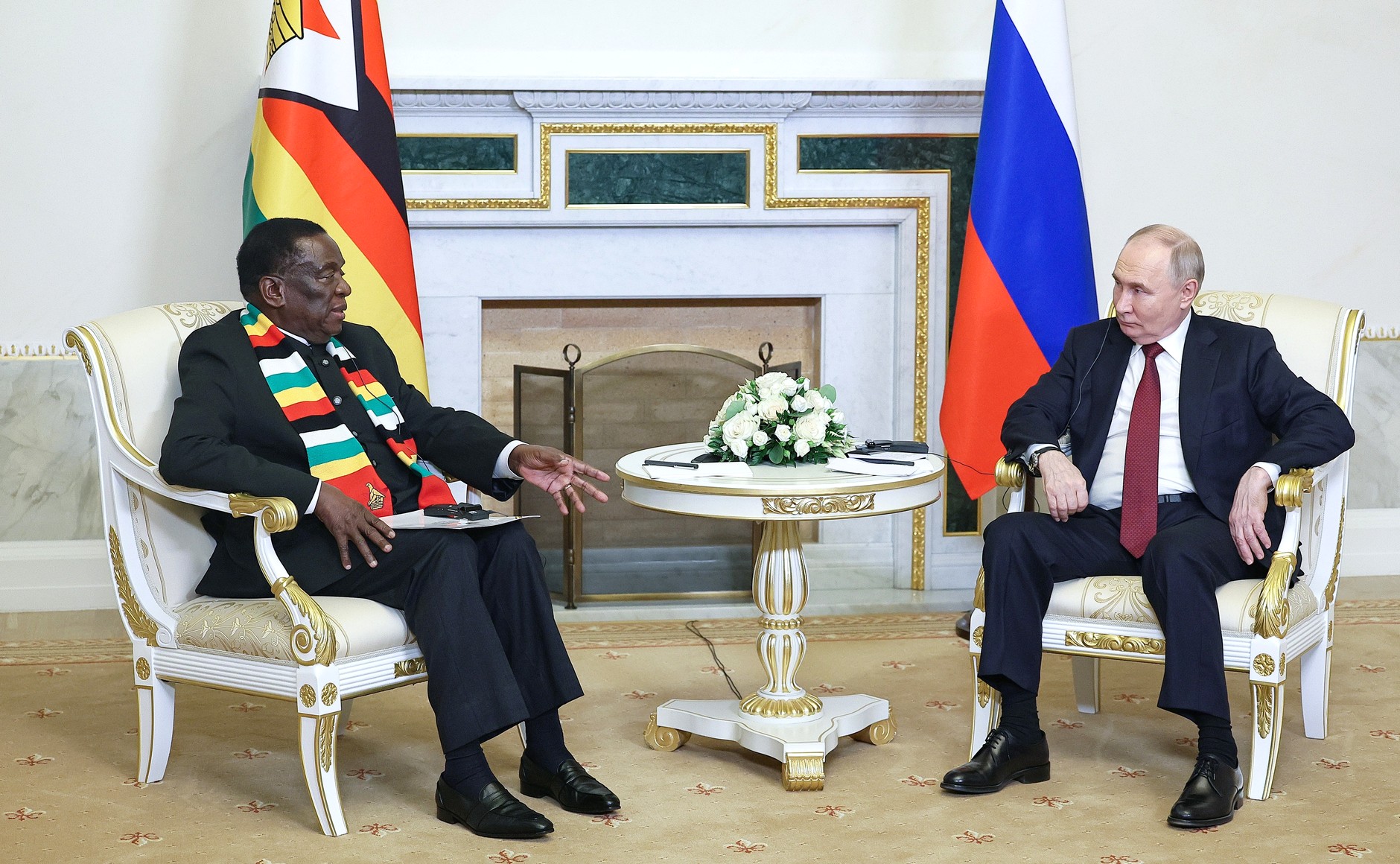
Zimbabwean President Emmerson Dambudzo Mnangagwa, during a special meeting on the sidelines, St. Petersburg International Economic Forum, with President Vladimir Putin, underscored the development of relations between Russia and Zimbabwe, highlighted possible spheres of bilateral cooperation and, most importantly, Zimbabwe’s position within the Southern African Development Community (SADC).
According to Mnangagwa, “the West has just begun consolidating its power in Zambia, our next neighbour. You know, there was a time when Zambia and Zimbabwe were one; it was called Northern and Southern Rhodesia. It was made one by the British, but they are now separate. And the Americans are consolidating their power in that country, both in terms of security and in terms of financial support to Zambia.”
Within the context of the great power competition, Mnangagwa further explained that its neighbours, Zambia and Malawi, are very heavily supported by the West. But in spite of that, Zimbabwe’s economic growth is the fastest growing economy in the region, in spite of being isolated by the Americans.
“We feel we have better relations with the people who respect us, not the persons who look down upon us. We are anxious to have more comprehensive and concentrated relations with Russia. And there is a lot that we can open for the Russian Federation to participate in our economy, especially in the mining sector and agriculture,” emphasized Mnangagwa.
That Zimbabwe is one of the few countries in Southern Africa that is regarded as anti-West. It was previously “disregarded as an isolated island in Southern Africa,” the Zimbabwean leader informed Putin. Mnangagwa suggested that as the relations are critically important, it is necessary to make them more comprehensive and share its emerging challenges.
“We received food allocations last year, and we have received cooperation in the military and security sector. That alone, as you continue to do so, we continuously become isolated in our region,” he underlined.
Mnangagwa referred to President Vladimir Putin as “my dear brother” and said Russia was a consistent ally of Zimbabwe. Mnangagwa rained praises on Putin for defending the independence and territorial integrity of Russia.
“It is regrettable and unacceptable that the collective West continues to peruse hegemonic tendencies that blatantly violate the sovereign equality of nations, justice and fairness,” Mnangagwa later told the business forum. Still Zimbabwe was “open for business”, he maintained frankly.
Mnangagwa’s speech in St. Petersburg has sparked criticisms across the media in southern Africa. For instance, Tendai Ruben Mbofana, a social justice advocate and research writer, in an article, wrote that the southern African region has, by and large, been regarded as a peaceful place.
It came as a huge shock watching a video of Zimbabwe President Emmerson Dambudzo Mnangagwa moaning to his Russian counterpart, Vladimir Putin, over what he perceived as Zambia’s close alliance with the United States.
In his remarks – which I am sure have sent shockwaves not only across the region but the entire African continent (if not the world) – Mnangagwa appeared to be begging for military support for Putin to ostensibly counter ‘Zimbabwe’s loneliness’ in the region.
In his pitiful display, he seemed to paint a picture of a Zimbabwe under possible threat from the United States using Zambia as a launching pad. Surely, on what ridiculous basis would Mnangagwa assume or even conclude that the United States would want to attack Zimbabwe?
Save for a few conflict zones – such as Mozambique, Angola, and the DRC – we have avoided stoking the flames of war. This is particularly so as it pertains to inter-nation conflict. Of course, countries such as Rwanda and Burundi (although not southern African states) have repeatedly been fingered in sponsoring cross-border wars in SADC member DRC.
Southern African region has been known for maintaining peace and stability by any means necessary – even if that meant states turning a blind eye to gross injustices perpetrated in their neighbors against their populations. As a matter of fact, Zimbabwe is one of those countries that has benefited immensely from this ‘see no evil, hear no evil, and say no evil’ policy of SADC.
Granted, the United States, on April 26, 2022, established its military Africa Command (AFRICOM) in Zambia. However, it should be noted that this is not, by any stretch of the imagination, a military base.
AFRICOM in Zambia is merely an office set up in the US Embassy in Lusaka to assist the Zambian forces in the United Nations Multidimensional Stabilization Mission in the Central African Republic (MINUSCA). As can he clearly determined this is neither a military base nor Zimbabwe the target. Similarly, Zambia itself has never indicated a desire to engage with Zimbabwe in any military hostilities.
This then poses a crucial questions. Why did Mnangagwa say what he said to Putin? For what reason did he make it appear as though Zimbabwe was under threat from the US using Zambia? Does he now hate Hichilema so much that he will do anything to ‘punish’ him for his bold stance – including launching a military attack against Zambia?
Nonetheless, there were never signs of any desire on Zambia’s part to wage war or take any other action against Zimbabwe. Yet we have hardly lifted a hand against the kleptomaniac oppressive regime. Here we have, though, our head of state seemingly pleading with the Russians to offer military assistance to the regime in apparent readiness with a war with Zambia, according to Tendai Ruben Mbofana.
Mnangagwa’s statement has potentially positioned Zimbabwe as a regional security threat. This may demand the immediate intervention of the SADC Organ on Politics, Defense, and Security – which is, interestingly, currently chaired by Zambia. In fact, this may also require an extraordinary summit of the SADC heads of state to discuss this possible danger to the region.
Russia-Zimbabwe relations were established a long time ago when it was struggling for political independence which it finally gained on 18 April 1980. Zimbabwe, with roughly 15 million people as per 2022 census, is a landlocked country in southern Africa. In southern African region, it is the biggest trading partner of South Africa. Zimbabwe is one of the members of the Southern African Development Community (SADC).