Africa
Air Peace Customer Service Faux Pas: It’s Not About Oshiomhole, It’s About Nigerian Air Travelers -By Isaac Asabor
Senator Oshiomhole was right: “You cannot profit from your own inefficiency.” The Nigerian government must not only investigate this specific incident but use it as a springboard to overhaul consumer protection in the aviation industry.

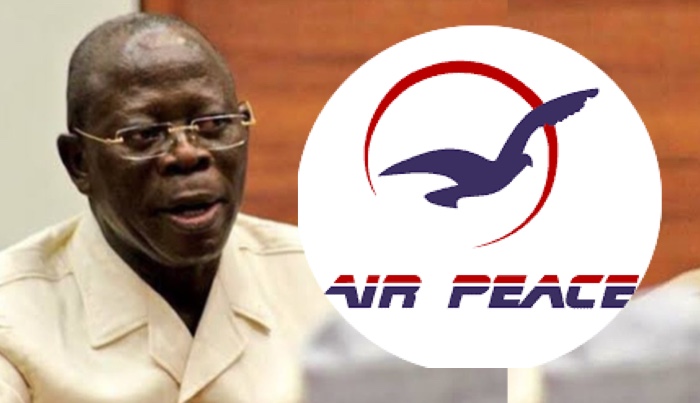
Senator Adams Oshiomhole may be the central figure in the latest clash between a passenger and Air Peace, but let us be very clear: this incident is not about him. It is about the thousands of Nigerian consumers who endure extortion, poor service, and systemic abuse in the nation’s aviation sector, daily, silently, and without any political title to amplify their pain.
If Oshiomhole had quietly accepted the VIP treatment that was offered to him, this would have been just another ordinary day at a Nigerian airport. He would have boarded, arrived in Abuja, and life would have gone on, at least for him. But the moment he rejected preferential treatment and chose to stand with the regular Nigerians stranded, denied, and exploited, the issue left the domain of political bickering and entered the territory of consumer rights where this writer holds sway as a Consumer Affair beat journalist.
Now, we must ask: Why are Nigerian passengers being treated like beggars by airline operators who should be accountable to the public?
What Oshiomhole described, and he did so with evidence, according to him, is an all-too-familiar experience for anyone who has used Nigerian airports regularly. Delayed flights, sudden changes in check-in policy, arbitrary cancellation of tickets, poor customer service, and worse still, exploitation in the form of dynamic pricing pushed to abusive extremes.
Imagine paying N146, 000 for a ticket online, arriving on time, only to be told you are late, while someone who just strolled in with N250, 000 cash is sold a ticket on the spot. What is this, a Ponzi scheme in disguise? If this is not modern-day extortion under the guise of “Aviation Logistics,” then what is it?
Air Peace, and indeed many other airlines in Nigeria, operate in an environment where the absence of competition and weak regulation has created a breeding ground for impunity. They behave as though they are doing the public a favor, as if transporting passengers is some philanthropic service they offer out of generosity.
When an airline arbitrarily changes check-in deadlines from 30 minutes to 45 minutes without adequate prior notice, and uses that change to exclude prepaid passengers from boarding, what you have is not a company enforcing policy, but one capitalizing on confusion to enrich itself.
It becomes even more disgraceful when regulatory agencies, especially the Nigerian Civil Aviation Authority (NCAA), look the other way. In more functional societies, an incident like this would have triggered an immediate investigation. The airline would have been asked to explain, not just to Oshiomhole, but to every single affected passenger. But in Nigeria, silence is the loudest response.
Senator Oshiomhole deserves commendation for refusing the “VIP treatment” that is often used as a silencing mechanism for the privileged. The bigger issue, however, is the entrenched culture of classism at Nigerian airports.
Big men are boarded last minute. They do not queue. They do not get stranded. They do not get told the counter is closed. They do not get asked to pay an additional N109, 000 to be put on the next flight. And they certainly don’t sleep on plastic chairs at the terminal, waiting endlessly.
But what of the average Nigerian who does not have a senator’s voice, a title, or media coverage? They endure these inhumane practices every single day. For them, air travel in Nigeria is not just a stressful experience, it is warfare. The system is designed to frustrate them, extract more money from them, and offer as little value as possible.
The core function of any aviation authority is to protect passengers, not airlines. But in Nigeria, the NCAA acts more like a security outfit for airline operators. When was the last time a major airline was penalized publicly for violating passenger rights?
The consumer protection arms of the aviation sector, NCAA’s Consumer Protection Directorate, Federal Competition and Consumer Protection Commission (FCCPC), and even the Federal Ministry of Aviation, are largely absent in the day-to-day lives of travelers. Where they should be defending the rights of customers, they have become complicit in systemic silence.
And this silence is costing Nigerians their dignity, their money, and their patience. Good enough, a Senator’s experience has mirrored the people’s reality. The truth is, Oshiomhole’s ordeal is not exceptional, it is typical. What is exceptional is that someone in his position chose not to sweep it under the rug.
His decision to raise his voice, not just for himself but for the many stranded passengers, including a woman with a six-month-old baby, deserves more than online noise or partisan bickering. It is a mirror to the deeper rot we all face: a country where systems are not designed to work for the ordinary person.
Let us also not lose sight of the fact that Oshiomhole did not resort to threats or thuggery, but insisted on calm, civil protest. He used his platform to spotlight what many endure in silence. That is rare. Most people in his position would quietly accept preferential boarding and leave the rest behind.
This incident must not be reduced to a matter of “Oshiomhole vs. Air Peace.” That is a distraction. The real issue is systemic abuse in a poorly regulated aviation sector where the consumer is always at the bottom of the pyramid.
If the NCAA fails to act, if the Ministry of Aviation pretends not to see, then it is time for passengers themselves to begin organizing, not violently, but structurally. Class action lawsuits, consumer associations, public awareness campaigns, and constant media scrutiny must become the tools of the ordinary Nigerian.
No Nigerian should have to pay twice for a seat that is already theirs. No Nigerian should be denied boarding because the airline wants to sell a more expensive ticket on the spot.
And no airline should be allowed to change boarding rules arbitrarily at the expense of consumers who followed all prior instructions.
Given the foregoing height of disservice that has characterized the operations of Air Peace as gathered, it is time we stopped seeing such incidents as isolated skirmishes between “big men” and businesses. What happened to Oshiomhole is what happens to Nigerians, every day, every airport, every airline.
This is not about party politics. It is not about personality. It is about principle. If the rights of passengers cannot be protected in something as straightforward as air travel, then what hope is there in more complex sectors like healthcare or education?
Senator Oshiomhole was right: “You cannot profit from your own inefficiency.” The Nigerian government must not only investigate this specific incident but use it as a springboard to overhaul consumer protection in the aviation industry.
Until that happens, Nigerian consumers will continue to pay for flights with their wallets, and their dignity.