Africa
Arewa Is Bleeding: How Violence, Poverty and Insecurity Are Devastating Northern Nigeria -By Abdulazeez Toheeb Olawale
As dusk settles on the settlement, Aisha lights a small lamp and gathers her children around a shared plate of food. It is not much but it keeps them going for another day. This fragile endurance is the story of northern Nigeria: wounded by violence and poverty, yet still standing.

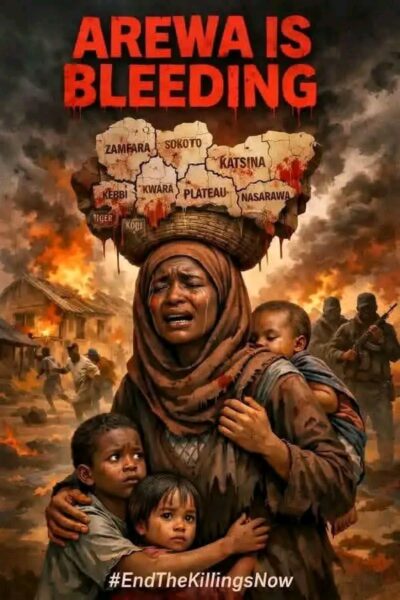
In a dusty settlement on the edge of a northern Nigerian town, Aisha sits with trembling hands, counting loose coins that are far from enough to feed her four children. Hunger, fear and uncertainty have become familiar companions, remnants of a life eroded by violence, economic hardship and long-standing neglect.
This is not a singular story. It is the lived reality for many in Arewa, a region where poverty and insecurity have intertwined to create a crisis that communities are only beginning to articulate.
Terror in the Mosque: Five Worshippers Killed During Prayers
On a heartbreaking morning this week, residents of Kebbi State’s Maiyama Local Government Area woke to news of yet another atrocity: five worshippers were killed in a terror attack on a mosque during morning prayers, according to police statements.
Authorities confirmed that gunmen opened fire on worshippers at Dadinkowa Mosque, killing five congregants and injuring others before fleeing. The attack struck at the heart of daily life, a place of sanctuary and spiritual solace violated by senseless violence.
The Kebbi State Police Command described the incident as a “terror related attack” and vowed to pursue justice, but for families who lost loved ones, words are cold comfort. Residents say what began as a calm prayer gathering ended in chaos, panic and grief.
“They never expected danger while praying,” lamented a local community leader. “This is a community that just wants peace.”
The mosque attack is the latest in a string of violent incidents across northern Nigeria where armed groups, bandits and criminal elements have expanded their reach into civilian spaces, eroding a sense of safety and everyday normalcy.
Six Months in Captivity: A Kidnapped Man’s Plea for Help
In northern Nigeria’s ongoing insecurity crisis, abductions have become alarmingly common. Many kidnapped youths and adults are held for months, often under brutal conditions.
In a tragic account that emerged today, a former kidnapping victim, held for six months in a bandits’ den, has lost his sight and is now begging for help after his family could not raise his ransom.
The man, whose name was withheld for safety reasons was rescued near Karene Forest after his captors reportedly fled security operations. When found, his eyes were badly damaged, likely a result of prolonged abuse, untreated infection, or starvation. Friends and relatives shared a voice note in which he pleaded:
“Chatano… only last money. Only last money.”
The haunting message illustrates both his desperation and the crushing burden placed on families who cannot meet extortion demands.
Local community sources say his family, like many others, had already sold livestock and taken loans trying to raise ransom funds, with little success. Now, the victim faces lifelong disability and the emotional burden of having survived captivity but lost his sight.
Insecurity as a Daily Burden
These recent events highlight how violence is no longer confined to remote forests or clashes with security forces. It has entered places of worship and infiltrated family life, turning everyday routines into fraught moments.
Economist and peace analyst Dr. Umar Sani explained:
“When places of worship become targets, and ordinary citizens suffer extreme cruelty, the psychological and economic toll multiplies. People no longer plan for the future, they plan for survival.”
Health facilities in many affected states lack the capacity to treat severe injuries or trauma, so families often bear the cost of limited care. Even a simple injury can spiral into a life-long disability when access to specialised treatment is absent.
Women Carrying the Heaviest Load
For those left at home women, children, the elderly, the impact is relentless. With men killed, injured, kidnapped or displaced, women often become sole providers. But with inflation rising and work opportunities scarce, the odds are stacked.
Suweiba, the single mother, said:
“If I survive on nothing today, my children will face nothing tomorrow.”
Advocates say insecurity and poverty work in tandem: violence uproots families, devastating livelihoods, and pushes entire communities deeper into deprivation.
Education Under Threat
Schools in conflict-affected areas are closing more frequently, either because students and parents fear for their safety or because facilities are commandeered for shelter. Children who once walked to class now stay home, while teachers say fear and economic strain has eroded attendance.
Fatima Lawal, an education policy expert, said:
“When children are not in school especially girls, the consequences are long-term. Loss of education deepens inequality and undermines the region’s future.”
A State That Feels Far Away
Government social programmes and safety nets exist on paper but many residents say help arrives too late, if at all. Frequent attacks and porous borders make consistent aid delivery difficult. Political leaders often visit with announcements of support, but communities see little follow-through.
Why This Matters Beyond Arewa
Northern Nigeria accounts for a significant share of the country’s youth population. When children are out of school and families are unsafe, the effects ripple across society deepening inequality, increasing displacement, and heightening social tensions.
On the streets of Sokoto, a civil society organiser said:
“Violence and poverty feed each other. If we don’t address both, cycles of displacement and despair will continue.”
Toward Solutions
- Experts emphasise the need for a coordinated response that combines:
- Improved civilian protection and community policing
- Targeted economic support for vulnerable families
- Expanded access to education and healthcare
- Accountability and transparent delivery of aid funds
- But for many like Aisha, immediate relief remains elusive.
Arewa Is Bleeding And Still Standing
As dusk settles on the settlement, Aisha lights a small lamp and gathers her children around a shared plate of food. It is not much but it keeps them going for another day. This fragile endurance is the story of northern Nigeria: wounded by violence and poverty, yet still standing.
The question now is not only whether policymakers will act, but whether the nation will finally confront the deep social fractures that allow tragedy, deprivation and insecurity to persist.
Abdulazeez Toheeb Olawale is a Nigerian journalist specialising in conflict, governance and social justice reporting, focusing on human impact in the Global South.