Breaking News
CBN, Finance Ministry Formalise Policy Coordination as Cardoso, Oyedele Sign MoU
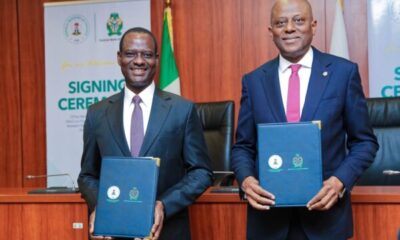
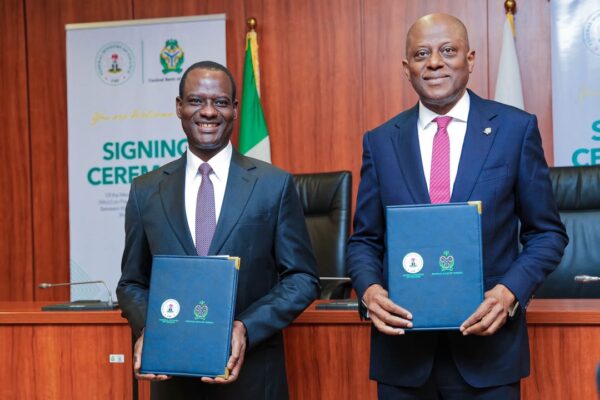
Olayemi Cardoso and Taiwo Oyedele sign a new MoU formalising coordination between Nigeria’s monetary and fiscal authorities to support economic stability.

The Central Bank of Nigeria (CBN) and the Federal Ministry of Finance have formalised a new framework for coordinating monetary and fiscal policies as the government seeks greater consistency in economic management.
CBN Governor Olayemi Cardoso and Minister of Finance and Coordinating Minister of the Economy Taiwo Oyedele signed the Memorandum of Understanding (MoU) in Abuja on behalf of their respective institutions.
The agreement is designed to deepen information sharing and coordination on issues ranging from government borrowing and liquidity to debt management, macroeconomic forecasting and monetary policy.
Speaking at the CBN headquarters, Cardoso described the MoU as a shared commitment to stronger economic policy coordination.
He said fiscal and monetary policies were complementary tools for managing a modern economy.
“Fiscal and monetary policies remain two important and complementary instruments for the management of a modern economy.”
Cardoso explained that government spending, taxation and borrowing decisions influence economic activity, while monetary policy focuses on price stability and financial-system soundness through liquidity, interest rates and broader monetary conditions.
“When these policies work in harmony, their combined impact is far greater than their individual efforts,” he said.
‘Not a New Relationship’
Cardoso said the agreement should not be interpreted as the beginning of cooperation between the CBN and the Finance Ministry.
The two institutions, he noted, have worked together for decades on issues including inflation, debt sustainability, budget financing, exchange-rate stability, economic reform programmes and responses to economic shocks.
What has changed, according to the CBN governor, is that the relationship will now operate within a clearly defined institutional framework.
“This Memorandum provides a structured framework for regular consultation, information exchange and policy coordination,” Cardoso said.
He said the arrangement would improve cooperation on government cash management, debt issuance planning, liquidity forecasting, macroeconomic analysis and periodic policy consultations.
According to Cardoso, formalising the relationship would make policy engagement more predictable, improve decision-making and reduce uncertainty.
Inflation Targeting in Focus
Cardoso also linked the agreement to the CBN’s transition towards an Inflation Targeting framework.
He said the effectiveness of inflation targeting depended not only on monetary policy but also on a supportive fiscal environment.
“Across the world, the success of inflation targeting is known to rest not only on the effectiveness of monetary policy, but also on the existence of a supportive fiscal environment.”
He said the MoU would help create the operational framework required for implementation by facilitating regular dialogue, information sharing and coordinated policy assessments.
The objective, he added, is to enable both institutions to align their actions, reduce policy conflicts and pursue common economic goals.
“The ultimate goal is clear: to build a more stable, resilient and productive economy capable of delivering broad-based prosperity for present and future generations of Nigerians.”
Oyedele: ‘Independence Does Not Mean Isolation’
Oyedele, meanwhile, said closer coordination should not undermine the independence of either institution.
“Good economic management requires independent institutions, but independence does not mean isolation. Fiscal and monetary authorities have distinct mandates, but we serve the same economy.”
He pointed out that fiscal and monetary decisions are closely interconnected.
“Government borrowing affects liquidity and interest rates. Monetary policy affects the government’s financing cost. Tariffs and exchange rates affect prices and revenue. Spending affects demand,” he said.
“Our mandates are distinct, but our outcomes are interconnected. That is the philosophy behind this MOU. We are institutionalizing coordination now.”
Oyedele noted that the government already has coordination platforms, including the Economic Management Team and National Economic Council, while the CBN Act provides for the bank’s autonomy and includes institutional links with the Finance Ministry.
The new agreement, he said, would make those relationships more deliberate through improved information sharing, aligned macroeconomic assumptions, more consistent forecasts and clearer mechanisms for resolving policy differences.
The MoU consequently provides a formal structure for fiscal and monetary authorities to coordinate their actions while retaining their separate mandates.
Africans Angle News