Breaking News
Electricity Tariff Hike Not on FG’s Immediate Agenda — Tegbe
The Federal Government has ruled out an immediate electricity tariff hike as Power Minister Joseph Tegbe outlines recent gains in generation and transmission.

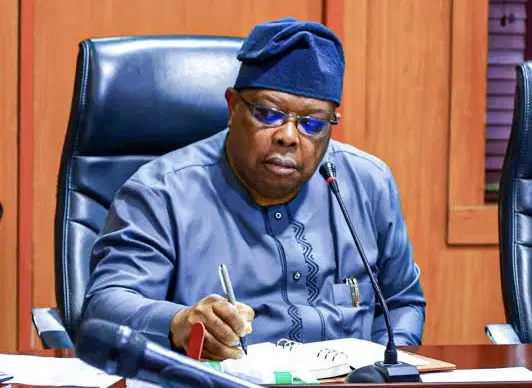
The Federal Government has ruled out an immediate increase in electricity tariffs, with the Minister of Power, Joseph Tegbe, saying the priority is to consolidate recent gains in generation and transmission and improve the reliability of supply.
Tegbe made the clarification in Abuja on Monday while presenting his scorecard for his first 100 days in office, covering June 8 to September 16, 2026.
He said operational records showed that electricity generation and transmission had exceeded 5,000MW in recent weeks, compared with a range of 3,700MW to 4,700MW before June.
The sector also recorded a generation peak of 5,330MW during August and September after interventions to restore infrastructure and improve the performance of existing assets.
“Operational record reports show generation and transmission above 5,000MW over the past couple of weeks, compared to the 3,700 to 4,700MW range before June, and a generation peak of 5,330MW during August and September,” Tegbe said.
“Our next task is to sustain these gains and translate them into more dependable supply at customer level.”
Despite the increase in output, the minister admitted that many Nigerians were yet to experience a corresponding improvement in electricity reliability.
He said the government’s first 100 days had therefore concentrated on stabilising the power value chain, restoring market discipline and strengthening governance.
Among the interventions, Tegbe said the 375MW Alaoji open-cycle power plant was returned to the national grid after being offline for three years.
He also disclosed that transformers commissioned at Apapa, Ijora, Alausa and Lekki in Lagos had unlocked 672MW in transmission capacity. Another 300MVA transformer at Katampe, Abuja, added 240MW.
The interventions, he said, were aimed at recovering stranded electricity capacity and improving supply to major areas of demand.
Tegbe said TCN had also obtained the release of more than 300 containers containing critical power equipment that had been delayed at the ports. The equipment is expected to be inspected and deployed for ongoing transmission infrastructure projects.
The minister said progress had also been recorded in expanding electricity access, with 62 solar and mini-grid installations completed across 30 states.
The projects provide about 43.6MW of installed solar capacity and 41,735 new connections, with more than 208,000 people estimated to benefit.
Among the projects is a 3MW solar hybrid system commissioned at Yakubu Gowon University in Abuja. Other initiatives include a 20MW off-grid project in Kogi, a 3.5MW solar project in Kebbi, a 5.5MW mini-grid in Epe, Lagos, and 39 mini-grids in Adamawa State with nearly 27MW of capacity.
Tegbe said RAMCO would be responsible for managing publicly financed renewable energy assets and was expected to mobilise N3 trillion over the coming years.
On the sector’s financial challenges, the minister said the government had raised about N1.23 trillion to help settle outstanding power-sector debts under a broader programme targeting N3.3 trillion in liabilities.
He said the intervention would improve liquidity across the electricity value chain and help operators maintain infrastructure and meet their financial obligations.
Tegbe also said the government had blocked revenue leakages associated with electricity theft and other losses along the Ikorodu-Sagamu industrial corridor, estimated at approximately N120 billion annually.
On metering, he said about 350,000 meters were installed within his first 100 days, taking total installations to 1,004,260 as of August 2026.
He added that the resolution of the AMMON litigation had enabled the procurement of about 1.4 million smart meters for affected programmes.
The minister said 90,000 meters had been installed in military formations, while 5,000 young Nigerians were undergoing training as smart-meter installers under the Power Force programme.
Tegbe again ruled out an immediate tariff increase, saying the government was focused on improving electricity supply and strengthening the sector’s financial and physical foundations.
He said attention would now shift to stabilising major transmission corridors, including Lagos, Enugu-Port Harcourt and Abuja-Kaduna-Kano, as well as advancing the proposed Transmission Super Grid.
Technical audits had commenced along the Lagos and Abuja corridors to identify weak points and determine where investment would have the greatest impact.
The government, he added, would also encourage bilateral arrangements between generation and distribution companies to improve capacity utilisation and payment certainty.
Tegbe said discussions with Chinese companies had secured commitments to accelerate priority projects, including the 1.9GW Presidential Power Initiative, with the first transmission lines expected to be delivered in the first quarter of 2027.
He said efforts would continue to improve grid protection and control systems, increase gas availability to power plants, and combat vandalism and electricity theft.
While acknowledging that national generation figures do not necessarily reflect the experience of every community, Tegbe said the government would assess progress based on supply reliability, billing accuracy and how quickly faults and complaints are resolved.
He said the next six months would be focused on turning the repairs and reforms into noticeable improvements in electricity supply.
Africans Angle News