Africa
From Speculation To Facts: Setting The Record Straight On IGP Egbetokun’s Tenure -By Adewole Kehinde
Secondly, Mr. Olubori’s accusation that Egbetokun employs “high-handedness” in policing dissent is an overreach unsupported by credible data. Yes, protests have occurred during his tenure, as they do in any functioning democracy, but the Nigeria Police Force under his leadership has maintained a consistent policy of facilitating lawful assemblies while intervening where protests devolve into threats to public safety or breach of peace.

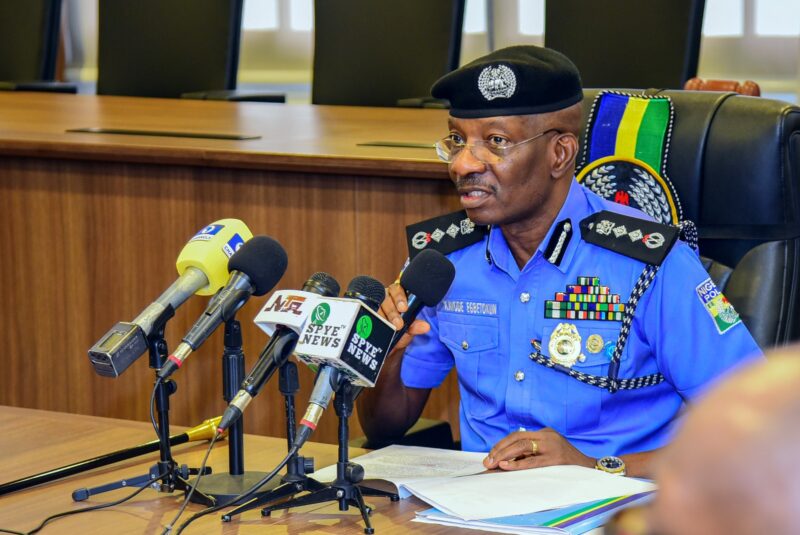
In his recent article, “From Usman Baba To Egbetokun: How Nigeria Clandestinely Legalized IGPs’ Overstay Beyond Retirement Age”, Mr. Femi Olubori paints a picture of Nigeria’s policing leadership that is as misleading as it is alarmist.
While his prose may be persuasive to the casual reader, it collapses under the weight of verifiable facts and the clear provisions of the law.
First, let us dispense with the core insinuation; that Inspector-General of Police, IGP Kayode Egbetokun is somehow overstaying his time in office. This claim willfully ignores the unambiguous provisions of the Nigeria Police Act, 2020, particularly Section 7(6) and Section 18(8a).
These sections stipulate the tenure and service limitations of the IGP’s office, ensuring there is a clear expiry date for every occupant. The law does not permit indefinite occupation of that office, and there is no evidence, legal or otherwise, that Egbetokun’s tenure is being manipulated to breach this provision.
For the avoidance of doubt, Section 7(6) provides that the IGP shall hold office for a four-year term subject to the President’s discretion within the law, while Section 18(8a) makes it clear that the retirement age and service years are not a backdoor to prematurely terminate a lawful tenure.
These safeguards are deliberate, designed to strengthen stability and continuity in the leadership of the Nigeria Police Force (NPF), not to create an “entrenched political fiefdom” as Mr. Olubori wrongly fears.
The IGP’s office is not a monarch’s throne. It is bound by statute, policy, and public accountability. The mere fact that an IGP serves beyond the traditional retirement age is not a legal aberration when the tenure provision is still in force, it is a feature of the reformed policing framework, not a bug.
Secondly, Mr. Olubori’s accusation that Egbetokun employs “high-handedness” in policing dissent is an overreach unsupported by credible data. Yes, protests have occurred during his tenure, as they do in any functioning democracy, but the Nigeria Police Force under his leadership has maintained a consistent policy of facilitating lawful assemblies while intervening where protests devolve into threats to public safety or breach of peace.
The isolated instances where security personnel have had to disperse gatherings with force are the exception, not the rule, and they are always subject to internal review. To conflate these operational realities with systemic repression is to ignore the constitutional responsibility of the police to protect both the protesters and the broader public.
It is intellectually lazy to characterise lawful security operations as “clamping down on dissent” without considering context, intelligence reports, or the need to prevent violence. A nuanced assessment reveals that Egbetokun has not militarised public order policing; rather, he has balanced law enforcement with civil rights, a task far more complex than Mr. Olubori’s framing admits.
Finally, the suggestion that the IGP’s office could “become another entrenched political fiefdom” is not only speculative but also ahistorical. Nigeria’s modern policing reforms have deliberately erected legal guardrails to prevent such entrenchment.
The four-year fixed term, the oversight role of the Police Council, and the constitutional powers of the President all combine to ensure that no IGP can unilaterally perpetuate himself in office.
If anything, Egbetokun’s tenure has demonstrated a professional commitment to service, operational reforms, and community engagement, not the political self-preservation Mr. Olubori insinuates.
Public debate is healthy for democracy, but it must be anchored on truth, not conjecture. On this matter, the truth is straightforward:
- The IGP’s tenure is clearly defined by law, with an explicit expiry date.
- Egbetokun is not overstaying his term.
- Allegations of high-handedness in policing protests are exaggerated and lack a fair reading of facts.
Nigeria’s policing leadership is not perfect — no public institution is, but undermining it with unfounded narratives serves neither the public nor the principles of justice.
Adewole Kehinde is the Publisher of Swift Reporters and Public Affairs Analyst. 08166240846. kennyadewole@gmail.com @kennyadewole