Opinion
Governing the Ungovernable: Illegal Mining and the Collapse of Mining Law Under State Power -By Fransiscus Nanga Roka
From gold fields in the Amazon to rare earth corridors in Africa and Southeast Asia, illegal mining has morphed into a parallel system of extraction, one that works outside the reach of regulation yet rarely beyond the grasp of the state. The real question is not the reason for illegal mining. It is why it can be so easily tolerated within systems that profess to outlaw it. The answer to this lies in a brutal contradiction: the same states that criminalize illegal mining also rely on it, politically, economically and sometimes institutionally.

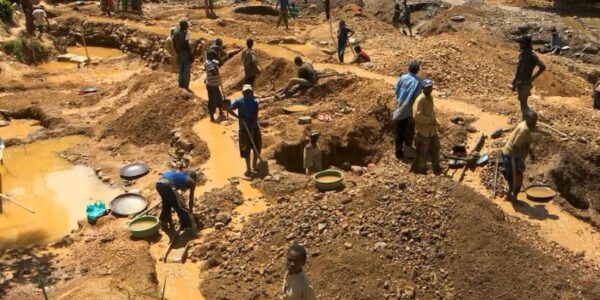
Illegal mining is often characterized as a failure of law enforcement. That characterization is not only incomplete, it is perilously misleading. The illegal proliferation of mining in the world doesn’t occur in a legal vacuum. It’s happening under its shadow, all too often, protected. From gold fields in the Amazon to rare earth corridors in Africa and Southeast Asia, illegal mining has morphed into a parallel system of extraction, one that works outside the reach of regulation yet rarely beyond the grasp of the state. The real question is not the reason for illegal mining. It is why it can be so easily tolerated within systems that profess to outlaw it. The answer to this lies in a brutal contradiction: the same states that criminalize illegal mining also rely on it, politically, economically and sometimes institutionally. In much of the world, mining law operates by definition as a gatekeeping mechanism dictating who can extract, where, and under what conditions. But these legal frameworks are selectively enforced in practice. And the large scale illegal operations never survive because they can be invisible. They survive because they are accepted. But they are frequently protected, at least in some instances, by networks of political patronage, corrupt enforcement and fragmented governance. This isn’t regulatory failure. It is regulatory capture.
Illegal mining flourishes in the gray zones between law and power. Enforcement agencies might undertake periodic crackdowns, frequently featured as evidence of state control. These operations are often intermittent, small actors are targeted, but larger, more organized networks go unscathed. For it is the spectacle of enforcement that becomes a substitute for its material substance. At the same time, the costs to the environment and humans will be higher. Rivers are polluted with mercury and cyanide.
Forests are stripped bare. And local communities confront displacement, violence, and economic dependence on the very activities that devastate their environment. These are not unintended consequences. They are predictable outcomes of a system that permits illegality to function as an informal extension of the formal economy. At the core of that system is a deeper paradox of law: illegality that is structurally enabled. In many countries, mining laws are not inherently weak. On paper, such laws often have robust provisions, licensing requirements, environmental safeguards, criminal penalties.
But the effectiveness of these laws is not determined by whether or not they exist, but by how effectively they are applied. When enforcement is selective, when oversight institutions are compromised, when political incentives lie in extraction rather than protection, law is performative. Illegal mining is not outside the system of mining. It is embedded within it. State power plays a key role. In regions where governance is fragmented, illegal mining plays an important role in filling economic gaps, where formal employment opportunities are limited. To keep from causing social unrest, states may allow for such activities. It is only in more centralized contexts that illegal mining is embedded with elite interests in a way that makes it grow from a crime into a politically protected one. But what happens in either case is that the line between what is legal and illegal becomes blurred and that is not because there is ambiguity in the law, but because the force of its enforcement is discretionary. And that arbitrary enforcement is the point in which the rule of law starts getting eroded. When the law is implemented in an unequal manner, then it ceases to be a neutral yardstick and becomes a tool which can be manipulated. There are criminalized small-scale miners, but large actors continue to operate with impunity.
Communities are held to blame for environmental degradation while the structural conditions necessary for exploitation go unaddressed. The storyline of “illegal mining” is, as a result, a convenient simplification one that leaves the state as the main offender in the solution to the very problem it purports to help solve. The effects also reach beyond the environmental devastation. They undercut the legitimacy of the legal systems themselves. The more citizens notice that laws are enforced selectively, the less trust they have, because laws are enforced selectively. Compliance becomes irrational. So why follow rules that are only for the powerless? Changing this trend will take more than stricter laws or heavier penalties. It requires a fundamental re-orientation of governance. First, enforcement needs to be consistent and transparent. The focus on selective crackdowns should give way to sustained, systemwide accountability focused on whole networks rather than the most visible actors. Secondly, institutional integrity must be reinforced. Oversight agencies also need to be independent, resourced and free from political manipulation. Third, the economic factors that lead to illegal mining should be targeted.
Without other alternatives, communities will remain reliant on informal extraction despite legal bans. And finally, and most importantly, states need to look their own complicity in the eye. As long as illegal mining aligns with political or economic interests, it will remain “ungovernable,” in name only. The challenge here is not the lack of control, it’s the lack of will. Mining illegally doesn’t put a world without law on display. It makes manifest a world where law exists but is undermined. A system that tolerates for the powerful the act of illegality, but punishes the weak who have committed it does not rule. It manages inequality. And in that management the law doesn’t collapse by accident. It collapses by design.
Fransiscus Nanga Roka
Faculty of Law University 17 August 1945 Surabaya Indonesia