Africa
How Improved Security Empowers Nonprofits to Transform Remote and Rural Communities -By Abdullahi Abubakar Ladan
The Foundation’s advocacy for institutionalized government-citizen dialogue platforms is a vital step toward sustained collaboration. These platforms ensure that the voices of marginalized communities, often amplified by nonprofits, are heard in policy-making spaces, promoting transparency and accountability. The summit’s focus on strengthening agricultural value chains, livestock development, and rural industrialization aligns with the vision of creating self-sufficient communities that contribute to Nigeria’s economic diversification.

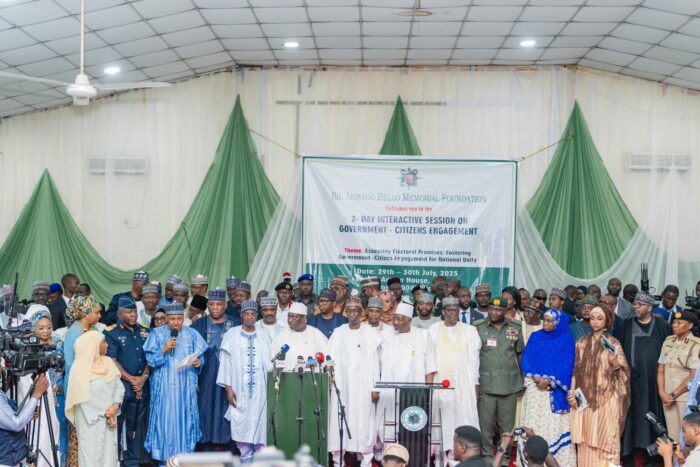
The Sir Ahmadu Bello Memorial Foundation (SABMF) has taken a bold and commendable step by hosting a 2-day interactive session on Government-Citizen Engagement, themed “Assessing Electoral Promises: Fostering Government-Citizen Engagement for National Unity” at Arewa House, Kaduna, on July 29-30, 2025. This timely initiative brought together a diverse group of stakeholders ranging from government officials, security agencies, civil society organizations, traditional and religious leaders, academics, and development partners with the sole purpose of demonstrating the Foundation’s steadfast commitment to fostering dialogue and inclusive decision-making.
A key highlight of the summit was the recognition of the significant progress made by President Bola Ahmed Tinubu’s administration in fulfilling electoral promises, particularly in improving security. For nonprofit organizations operating in rural, satellite, and marginalized communities across Northern Nigeria, this enhanced security environment has been a game-changer. In previous years, escalating insecurity forced many nonprofits to scale back or abandon vital interventions in communities grappling with challenges like limited healthcare access, educational deficits, and persistent gender-based violence and human rights violations. Despite the government’s efforts, the scale of these issues often outstripped available resources. Nonprofits have consistently played a complementary role, bridging gaps and delivering essential support to underserved populations.
The improved security landscape, as emphasized during the summit, has enabled nonprofits to safely resume operations in these communities, delivering critical healthcare, education, and empowerment programs. For example, in rural Kaduna and Borno, maternal health projects and vocational training for women was previously halted due to insurgent activities but have been revived now. The ability to work without the constant threat of violence has not only saved lives but also restored hope in communities that once felt forgotten. Coupled with the government’s notable advancements in infrastructure, such as highways and rural irrigation schemes, this progress has created an enabling environment for nonprofits to amplify their impact, alleviating pressure on government agencies and advancing sustainable development.
The summit’s acknowledgment of the administration’s strong performance in delivering on electoral promises resonates deeply with the nonprofit sector. Beyond security, the government’s commitment to sustaining critical projects, particularly those affected by past funding cuts, underscores its dedication to equitable development. A prime example is the continuation of the Safe Motherhood Initiative, which focuses on reducing maternal and infant mortality in underserved regions. This program, previously reliant on international donors, faced significant challenges during the Trump administration’s cuts to global health funding. The Nigerian government’s timely intervention to not only fund but went further and expand this initiative has ensured that thousands of women in rural areas continue to access life-saving maternal care. This has proven the administration’s genuine commitment to the well-being of Nigerians and the broader goal of national unity.
Furthermore, the government’s adoption of dialogue as a non-kinetic, cost-effective strategy to address insecurity, as highlighted at the summit, is another commendable achievement. This approach, which prioritizes community-driven solutions and engagement with traditional and religious leaders, resulted to trust and collaboration at the grassroots level. For nonprofits, this creates a stable environment to implement programs that empower communities to tackle their own challenges. Dialogue, as opposed to militarized responses, has proven effective in de-escalating conflicts and building lasting peace, aligning seamlessly with the nonprofit sector’s ethos of inclusion and community empowerment.
Despite these achievements, the summit rightly noted that challenges remain. The call for Northern governors to invest heavily in industrialization to engage the region’s youth population is critical. p
Promoting agro-allied industries and vocational training is advised, the government can channel young people’s energy into productive, nation-building activities, reducing the risk of conflict. Industrialization, alongside significant investments in education to address the out-of-school children crisis, offers a professional, non-violent approach to combating insecurity. A productive youth population is a cornerstone of peace, complementing the government’s dialogue-driven strategy.
The Foundation’s advocacy for institutionalized government-citizen dialogue platforms is a vital step toward sustained collaboration. These platforms ensure that the voices of marginalized communities, often amplified by nonprofits, are heard in policy-making spaces, promoting transparency and accountability. The summit’s focus on strengthening agricultural value chains, livestock development, and rural industrialization aligns with the vision of creating self-sufficient communities that contribute to Nigeria’s economic diversification.
The Sir Ahmadu Bello Memorial Foundation deserves resounding commendation for spearheading this critical dialogue. The summit’s outcomes highlight the power of collaboration in addressing Nigeria’s challenges. The administration’s advancements in security, infrastructure, and economic reforms have created a fertile ground for nonprofits to continue their work, complementing government efforts and reaching those most in need. All stakeholders including government, civil society, traditional leaders, and the media are urged to sustain this momentum. We are beginning to see a Nigeria where peace, justice, and prosperity are realities for all is within reach. Every action, counts.
Abdullahi Abubakar Ladan
abbahladan1@gmail.com
31st August, 2025