Africa
I no gree dey tear shirt—Empowering Traditional Leaders for Peace -By Prince Charles Dickson Ph.D
By merging indigenous approaches with ADR, trainings such as this represents a practical model for how Nigeria’s plural justice systems can work in harmony. As one participant from Bokkos put it: “We used to think mediation was just sitting two people under a tree until they stopped shouting. Now we see it as a structured way to build peace.”

The courtyard of peace is never built in a day. In Plateau State, that courtyard is slowly taking shape through a quiet but powerful partnership—one that blends tradition, law, and community wisdom into a living framework for justice.
Last week, the Plateau MultiDoor Courthouse (PMDC) and the Tattaaunawa Roundtable Initiative (TRICentre), with support from the Government of Sweden through the Norwegian Refugee Council (NRC), convened a landmark three-day capacity-building workshop on Collaborative and Alternative Dispute Resolution (CDR/ADR). The project was part of the broader initiative, Improving Access to Women’s Housing, Land and Property (HLP) Rights through Legislative Actions and Strengthening Institutional Capacity in Plateau State.
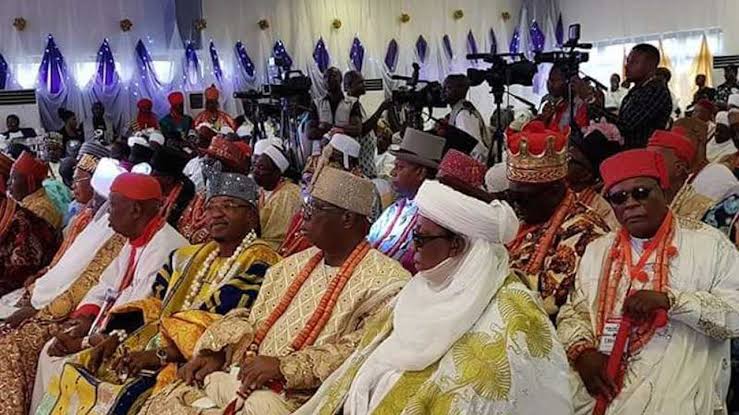
Held under the theme “Empowering Traditional Leaders for Sustainable Peace and Community Justice”, the workshop assembled traditional rulers from six local government areas—custodians of culture and frontline actors in grassroots conflict resolution. It was more than training; it was, as one participant put it, “a council of minds meeting for the future of peace.”
This might look ordinary, but trust me it is not, especially as conversations around giving traditional rulers constitutional powers and community and state police dominate public discourse. Trainings such as this is important!
In her opening address, Hon. Justice Nafisah Lawal, Chairperson of the Plateau MultiDoor Courthouse, was unequivocal about the urgency of the moment:
“The MultiDoor Courthouse exists to advance access to justice, ease the burden on our formal courts, and strengthen community cohesion. But the bridge between our indigenous systems and modern ADR must be walked together—and our traditional leaders are key to that journey.”
She underscored the need for equipping traditional leaders with tools that respect custom while embracing globally recognized dispute resolution practices.
Speaking on behalf of the NRC, Mr. Ephraim Hellandendu, Programme Manager for the Jos Office, stressed the accessibility of ADR for communities often far removed from formal judicial corridors:
“ADR offers not just faster and less costly justice—it offers justice people can relate to. Our work here is about empowering local actors so that peace is not imported into communities but grown within them.”
From the Plateau Peace Practitioners Network (PPPN), Bali D. Namank offered a goodwill charge to the assembled rulers: “The work of peace is patient work. Use these three days not only to learn but to unlearn, so your decisions will carry both fairness and foresight.”
I find myself privileged to be a Council Member of the PMDC and Head of Faculty, and as the workshop’s lead facilitator, the training was “a call to become for the traditional leaders to peace architects in their domains.”
My emphasis was not on academic abstraction but on lived application:
“A native proverb says, ‘A rope that ties two goats together must be strong enough for both.’ Our mediation must serve both parties, holding justice for all without snapping under pressure.” As one whose blood has roots on the Plateau I know better, the cruel journey of conflict around land and resources.
The faculty delivered an engaging sequence of sessions that seamlessly combined theory, casework, and cultural reflection. Participants were introduced to the Foundations & Frameworks of ADR/CDR, exploring the legal, historical, and cultural landscapes of dispute resolution. They examined the ADR spectrum, gaining clarity on the distinctions and overlaps between negotiation, mediation, arbitration, and litigation. In-depth conflict analysis tools for traditional justice systems were presented, from root cause mapping to stakeholder analysis, alongside a thought-provoking module on restorative justice, which bridged indigenous wisdom with contemporary ADR principles. The critical interplay between mediation and culture was explored, highlighting how to safeguard custom and dignity within modern legal mechanisms.
The programme further tackled the business dimensions of disputes, equipping chiefs to manage emerging economic tensions through arbitration and mediation. Peacebuilding and mediation were reframed as tools for strengthening community cohesion, supported by an understanding of personality types and communication skills that influence negotiation dynamics. Practical, hands-on sessions on mediation skills addressed neutrality, emotional management, and consensus-building, while negotiation skills for community justice emphasized persuasion without coercion. Finally, a session on the Code of Conduct for Mediators reinforced the ethical foundations necessary for trust and credibility in dispute resolution practice.
Interactive role plays brought life to theory, including a simulation of the Small Claims Court, where chiefs practiced acting as mediators between fictional disputants over land, debt, and family disagreements. These were real issues that bedevil the Nigerian state beyond Plateau.
For me, I will end these admonition in the form of an old story:
A lawyer sold his well to a teacher. Two days later, the lawyer returned “Sir, I sold you the well, but not the water inside. If you want the water, you’ll have to pay extra.”
The teacher smiled: “In fact, I was coming to tell you to remove your water from my well—or start paying rent from tomorrow.”
Flustered, the lawyer backed down: “I was just joking.”
The teacher laughed: “And this is how people like you become lawyers after studying with us.”
While the story drew warm laughter from participants it served a deeper purpose—it illustrated negotiation, leverage, and the clarity of terms. “In mediation, the one who frames the conversation often shapes the outcome.” I look deep Ito the Nigerian conversation towards 2027 that has been brought forward by the political class.
“When two brothers fight over a kola nut, strangers will eat it.” — I warn that unresolved disputes invite outsiders to take what belongs to both.“The stream that forgets its source will dry up.” — I subtly beg to remind us that modern justice must honor the roots of traditional practice. The go-to-court and damn it all, and the electorate system where the peoples voice are left in the hands of few judges must become a thing a the past.
Nigeria as I witnessed and can be validated by the thoughts of the traditional leaders in my conversation is reflective of the fact that insight into coexistence amid diversity that Nigeria needs, “Peace is not the absence of noise, but the presence of harmony in the market square.”
In her closing remarks, erudite Justice Nafisah Lawal words captured the moment—“You came as custodians of tradition; you leave as custodians of both tradition and transformation. Let this knowledge serve not just disputes, but the dignity of every citizen you stand for.”
This matters because Plateau State, with its diverse ethnic and religious communities, has known its share of tensions. Traditional leaders remain the first line of resolution for many disputes—particularly in rural areas where formal courts are geographically or financially out of reach. Yet these leaders face modern challenges: land disputes complicated by urban expansion, gender-based claims on property, intergenerational conflicts, and commercial disagreements born from a growing informal economy.
By merging indigenous approaches with ADR, trainings such as this represents a practical model for how Nigeria’s plural justice systems can work in harmony. As one participant from Bokkos put it: “We used to think mediation was just sitting two people under a tree until they stopped shouting. Now we see it as a structured way to build peace.”
The success of the workshop will ultimately be measured not by the certificates awarded but by the disputes quietly resolved without escalating into violence.
“May the fire we refuse to quench at the anthill not one day burn the compound.” By equipping traditional leaders to intervene early, firmly, and fairly, initiatives like this are dousing the sparks before they become infernos.
“Peace does not happen because we wish it so. It happens because we build it—door by door, case by case, handshake by handshake.” May Nigeria win!
—
Prince Charles Dickson PhD
Team Lead
The Tattaaunawa Roundtable Initiative (TRICentre)
https://tattaaunawa.org/
Development & Media Practitioner|
Researcher|Policy Analyst|Public Intellect|Teacher
234 803 331 1301, 234 805 715 2301
Alternate Mail: pcdbooks@yahoo.com
Skype ID: princecharlesdickson