Africa
Is Nigeria’s Economy Still in ICU Or Just Recuperating? -By Isaac Asabor
So, is Tinubu’s economy still in ICU or just recuperating? In answering the foregoing question, it is not wrong to opine that it is both, as it is showing faint signs of recovery on paper, but still critically unstable across homes and markets. Until the reforms are matched with real, robust, and consistent social protection, jobs, food access, business support, and healthcare, the economy will remain suspended between the promise of reform and the pain of reality. In the meantime, Nigerians are waiting, some with hope, others with hunger.

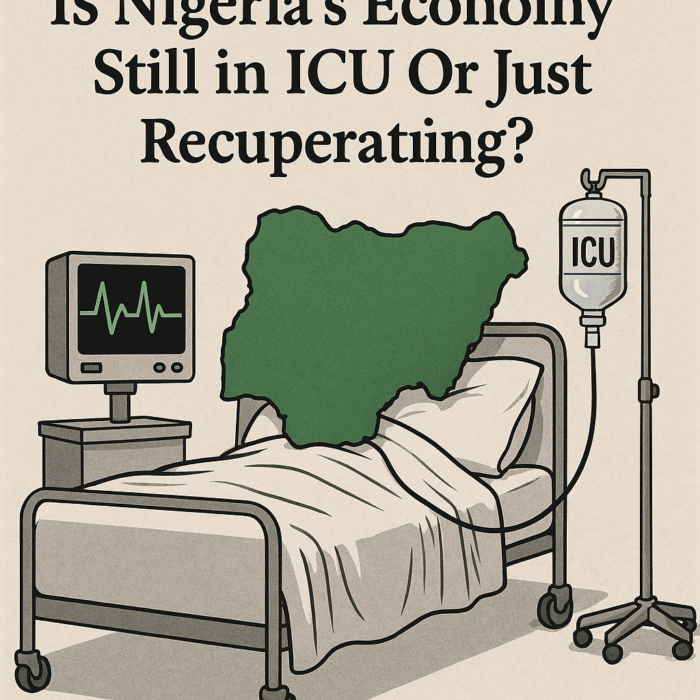
Since President Bola Ahmed Tinubu took office on May 29, 2023, the Nigerian economy has been placed under what looks like economic life support. His team has spoken of “bold reforms” and a long-overdue rescue mission. But as it stands today, there is a lingering, unavoidable question: “Is the economy slowly recuperating or still gasping for breath in the Intensive Care Unit (ICU)?”
From Tinubu’s corner, the narrative is one of strategic surgery, cutting off the fuel subsidy tumor, realigning the foreign exchange market, expanding the tax base, and opening up to foreign investment. Supporters brand these reforms as painful but necessary for long-term economic healing. They argue that the government is setting up a new foundation and that stability, albeit slow, is on the horizon.
You will often hear members of the ruling APC tout recent naira appreciation, increased oil production, and foreign engagements as signs that Nigeria is “getting better.” According to them, these are early signs of economic stabilization. “This is the beginning of confidence returning to the market,” one APC stalwart claimed on national television.
But go beyond the podiums and press releases, into the marketplaces of Lagos, the roads of Warri, the schools of Aba, and the homes of pensioners in Kano, and a harsher truth emerges. For millions of Nigerians, the economy does not feel like it is recuperating. It feels like it is on life support, if not already flat lined.
Prices of food have continued to soar beyond reason. Transportation costs have doubled in many cities. Electricity is still epileptic. Job losses are mounting. The average Nigerian can no longer feed, fuel, or find footing. Talk to small business owners, civil servants, artisans, or retirees, and you will hear the same refrain: “Stabilization for who?”
As one trader in Ogba in Lagos bluntly puts it, “They say the economy is recovering. Maybe in Abuja. But for us here, we cannot even eat twice a day.” That is not recovery, it is survival.
What we are seeing is not just economic hardship, it is what economists have termed a “vibecession”, a situation where official data says things are getting better, but the people feel worse. According to global trends, vibecessions occur when the macroeconomic indicators (like GDP growth or forex stability) are disconnected from the public’s lived reality, rising prices, job insecurity, and general hopelessness.
Yes, inflation is a global concern. Yes, exchange rates needed fixing. Yes, subsidies were unsustainable. But reforms without cushioning measures are like sending patients into surgery without anesthesia. The pain is unbearable, and in Nigeria’s case, dangerously destabilizing.
Take Egypt and India as examples. Both countries removed fuel subsidies but coupled the move with well-structured cash transfers and targeted support programs. India reached over 160 million households with direct payments. Egypt expanded its Karama and Takaful programs to cover millions. The result? Protests were limited, and the public gradually bought into the reform.
In contrast, Nigeria’s approach has been lopsided. While implementing hard-hitting reforms, the government rolled out palliatives that were poorly designed, inconsistently distributed, and grossly inadequate. The so-called relief packages, bags of rice, token transfers, came late, missed the poorest, and in some cases, became political tools. Meanwhile, government spending on direct social protection remains below 2% of the 2024 budget. Compare that with over 45% spent on debt servicing, and you begin to see why the economy feels like it’s in the ICU, not recovery mode.
The latest data from the National Bureau of Statistics (NBS) paints a grim picture: 133 million Nigerians are considered multidimensionally poor. With rising food costs, declining job opportunities, and no clear safety nets, that number is likely climbing. Even the World Bank and IMF, both cautiously optimistic, have warned that without strong social investment, the so-called economic rebirth may collapse under public frustration.
To his credit, Tinubu’s Central Bank under Yemi Cardoso has taken steps to stabilize the naira, rebuild reserves, and rein in inflation. But the effects are yet to be felt on the streets. For now, stabilization remains a theory in conference rooms, not a reality in Nigerian homes.
Let’s call a spade a spade. The economy is not yet out of the ICU. Yes, some vital signs are improving, exchange rate stabilization, policy reforms, and external support, but without real social cushioning, the patient (Nigeria) is still bleeding.
In fact, it is fair to say that the country is now floating in a limbo, not yet healed, not yet dead, just drifting between economic coma and fragile stabilization. It is the kind of uncertainty that fuels distrust, disillusionment, and despair.
Public confidence is low, and history has made Nigerians wary. So even when Tinubu’s team means well, skepticism runs high. Nigerians have seen this script before, grand economic reforms that do not reach the masses. For many, the big question remains: “When will this economic turnaround become more than talk?” “When will Nigerians feel the change in their pockets, not just in press briefings?”
For now, the answer is not clear. What is clear is that time is running out. Patience is thinning. And the average Nigerian is tired of being told to “endure” while leaders promise a tomorrow that never seems to arrive.
So, is Tinubu’s economy still in ICU or just recuperating? In answering the foregoing question, it is not wrong to opine that it is both, as it is showing faint signs of recovery on paper, but still critically unstable across homes and markets. Until the reforms are matched with real, robust, and consistent social protection, jobs, food access, business support, and healthcare, the economy will remain suspended between the promise of reform and the pain of reality. In the meantime, Nigerians are waiting, some with hope, others with hunger.