Africa
Like Kemi Badenoch, Unlike Ademola Lookman, by Isaac Asabor

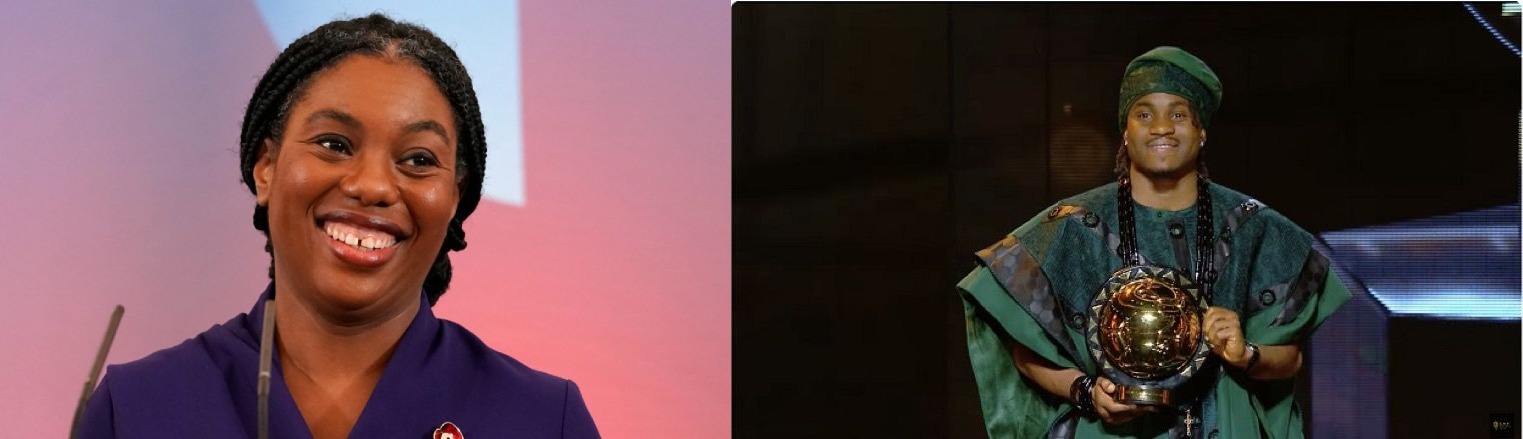
In a world where representation matters, two Nigerians, Kemi Badenoch and Ademola Lookman, stand as symbols of success on different stages. However, the paths they have carved out offer distinct lessons about identity, ambition, and the diverse definitions of what it means to represent Nigeria.
To explanatorily put the forgoing in its contextual perspective, it is not a misnomer to recall that Kemi Badenoch, a British Conservative politician, who currently serves as the UK Secretary of State for Business and Trade was born in Wimbledon, London, to Nigerian parents and raised partially in Lagos, has risen to prominence in a system where diversity in leadership has historically been limited.
Badenoch has consistently emphasized her Nigerian roots, recounting childhood experiences in Lagos and her journey through British society. However, her alignment with conservative policies, especially on issues like immigration and race relations, has often sparked debates. While some criticize her for what they perceive as a detachment from the struggles of immigrants and minorities, others celebrate her as a trailblazer breaking barriers in the highest echelons of British politics.
Her trajectory underscores the power of adaptability and the importance of navigating complex systems with strategic finesse. Badenoch’s story inspires Nigerians to see the global stage as an arena where their voices can influence policies and narratives.
Yet, this success comes with complexities. Her critics in Nigeria often question whether her policies align with the hopes and aspirations of her ancestral homeland. While she has occasionally acknowledged her Nigerian heritage, her focus remains firmly on the British electorate, a necessary priority in her role as a UK government official. Her career trajectory highlights the delicate balance many diaspora Nigerians must strike between representing their roots and thriving in adopted nations.
In contrast, Ademola Lookman represents a different brand of Nigerian excellence. Born and raised in England, the talented footballer embraced his Nigerian heritage by switching allegiance from England to Nigeria in international football. This decision was not just a personal choice; it was a statement of pride and connection to his ancestral home.
Lookman’s exploits on the pitch, including his impressive performances for Atalanta in Serie A and the Nigerian Super Eagles, have endeared him to fans across the globe. His commitment to representing Nigeria highlights a sense of loyalty that transcends national borders. Lookman’s Nigerian roots are not just a backdrop to his career, they are central to his identity and the choices he has made as an athlete.
A defining moment that showcased Lookman’s pride in his Nigerian heritage was his acceptance speech at the 2024 CAF Awards, where he was named African Player of the Year. In his heartfelt speech, Lookman spoke in Yoruba language, as he thanked his fans, teammates, and the Nigerian Football Federation. This moment resonated deeply with Nigerians, who saw in Lookman’s words a reflection of their collective pride and resilience.
His ability to exert his “Nigerianese” on such a global stage is a testament to his understanding of what it means to be Nigerian in today’s interconnected world. Unlike many diaspora athletes who often shy away from overt displays of their heritage, Lookman embraced it fully, cementing his place as a cultural and sporting ambassador for Nigeria.
While Badenoch’s journey reflects a narrative of breaking ceilings in global politics, Lookman’s story is one of embracing grassroots connections. Badenoch works within the framework of British society, often prioritizing her adopted nation’s interests over her Nigerian heritage. In contrast, Lookman’s decision to play for Nigeria is a deliberate act of embracing his roots and contributing to the nation’s identity on the global stage.
The differences between Badenoch and Lookman’s approaches to their Nigerian heritage are striking. Badenoch’s Nigerian roots often appear as a footnote in her political narrative, while Lookman places his heritage front and center. Badenoch’s success demonstrates how Nigerians can thrive in international systems by assimilating and excelling within established structures. On the other hand, Lookman’s career highlights the power of cultural pride and the importance of connecting with one’s origins, even in the face of global challenges.
Both Badenoch and Lookman teach important lessons. Badenoch reminds us that Nigerians can compete and excel in any sphere, even at the highest levels of global governance. Her story is one of courage and resilience in a demanding political landscape. On the other hand, Lookman’s choice teaches the value of loyalty and the importance of reconnecting with one’s heritage, even when it might not guarantee personal glory or convenience.
Their stories also reveal the different ways Nigerians can contribute to national and global narratives. Badenoch’s influence lies in shaping policies that, while primarily benefiting Britain, still position Nigerians as capable leaders in global arenas. Lookman’s impact, meanwhile, is felt more directly by Nigerians who see him as a source of national pride and a representative of their collective aspirations.
The dichotomy between Kemi Badenoch and Ademola Lookman’s experiences also highlights the broader question of how the Nigerian diaspora can best represent their heritage. Should success be measured by one’s ability to influence global systems, as Badenoch does, or by one’s commitment to directly uplifting and connecting with their roots, as Lookman exemplifies? Perhaps the answer lies in a combination of both approaches, leveraging global platforms to create meaningful change while staying deeply connected to one’s heritage.
Like Kemi Badenoch, Nigerians can dare to dream big, stepping into global arenas with confidence and purpose. Unlike Ademola Lookman, some might choose to prioritize external influence over local connection. Yet, both paths hold valuable lessons for Nigerians navigating their roles in an increasingly interconnected world.
Ultimately, whether in politics or sports, these individuals showcase the extraordinary potential of Nigerians to excel, inspire, and make a difference, both at home and abroad. As Badenoch shapes policies that affect millions and Lookman continues to thrill fans with his prowess on the pitch, they remind us that there is no single path to success. What matters most is staying true to one’s values, embracing one’s identity, and making a lasting impact, wherever one’s journey leads.