Africa
The Sycophancy of Orji Uzor Kalu and the Degradation of Legislative Independence -By Jeff Okoroafor
Nigerians must demand better from their representatives. Lawmakers should be judged by their contributions to national development, not by their ability to lick the boots of those in power. If Kalu and his ilk are more interested in campaigning than lawmaking, perhaps they should resign and join the president’s media team—because the National Assembly deserves better.

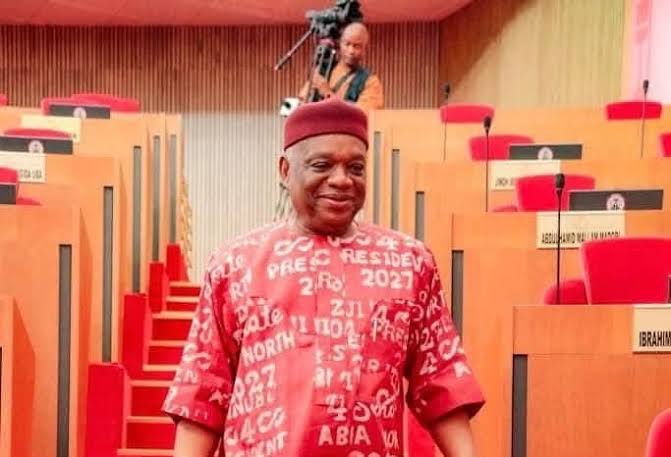
In a democracy, the legislature is meant to serve as a check on executive power, a bastion of independent thought, and a forum where the interests of the people are vigorously debated. Unfortunately, Nigeria’s political culture often reduces the National Assembly to a theater of sycophancy, where lawmakers prioritize personal ambition over principle. The recent spectacle of Senator Orji Uzor Kalu wearing a “Tinubu for President 2027” campaign shirt to the Senate chamber is a glaring example of this disturbing trend.
On May 27, Senator Orji Uzor Kalu, a former governor and current Chief Whip of the Senate, walked into the National Assembly adorned in a shirt boldly emblazoned with “Tinubu for President 2027.” This act was not just a premature endorsement—it was a brazen display of political servility, an affront to legislative decorum, and a slap in the face of the constituents he supposedly represents.
Kalu’s stunt raises critical questions: Why would a sitting senator, barely two years into President Bola Tinubu’s first term, openly campaign for his re-election in the hallowed chambers of the National Assembly? Is this not a blatant violation of the impartiality expected of lawmakers? And more importantly, what does this say about the state of Nigeria’s democracy when legislators behave like cheerleaders rather than critical thinkers?
Nigeria’s political landscape is already plagued by a lack of ideological depth, where politicians switch allegiances at the drop of a hat in pursuit of personal gain. Kalu’s early endorsement of Tinubu—despite the administration’s ongoing struggles with economic hardship, insecurity, and policy contradictions—suggests that his loyalty is not to the Nigerian people but to the corridors of power.
This is not the first time Kalu has engaged in such sycophantic behavior. Recall that in the buildup to the 2023 elections, he was a vocal supporter of former President Muhammadu Buhari, only to later criticize his administration when it became politically expedient. His latest stunt reeks of the same opportunism—a desperate attempt to secure relevance and possibly a ministerial or other lucrative appointment in the event of a Tinubu re-election.
The National Assembly is not a campaign ground. It is an institution where laws are made, executives are held accountable, and national issues are debated. When a senator uses the Senate floor as a platform for partisan grandstanding, he undermines the very essence of legislative independence.
Would Kalu have dared to wear such a shirt if he disagreed with Tinubu’s policies? Unlikely. His actions demonstrate that, for many Nigerian politicians, governance is secondary to political survival. Instead of focusing on pressing national issues—such as the rising cost of living, insecurity, or electoral reforms—Kalu is more interested in currying favour with the executive.
Nigeria’s democracy is increasingly resembling a cult of personality, where political figures are worshipped rather than scrutinized. Tinubu’s presidency is still in its early stages, and Nigerians are yet to see whether his policies will yield tangible benefits. Yet, politicians like Kalu are already positioning themselves as propagandists, attempting to shape public perception before any meaningful assessment can be made.
This premature hero-worship is dangerous. It discourages critical debate, stifles dissent, and creates an environment where leaders are not held accountable. If lawmakers are more invested in promoting individuals than in upholding their constitutional duties, then democracy is in trouble.
Orji Uzor Kalu’s “Tinubu for President 2027” shirt is more than just a fashion statement—it is a symbol of the rot in Nigeria’s political system. It reflects a culture where sycophancy is rewarded, where loyalty to a man supersedes loyalty to the nation, and where the legislature is reduced to a rubber stamp.
Nigerians must demand better from their representatives. Lawmakers should be judged by their contributions to national development, not by their ability to lick the boots of those in power. If Kalu and his ilk are more interested in campaigning than lawmaking, perhaps they should resign and join the president’s media team—because the National Assembly deserves better.
Until Nigerian politicians learn that true leadership is about service, not servitude, the country will continue to stagnate in the cesspool of sycophancy and underdevelopment.

Jeff Okoroafor
Jeff Okoroafor is a social accountability advocate and a political commentator focused on governance, accountability, and social justice in West Africa.