Africa
Who Will Tell Wike, Fubara And Their Supporters That Rivers Does Not Belong To Them?, by Isaac Asabor

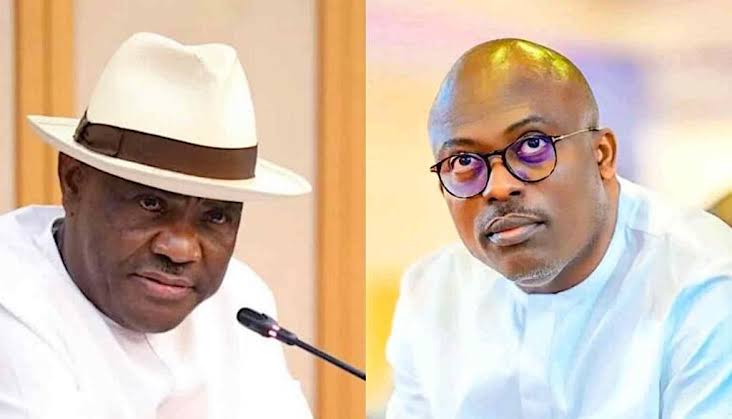
The political terrain in Nigeria is often seen as a battleground where the rule of law and accountability tend to take a back seat. Rivers State is no exception, and recent developments beg the question: “Who will tell Nyesom Wike, Governor Siminalayi Fubara, and their supporters that Rivers State does not belong to them?”
For years, the political scene in Rivers has been dominated by powerful individuals whose influence and actions suggest an unchecked belief that the state is their personal fiefdom. Nyesom Wike, the former governor and current Minister of the Federal Capital Territory (FCT), and Siminalayi Fubara, the incumbent governor, have become the faces of this perceived political hegemony. Their supporters, emboldened by their political clout, are seemingly complicit in a narrative that depicts Rivers State as a political inheritance of Wike’s making.

Nyesom Wike’s rise to prominence has been a significant political story in Rivers. After serving as Chief of Staff to former governor Rotimi Amaechi, Wike’s influence grew, and he eventually became governor in 2015. During his time in office, Wike earned a reputation as a strongman, one who could use the powers of incumbency to sway political outcomes. His administration was marked by several achievements, notably in infrastructure, but was also criticized for high-handedness and for stifling dissent.
In 2023, Wike helped engineer the ascension of Siminalayi Fubara as his successor. Fubara, a former Accountant-General of the state, was seen by many as Wike’s handpicked candidate, someone who would protect the interests of the former governor even after his exit from the state’s top seat. Unfortunately, the relationship between Fubara and Wike has since become sour, raising concerns about whether the state is being governed in the interest of the people or for the benefit of a few political elites.
While their relationship was initially seen as a united front, recent reports suggest that Wike and Fubara may be embroiled in a quiet power struggle. Fubara’s refusal to attend a recent Peoples Democratic Party (PDP) rally in the state was seen as an open challenge to Wike’s authority. This has sparked speculations of friction between the two, with some interpreting it as a subtle attempt by Fubara to assert his independence. However, this clash is a reflection of deeper problems: a political culture where personal loyalty and interests take precedence over governance and the will of the people.

The battle between these two political figures, if unchecked, could drag the state into further instability. Rivers is no stranger to politically motivated violence, and a brewing conflict between Wike’s loyalists and Fubara’s camp could escalate tensions in the region. Rivers people deserve better than to be caught in the crossfire of political egos.
In the midst of this unfolding drama, one has to wonder: where are the voices of Rivers people? For too long, the citizens of Rivers State have been sidelined in political conversations about their future. Elections come and go, and leaders rise to power, but the people are left to watch from the sidelines as political elites carve out their influence.
It is a tragedy that in a democracy, the will of the people seems secondary to the ambitions of a select few. Rivers, rich in oil resources and strategically important to Nigeria’s economy, should be a beacon of progress, but instead, it remains mired in political turmoil. The state has witnessed successive administrations that prioritize personal political survival over addressing the pressing issues that face the people.
The question then becomes: who will tell Wike, Fubara, and their supporters that Rivers State does not belong to them? It is high time that the people of Rivers rise up and reclaim their state from the clutches of political godfatherism.
The concept of godfatherism in Nigerian politics is not new. It is a phenomenon where powerful political figures, often referred to as “godfathers,” wield immense influence over the political landscape, determining who gets elected into various positions of power. In Rivers, Wike has played this role, and Fubara’s rise to power is seen by many as a product of this system.

The problem with godfatherism is that it erodes the democratic process. Leaders are no longer accountable to the people but to the godfathers who put them in power. Policies are crafted not with the welfare of the populace in mind, but to please the political overlords. Rivers State, like many other states in Nigeria, has suffered from this undemocratic practice.
For Rivers to truly progress, there must be a collective rejection of godfatherism. The people must demand leaders who are accountable to them, not to a powerful few. It is only through such a shift that the state can move beyond the current cycle of political patronage.
It is not enough to simply identify the problem; there must be a concerted effort to address it. The people of Rivers must begin to question the legitimacy of a political system that operates in their name but excludes them from the decision-making process. Civil society organizations, traditional rulers, and youth groups must play a pivotal role in this regard. They must speak out against the monopolization of political power and demand greater transparency in governance.
Additionally, electoral reforms are needed to ensure that future elections in Rivers reflect the will of the people, not the preferences of political godfathers. The Independent National Electoral Commission (INEC) and other relevant bodies must work to curtail the influence of money and incumbency in the electoral process.
Furthermore, governance in Rivers must be people-centered. The state is plagued by numerous challenges, including unemployment, poor infrastructure, and insecurity. These issues require leaders who are focused on delivering dividends of democracy to the people, not on perpetuating their personal political empires.
The current situation in Rivers State is a microcosm of the larger political challenges facing Nigeria. The dominance of powerful political figures like Wike and the rise of leaders like Fubara under their tutelage is a clear indicator that the democratic process in Nigeria is still fragile. But it is not too late for change.
The people of Rivers must awaken to the reality that their state does not belong to any individual or group of individuals. It is a collective inheritance that must be governed with the interests of all in mind. Only through active participation, vigilance, and a rejection of political godfatherism can Rivers State truly fulfill its potential.
In the end, the question remains: who will tell Wike, Fubara, and their supporters that Rivers State is not their personal property? Perhaps it is the people of Rivers who will, by rising to demand better governance and an end to the stranglehold of political elites. The time for change is now, and it is up to the people to make their voices heard.