
Breaking News
Atiku, Mark, Adeleke Challenge Court-Ordered Deregistration of ADC, Accord, Others
ADC and Accord leaders vow to remain on the ballot after a Federal High Court directed INEC to deregister five political parties. Read reactions from Atiku, Mark, Adeleke and Sowore.


A fresh political controversy has erupted following a Federal High Court judgment directing INEC to deregister five political parties, with opposition leaders warning that the move could undermine Nigeria’s multi-party democracy ahead of the 2027 elections.
Justice Peter Lifu of the Federal High Court in Abuja ruled that the African Democratic Congress (ADC), Accord Party, Action Peoples Party (APP), Action Alliance (AA), and Zenith Labour Party (ZLP) failed to meet constitutional performance requirements and should no longer enjoy recognition as registered political parties.
The judgment followed a suit filed by the National Forum of Former Legislators (NFFL), which argued that the affected parties had consistently failed to secure the electoral benchmarks required under Section 225A of the Constitution.
The court ordered INEC to stop recognizing the parties, accepting their candidates, or facilitating their participation in future elections.
The Attorney-General of the Federation, Prince Lateef Fagbemi (SAN), backed the lawsuit, arguing that retaining underperforming political parties on the register amounted to a breach of constitutional obligations.
“The continued existence of non-performing political parties will inflate the ballots, burden public funds, complicate election administration, and undermine the constitutional intention behind Section 225A,” the AGF argued in court filings.
However, the ruling has drawn fierce opposition from affected parties and political figures.
ADC National Chairman Senator David Mark described the judgment as a temporary setback and vowed that the party would contest the decision through legal channels.
“The ADC will be on the ballot in 2027,” Mark declared. “This temporary setback will be overcome through the judicial process.”
ADC presidential candidate Atiku Abubakar accused the Tinubu administration of targeting opposition parties ahead of the next general election.
“The Tinubu administration is singularly focused on eliminating major political opponents ahead of 2027, rather than confronting insecurity, economic hardship and unemployment. This is not governance. It is political elimination by other means,” Atiku said.
The ADC also accused the Federal Government of backing efforts to remove opposition parties from the electoral process and warned that such actions could trigger a political crisis.
“We wish to warn, in the strongest possible terms, against any attempt to use the judiciary as an instrument to undermine democracy and plunge Nigeria into a major political crisis,” the party said in a statement signed by National Publicity Secretary Mallam Bolaji Abdullahi.
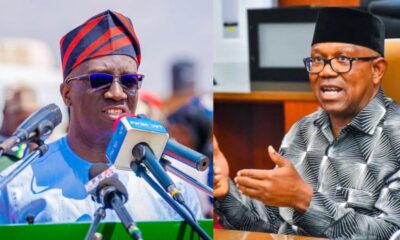
Governor Ademola Adeleke of Osun State, who is contesting the August 15 governorship election under Accord, argued that the judgment was delivered despite an existing Court of Appeal order directing a stay of proceedings.
“It is on record before Justice Peter Lifu that the Court of Appeal specifically pronounced that ‘The delivery of the judgment is still part of the proceedings of the Court,’” Adeleke said.
The governor maintained that Accord would remain on the ballot and urged supporters to continue mobilizing for the election.
Civil rights activist and AAC presidential candidate Omoyele Sowore also condemned the ruling, describing it as incompatible with democratic principles.
“I totally condemn the deregistration of political parties that have already concluded their primaries and are preparing for general elections. Such an action is undemocratic and unjustifiable in a multi-party democracy,” Sowore stated.
Peter Obi similarly warned against weakening key democratic institutions, stressing that strong nations are built on trust in the rule of law and judicial independence.
With appeals already pending before the Court of Appeal, the legal and political battle over the future of the affected parties is expected to intensify in the coming months, potentially shaping the landscape for both the 2027 presidential election and the upcoming Osun governorship poll.
Africans Angle News


























You must be logged in to post a comment Login