Politics
Convoys, Condescension, and Moral Theater: The Hypocrisy of Gov. Soludo’s Visit to Awka Secretariat -By Vitus Ozoke, PhD
What Anambra needs is not performative crackdowns. It needs functional governance. Turn on the lights. Stabilize the system. Support the workers. Then – and only then – can you begin to demand excellence. Until that happens, suspensions will not fix the problem. They will only deepen it. Because you cannot command productivity in the dark.

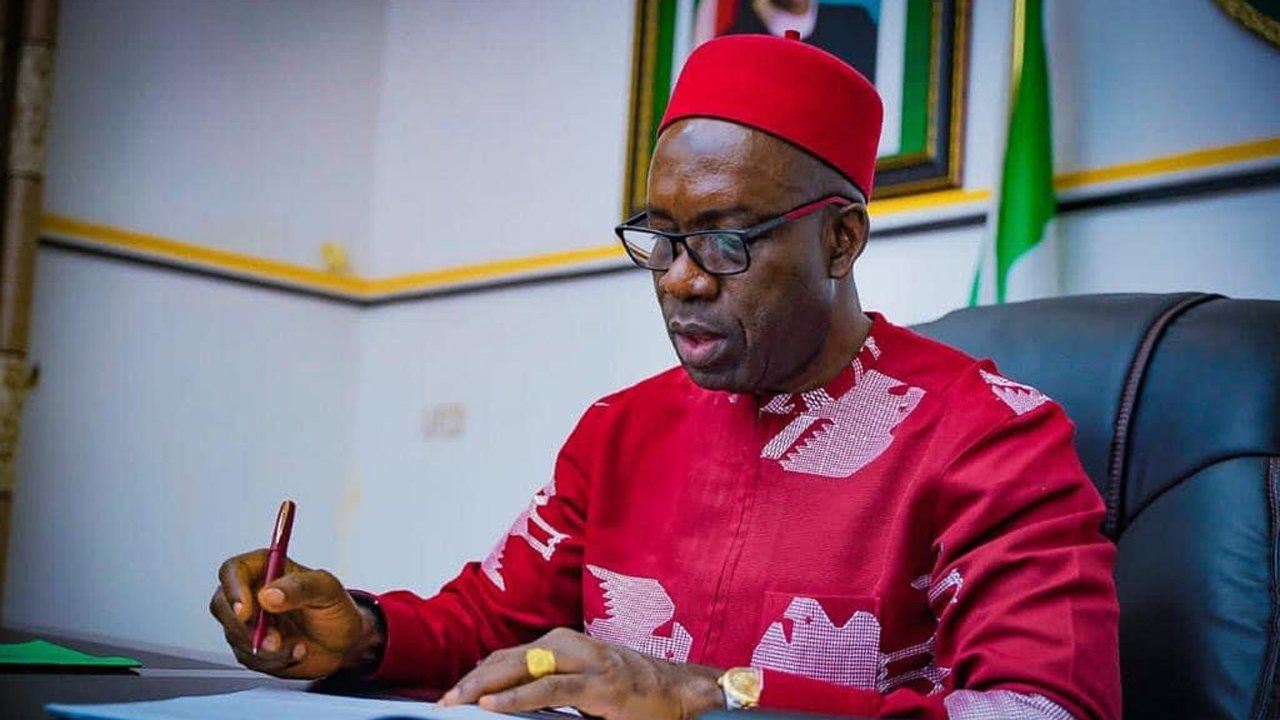
There is something profoundly unsettling about a governor who arrives in a blaze of authority and fanfare to punish failure while standing squarely in the middle of it.
When Charles Soludo stormed the Anambra State Secretariat in Awka on an unannounced visit on Thursday, March 26, and reportedly found over 95 percent of workers absent past 10:00 a.m., the optics were irresistible: a tough, no-nonsense governor confronting a lazy, undisciplined workforce. His response – ordering mass suspension for the rest of the year – was swift, dramatic, and, at first glance, decisive.
But peel back the spectacle, and what emerges is not leadership. It is theater, the worst sort of it – moral theater. Because what exactly did the governor inspect? A workplace without electricity. A Secretariat where fans hang uselessly in stagnant heat. Offices where computers are dead, lights are off, and productivity is structurally impossible.
This isn’t just an inconvenience; it is systemic institutional failure. And that failure does not belong to the workers. It belongs to the governor and his government. You cannot demand efficiency from people you have systematically deprived of the tools to be efficient. You cannot enforce punctuality in an environment where even the basic conditions for work – electricity, functioning infrastructure, and livable working conditions – are lacking. Leadership is not about catching people in failure; it is about removing the conditions that make failure inevitable. Yet instead of accountability, we witnessed moral posturing.
Consider the broader economic reality. Fuel prices have soared. Transportation costs have skyrocketed. For many civil servants in Anambra State – and across Nigeria, the daily commute is no longer a routine; it is a burden. So, some now walk long distances to work, stretching already exhausting mornings into ordeals of endurance. This is not speculation; it is the lived reality of Anambra state workers navigating an economy that has become increasingly hostile to their survival. And what has Gov. Soludo done to cushion this? Nothing. No transport support. No wage adjustments. No structural intervention. Just punishment.
Meanwhile, the governor arrives insulated from these realities – carried in a convoy funded by public resources, shielded by layers of security, untouched by the very hardships that define the lives of those he governs. It is a stark contrast: those who struggle are penalized; those who are protected pass judgment.
There is a screaming irony here that is too glaring to ignore. At the recent second inauguration of Charles Soludo in Awka, one absence spoke louder than the crowd: Peter Obi was nowhere to be found. Not because he declined the invitation, but because no invitation came. This was no oversight. It was a choice.
And the reasons, widely speculated, are as telling as they are troubling: the fear that Obi’s presence – his visibility, his credibility, his enduring popularity – might upstage the very man being sworn in. That, in a moment meant to symbolize unity and continuity, personal insecurity took precedence over statesmanship. What pettiness! Because leadership, at its highest level, is not threatened by stature – it is strengthened by it. It does not shrink the room to fit its ego; it expands it to accommodate excellence.
And here lies the deeper contradiction. If what the governor truly sought was a model of discipline, punctuality, and public service ethos, he need not have looked far. He could have invited Peter Obi to that same Secretariat. By every account, Obi would likely have been there before 7:00 a.m. – not for spectacle, but out of habit. Out of principle.
But that would have complicated the script. Because this was never just about punctuality. It was about power – who wields it, who displays it, and who gets to be diminished by it. The absence of Obi at the inauguration and the public berating of workers at the Secretariat are not isolated incidents; they are expressions of the same instinct: to control the narrative, to dominate the stage, and to ensure that no presence, whether colleague or civil servant, disrupts the hierarchy being performed. And in the end, it is easier to discipline the powerless than to stand beside the formidable.
And then there is the tone…
There is a moment in this episode that deserves far more attention than it has received. It was a brief exchange, almost casual in delivery, but deeply revealing in meaning. It was that moment when the governor confronted a female secretariat staff member and asked, “Say you are the who?” It was not merely a question. It was a statement of hierarchy, a performance of power, and a subtle act of sexist and misogynistic diminishment and devaluation. It didn’t matter that she was an Acting Director. Neither did it matter that she was among the few punctual good ones.
Language matters, especially from those who wield authority. In that single phrase lies an entire worldview: one in which public servants are not respected professionals contributing to the machinery of governance, but subordinates whose identities must be challenged, whose legitimacy must be questioned, and whose dignity is conditional. It is the language of suspicion, not leadership. Of interrogation, not engagement.
And this matters because tone is not incidental – it is foundational. A workplace culture is not shaped only by policies or sanctions; it is shaped by how leaders speak, how they listen, and how they regard those beneath them in the chain of command. When the first instinct of leadership is to belittle rather than understand, to assert dominance rather than build rapport, it sends a clear and corrosive message: you are not valued here.
In such an environment, punctuality becomes secondary to survival. Commitment erodes. Morale collapses. Because people do not give their best to systems that strip them of their dignity and shared humanity. Why should workers feel motivated to show up early to an environment where they are neither supported nor respected? Where the reward for diligence is humiliation? Where the system itself is stacked against their success? They withdraw – not always in open defiance, but in quiet disengagement. They show up late, leave early, or stop showing up at all – not simply out of indiscipline, but out of disillusionment.
So that one question – “Say you are the who?” – is not trivial. It is a small phrase, but it carries the weight of something larger: condescension, conceit, and arrogance. A subtle but unmistakable assertion of superiority. It is emblematic. It captures, in a fleeting moment, the distance between power and empathy, between authority and respect. And it raises a fundamental question: can a government that speaks to its workers in this way truly expect their loyalty, their diligence, or their best effort?
This is not to excuse absenteeism. Public service demands responsibility, and workers must meet their obligations. But responsibility is not a one-way street. Governments, too, have obligations—to provide the conditions under which work can be meaningfully done. Discipline without fairness is oppression. Accountability without self-reflection is hypocrisy. And enforcement without provision is injustice. You cannot run a state on punishment alone.
If anything, this episode exposes a deeper truth: the crisis is not merely one of worker discipline – it is one of leadership credibility. A government that cannot keep the lights on has little moral authority to lecture others about productivity. A leader who does not confront systemic failures but instead punishes their symptoms is not solving a problem – he is obscuring it.
What Anambra needs is not performative crackdowns. It needs functional governance. Turn on the lights. Stabilize the system. Support the workers. Then – and only then – can you begin to demand excellence. Until that happens, suspensions will not fix the problem. They will only deepen it. Because you cannot command productivity in the dark.
Dr. Vitus Ozoke is a lawyer, human rights activist, and public affairs analyst based in the United States. He writes on politics, governance, and the moral costs of leadership failure in Africa.