Politics
From Rebel to Reverent: When Power Teaches Our Politicians to Kneel -By John Oyebanji
Since crossing over to the APC, the governor’s rhetoric has become disturbingly repetitive and excessively reverential. Every road now leads to Tinubu. Every sentence genuflects. Every success is traced back to Tinubu. Every breath seems borrowed from Tinubu. One almost expects, any day now, a declaration of political salvation, Tinubu as “personal Lord and Saviour.” Loyalty should never degenerate into worship, but in this telling, it has crossed the thin line into reverence.

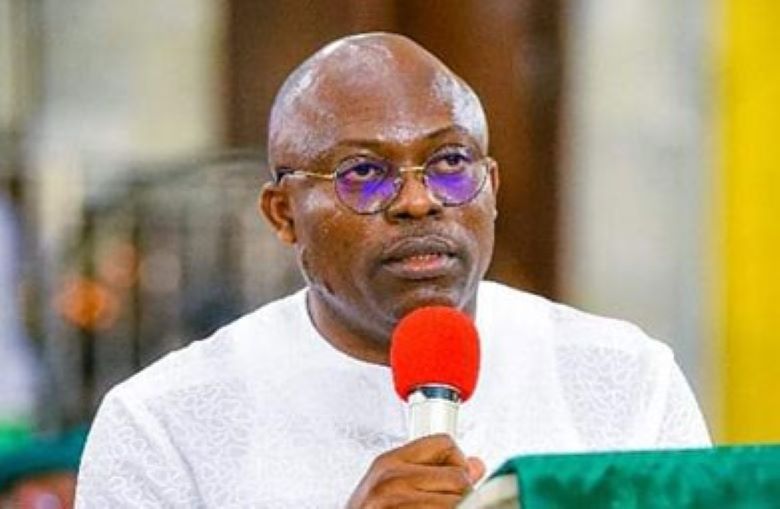
There was a time Governor Siminalayi Fubara inspired admiration, even from those of us who had nothing to gain by supporting him. At the height of his bitter feud with Nyesom Wike, many of us stood with Fubara, not because he was flawless, but because principle demanded it. He appeared cornered, embattled, and unfairly treated by a political godfather whose shadow loomed too large. In moments like that, neutrality feels like cowardice, and silence like consent. So, we spoke. We defended him, we believed.
But belief, like trust in literature, is a fragile thing. Once broken, it never returns whole. Politics, also like literature, often thrives on irony. And the irony of Sim Fubara today is both tragic and unsettling.
Today, watching Governor Fubara speak since his defection to the APC feels like rereading a familiar novel whose final chapters have been clumsily rewritten by a different author. The prose no longer flows, and the character arc no longer makes sense.
Recently, the governor was reported to have said, almost flippantly that he was never a member of the PDP. One pauses here, the way a careful reader pauses at a sentence that threatens to collapse the entire plot. If that statement is taken seriously, then its implications are grave. It suggests that he contested and won the governorship election on a platform he never belonged to. Was he, then, an independent candidate in disguise? Or a guest actor who somehow became the lead? And how does one reconcile that claim with his visible presence at PDP governors’ meetings? In fact, the Governors’ forum took a side with him, against Nyesom.
His public utterances have become deeply concerning, less the measured voice of a state chief executive and more the excitable chatter of a political neophyte newly admitted into the corridors of power. One begins to wonder where the gravitas went.
Words matter. Chinua Achebe once warned that “the trouble with Nigeria is simply and squarely a failure of leadership.” That failure often begins with careless words, uttered without regard for consequence, memory, or truth.
Since crossing over to the APC, the governor’s rhetoric has become disturbingly repetitive and excessively reverential. Every road now leads to Tinubu. Every sentence genuflects. Every success is traced back to Tinubu. Every breath seems borrowed from Tinubu. One almost expects, any day now, a declaration of political salvation, Tinubu as “personal Lord and Saviour.” Loyalty should never degenerate into worship, but in this telling, it has crossed the thin line into reverence.
This is not gratitude, this is grovelling.
It is embarrassing to watch a sitting governor reduce his own office to an echo chamber of presidential praise. Even more so when one remembers that this same man once spoke, during the emergency period, of a spirit that had “left the Government House,” of an indifference to returning. Now, restored, he behaves like a child whose confiscated bread has just been returned – giddy, noisy, and desperate to please.
For the sake of clarity, there is nothing wrong with joining the APC. Politics allows movement; democracy presumes choice. Political realignment is his constitutional right. There is nothing wrong with thanking the president either. Courtesy is not a crime, but when every sentence becomes an act of self-erasure, when a governor speaks like a subordinate desperate for validation, something has gone terribly wrong.
Other governors have defected. They did not lose their voices, or their dignity. They faced their jobs squarely, without turning public office into a loyalty parade. Fubara, by contrast, speaks as though he would rather be appointed at the villa, polishing shoes, ironing clothes, and clapping on cue, than governing a state with history, problems, and people.
And that is the tragedy. Because many admired him. From afar, yes, but sincerely. Today, those admirers wince each time he speaks, embarrassed by platitudes that sound less like statesmanship and more like servitude. A governor is not a houseboy. Loyalty does not require self-abasement. Respect is not earned by kneeling too long. Governors can be loyal without being slavish, they can be grateful without losing dignity, they can support a president without surrendering their voices.
Of course, his cheering orchestra will not tell him this. Courtiers rarely speak truth to power. But literature reminds us, again and again, that leaders fall not only because of enemies, but because of sycophants who clap them into ruin.
Yet, perhaps the deepest fault here is not entirely Fubara’s.
The real villain may be Nigeria’s peculiar democracy, where the president is the alpha and omega; where decrees travel faster than debate; where institutions bow reflexively; where the National Assembly dances to the executive’s tune; where even the highest court affirms that a president may, by emergency declaration, sweep aside elected governors. In such a system, survival often masquerades as loyalty, and fear frequently dresses up as praise.
So, maybe this is not just a new Fubara. Maybe this is what power does to men when democracy is weak and presidency is absolute. Still, even within a flawed democracy, character matters, words matter, and dignity matters.
History judges individuals, not excuses. It is not kind to leaders who forget who they were simply to remain where they are. And power, as literature has taught us time and again, does not only test loyalty, it exposes the soul.
I will reread the chapters, Fubara before the emergency rule, and Fubara after his political rebirth. But one lesson is already clear, never trust politicians by their words alone. Watch their actions, and listen for consistency. Character, like good literature, reveals itself over time.
And right now, this story is losing its readers.
—-
John Oyebanji is a Public Affairs Analyst, Media/PR Specialist, and Educational Administrator, among many other things he represents. He writes from Modakeke, Osun State, and can be reached via +2349032201075, thejohnoyebanji@gmail.com