Africa
Journalism Is Not For The Untrained: Stop Undermining A Noble Profession -By Isaac Asabor
My friend thought he had the authority to correct what he perceived as poor grammar in a newspaper headline. His argument, with an air of superiority, was that journalists were misusing the English language and were often guilty of writing in a manner that betrays academic standards. Despite his resort to scoffing Journalists and their profession which I belongs, I listened patiently, but when he concluded his monologue with a dismissive chuckle about journalism being “too basic,” I had to draw the line. I looked him straight in the eye and said, “No way.”

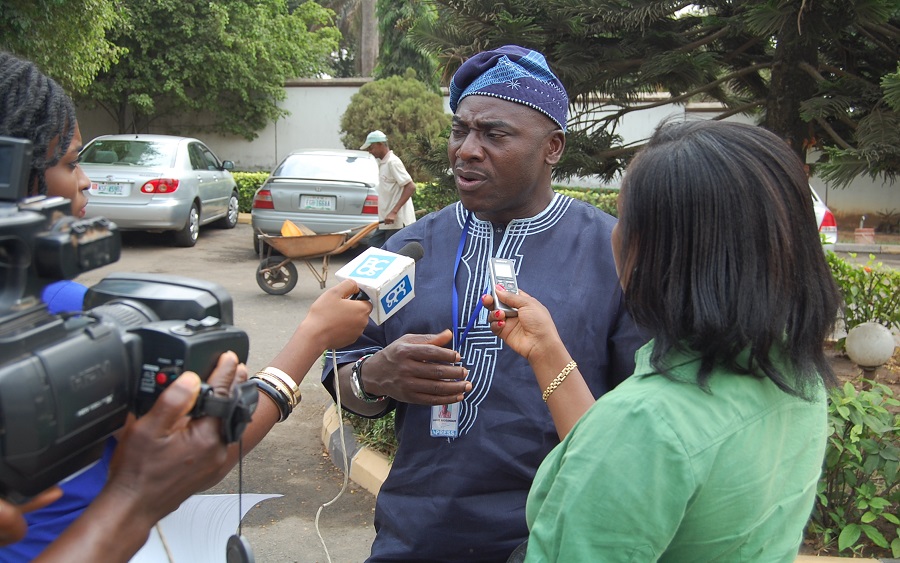
Recently, a friend of mine who I always doff my hats for as a result of his brilliance took a swipe at the Journalism profession and Journalists to my displeasure. My disapproval with him started when he asked, “Why do most Journalists write something like “The Minister Felicitates Muslims On Eid-el-Kabir instead of “The Minister Felicitates with Muslims On Eid-el-Kabir”?
He explained that the correct phrase is “Felicitates with Muslims”, to which I agreed with him as “Felicitates” is a transitive verb, meaning it usually requires an object.
I concurred with him against the backdrop of the understanding that when you say someone “felicitates with” a group, you are expressing shared joy or congratulatory sentiments alongside them, commonly used for celebrations or religious observances. For examples, “The president felicitates with Muslims on the occasion of Eid-el-Kabir”, “The governor felicitated with Christians during Christmas celebrations”. So, grammatically, it is “felicitates with Muslims,” not just “felicitates Muslims.”
Again, there is another Journalese (Words and phrases that are typically used by journalists to describe events or people, notwithstanding that It has become a common, yet disturbing trend in recent times to find people from various professions and walks of life openly disparaging journalists and the art of journalism. The thinking seems to be: if you can write, then you can be a journalist. Worse still, those who are eloquent or have good command of English feel they are in a position to lecture journalists on how they should write, structure their sentences, or even cast their headlines. This warped assumption is not only intellectually dishonest, but it is also a dangerous erosion of respect for a profession that plays a pivotal role in any democratic society.
My friend thought he had the authority to correct what he perceived as poor grammar in a newspaper headline. His argument, with an air of superiority, was that journalists were misusing the English language and were often guilty of writing in a manner that betrays academic standards. Despite his resort to scoffing Journalists and their profession which I belongs, I listened patiently, but when he concluded his monologue with a dismissive chuckle about journalism being “too basic,” I had to draw the line. I looked him straight in the eye and said, “No way.”
What many people, including PhD holders, fail to understand is that journalism is not just about stringing words together in grammatically correct sentences. It is not an extension of essay writing or a glorified version of letter composition. Journalism is a profession, a craft, and a discipline. It has its own codes, demands, constraints, and professional language, just like law, medicine, or engineering. The term Journalese exists for a reason, it is the unique style of writing adapted specifically for news reporting, designed to communicate facts clearly, quickly, and efficiently to the public.
In fact, there are key differences between what lawyers refer to as Legalese and what journalists call Journalese. Legalese is often packed with complex clauses, Latin phrases, and technical jargon, meant to leave no room for ambiguity, especially in legal arguments and contracts. Journalese, on the other hand, is sharp, lean, and stripped of unnecessary embellishment. It prioritizes clarity, brevity, and immediacy. It is not trying to win literary awards; it is trying to inform the public and hold power to account.
Yet, people who are good at writing compositions, often those with academic backgrounds, mistakenly believe they are superior in their use of language. They feel entitled to critique news stories based solely on grammar or literary standards, not realizing that journalists write within constraints that demand space economy, time sensitivity, readability, and headline impact. A news headline like “Senate slashes budget” is not lazy writing; it is an intentional condensation designed for immediate comprehension.
If journalism were as cheap or effortless as many believe, why then do people spend years in universities studying Mass Communication and Journalism? Why do we have diploma programs, undergraduate degrees, and postgraduate qualifications in journalism across the world? Are all these institutions and degrees a waste of time? The answer is a resounding capital NO. Journalism schools train students in the nuances of media law, investigative techniques, ethics, communication theory, news judgment, public affairs reporting, and more. The training is rigorous because the responsibility is enormous. Journalists are expected to not just write, but to write responsibly, ethically, and accurately.
Furthermore, journalism enhances public media literacy. By simplifying complex topics and breaking them down for mass understanding, journalists serve as educators in their own right. A report on the national budget, for instance, must explain economic concepts in a way that a market woman, a university student, and a civil servant can all understand. That is not simplification; that is skilled communication. In this role, journalists become bridges between technical subjects and everyday understanding.
There are also numerous examples of educational journalism, a subfield that focuses specifically on informing the public about scientific discoveries, civic responsibilities, health guidelines, and social issues. During the COVID-19 pandemic, for example, journalists played a crucial role in disseminating factual, science-based information that saved lives. They collaborated with health experts to break down scientific jargon into plain language for millions of people to grasp and act upon. That is journalism at its most impactful.
The impact of headline style on audience understanding is also grossly underestimated by journalism critics. A well-crafted headline is not only a summary, it is an entry point. In an age of information overload, headlines must compete for attention in milliseconds. If a headline is dull or too complex, the article beneath it will never be read. That is why journalists are trained to write leads and heads that hook, hold, and inform, all within character limits. This is not a lack of skill; it is the mark of a trained professional.
Yet, despite all these realities, journalism remains one of the most misunderstood professions. Because everyone writes something, whether emails, essays, or social media posts, many people assume they understand journalism. They do not. It is the same way watching courtroom drama does not make you a lawyer, or watching Grey’s Anatomy does not make you a surgeon. Journalism is guided by editorial standards, legal boundaries, ethical codes, and public accountability.
As journalists, we must stop accepting casual disrespect in silence. We must educate the public, gently but firmly, that journalistic writing is deliberate, not defective. When people try to correct us based on their own limited understanding of language or grammar, we must be confident enough to defend our craft. Our headlines are not mistakes. Our language is not broken. Our profession is not a joke.
In fact, not only are journalists’ reportages frequently critiqued, but the profession itself is often treated with thinly veiled disdain. A major reason for this lack of respect is the poor remuneration that plagues the industry, giving outsiders the impression that journalism is a fallback career or a hustle rather than a respected vocation. Worse still, the stigma of “brown envelope journalism”, a reference to unethical practices where reporters are allegedly induced financially to write favorably, has unfairly tainted the public’s perception of the entire profession. While it is true that no field is without its bad eggs, it is grossly unjust to dismiss the integrity and dedication of the many hardworking journalists who risk their lives and careers daily to bring truth to light. This misplaced contempt feeds the narrative that journalism is a lesser calling, when in truth, it is one of the most essential pillars of a democratic society.
So the next time someone with a degree in literature or law tries to explain how a headline should be written, remind them that every profession has its own language, and journalism is no exception. Remind them that if it were so easy, they would be in the newsroom and not in their lecture halls or courtrooms. And above all, remind them that journalism, for all its stylistic peculiarities, remains a cornerstone of any functioning society.
In fact, it is our collective responsibility as Journalists to tell non-Journalists that Journalism Is not for the untrained, and that they should stop Undermining the noble profession.