
Africa
Like Him or Not, Wike Said What Most Leaders Won’t—Nigeria’s Broken Dream Called Out at Obafemi Awolowo University -By John Egbeazien Oshodi
The lecture delivered by Nyesom Wike was more than a ceremonial address—it was a moment of rare alignment, where message and moment, vision and venue, leadership and legacy briefly converged. For a man often known more for political warfare than philosophical clarity, this was an unexpected unveiling of deeper reflection. His closing words struck a national chord: “Let it be said that we gathered here not to mourn what Nigeria has become, but to proclaim what Nigeria must be.”

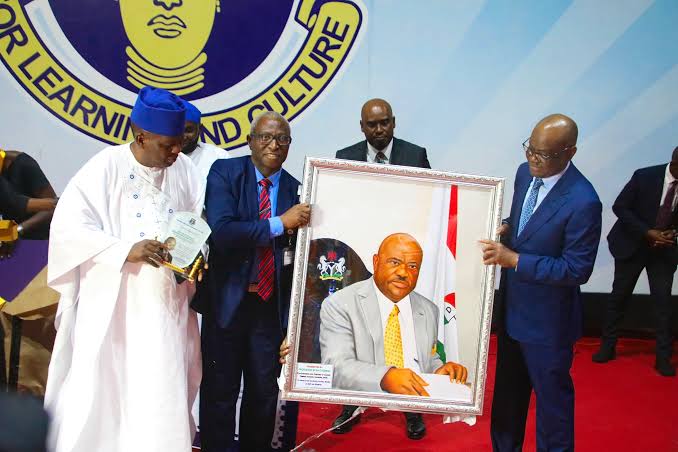
When the Bulldozer Paused to Build
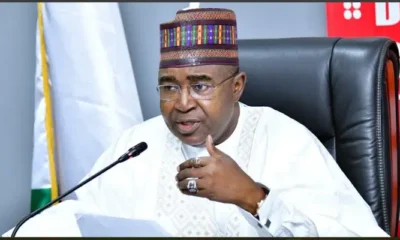
Nyesom Wike is a towering figure in Nigeria’s political arena, well known for his fiery temperament, combative rhetoric, and unwavering resolve in navigating the levers of power. Often associated with raw political might and hardline governance, Wike is not easily linked with reflective national vision. Yet, on June 5, 2025, inside the historic Oduduwa Hall of Obafemi Awolowo University (OAU), Ile-Ife, Wike surprised many. He did not come to defend political turf or escalate rivalries; instead, he delivered a deeply thought-provoking lecture titled, “The Nigeria of Our Dreams.” The moment was transformative. Here stood a man long defined by confrontation, now advocating for conscience. For once, Wike used his voice not to overwhelm, but to awaken.
A Stage of Legacy and Authority
The gravity of the moment was not accidental. This was the first Distinguished Personality Lecture in OAU’s 63-year history. That the university chose Wike for such a symbolic honor spoke volumes. It was a gesture of institutional respect, not for political polish, but for impactful performance. Vice-Chancellor Prof. Adebayo Bamire acknowledged Wike as “a pragmatic and result-driven public servant.” He praised the minister’s transformative work in the Federal Capital Territory, citing bold urban renewal initiatives, road network expansions, and efforts to restore dignity to Abuja’s physical and administrative environment. “We have tasted your work in Abuja,” Prof. Bamire said pointedly. “We would love to experience such impact here at OAU.” It was both a compliment and a challenge—an academic institution extending a hand for practical collaboration.
A Complex Figure: The Man Who Collects Debts
Pro-Chancellor Prof. Siyan Oyeweso, renowned for his historical acuity, added a sharper lens. Describing Wike as “the man who knows how to collect debt from debtors,” he painted the minister not just as an enforcer, but as a symbol of accountability in a system where consequences are often absent. “In no distant time from now,” Oyeweso said, “people will be studying Wike’s brand of politics.” The statement was prophetic. Wike is already a case study in contrast—a populist who delivers infrastructure, a combatant who speaks like a statesman when the moment demands, a power-broker whose political realism is now evolving into public philosophy.
The Ooni’s Blessing: Cultural Reverence for Merit
The presence and remarks of the Ooni of Ife, His Imperial Majesty Adeyeye Ogunwusi, added cultural and ancestral legitimacy to the moment. “Wike is one politician that must be studied,” the Ooni said, emphasizing his uniqueness in Nigeria’s contemporary political structure. The royal father commended President Tinubu for appointing Wike despite party differences, signaling a cultural call to national meritocracy. It was a statement laced with spiritual insight: leadership must transcend political coloration if Nigeria is to move forward. In a time when tribalism and partisanship dominate discourse, the Ooni’s words were a timely cultural antidote.
Wike’s Boldest Truths: Naming the National Rot
Wike did not come to perform—he came to provoke. And in doing so, he forced a mirror before the nation. His lecture was not a self-congratulatory sermon, but a piercing diagnosis of Nigeria’s moral, spiritual, and institutional decay.
“We now live in a country where corruption is culture, where stolen wealth is praised even from religious altars,” he declared. These were not just words—they were a searing moral indictment. With that statement, he shattered the polished silence of complicity that so often surrounds Nigeria’s ruling elite.
But Wike did not stop there
“The Nigeria we see today is not the Nigeria we dreamt of,” he continued. In that sentence, he gave voice to a generational disillusionment—a psychological wound felt by young and old alike, those who grew up believing in a nation that now feels alien.
Most strikingly, he turned his fire on the very institutions once seen as moral compasses.
“Both churches and mosques are now platforms where questionable wealth is sanctified, and moral decay is baptized as divine favor,” Wike charged. This was not a passing comment; it was a direct rebuke of religious bodies that have, in his view, traded their ethical duty for political and financial relevance.
From the devaluation of the Nigerian passport to the public celebration of impunity, Wike painted the picture of a nation adrift—one where power is performative and conscience is comatose. And yet, amid the wreckage, he offered a sliver of hope:
“The dream is not dead; it merely sleeps, waiting for those bold enough to awaken it.”
Eleven Pillars for National Redemption
To awaken that dream, Wike offered a practical and philosophical framework—his Eleven Pillars for National Renewal. They included: 1) Purposeful leadership grounded in service, 2) Infrastructure as the architecture of equality, 3) Education as the bedrock of national justice, 4) Cultural renaissance to reclaim moral compass, 5) Youth inclusion as a development strategy, 6) Security as a foundational right, 7) Ethnic dialogue to rebuild fractured trust, 8) Economic innovation beyond dependency on oil, 9) Ethical civil service reform, 10) Courageous and independent judiciary, and 11) Spiritual accountability, particularly targeting religious hypocrisy. This was not policy tokenism—it was a rethinking of the Nigerian condition from structural, ethical, and psychological dimensions.
The Weight of Experience: Wike’s Performance as Proof
Wike did not simply theorize. He backed every vision with proof of prior action. From his record as governor of Rivers State to his ongoing transformation of the FCT, he made it clear: “I did not come here to dream alone. I came to show that dreams are built with bulldozers, with laws, with budgets, and with sweat.” His critics often cite his aggressiveness, but even they cannot ignore his outcomes. He reminded the audience that leadership is not about perfection, but delivery. And in a system fatigued by recycled rhetoric, his emphasis on visible results was both refreshing and necessary.
A Call to the Youth: Beyond Clapping, Into Action
Perhaps the most powerful section of his speech was his address to students. “You cannot complain about Nigeria and then refuse to vote, refuse to serve, or refuse to confront injustice,” he said. In that one sentence, Wike channeled the frustrations of an entire generation, but also turned the mirror on them. He called for action over apathy, for civic courage over online commentary. It was an urgent plea not for blind patriotism, but for informed citizenship. In a country with a massive youth population yet low political engagement, this message was a necessary psychological intervention.
OAU as a Living Laboratory for Governance
Vice-Chancellor Bamire proposed something profound in the aftermath of the lecture—the creation of a Centre for Good Governance and Youth Leadership. This was more than an appeal for infrastructure; it was a proposal for intellectual partnership. OAU, long known as a cradle of resistance and conscience, now has the opportunity to institutionalize governance education as a national priority. The proposed center would be a bridge between theory and action, between ideals and implementation. Let it be established not just as a tribute to a day, but as a seedbed for the next generation of ethical leaders.
Final Reflections: A Moment of Alignment
The lecture delivered by Nyesom Wike was more than a ceremonial address—it was a moment of rare alignment, where message and moment, vision and venue, leadership and legacy briefly converged. For a man often known more for political warfare than philosophical clarity, this was an unexpected unveiling of deeper reflection. His closing words struck a national chord: “Let it be said that we gathered here not to mourn what Nigeria has become, but to proclaim what Nigeria must be.”
Wike did well—very well—telling the naked truth about bad leaders, deep-seated corruption, and the unbearable pain of Nigeria’s poor. He named what many fear to name. He described a country bleeding beneath the weight of betrayal. And for once, the applause was not just loud—it was deserved.
But here lies the tension: Nigerians applauded not just because of what was said, but because of what they hope it might mean. They listened not only as an audience—but as witnesses. And now, they hope, they pray, that Wike himself will begin to live the very truth he so eloquently delivered. Because it is one thing to speak against the rot—it is another to step away from it.
The words were powerful. The truth was unfiltered. The delivery was masterful. May God give him good health and long life—to live long enough not just to speak these truths, but to embody them.
Only then will the applause remain truly earned.
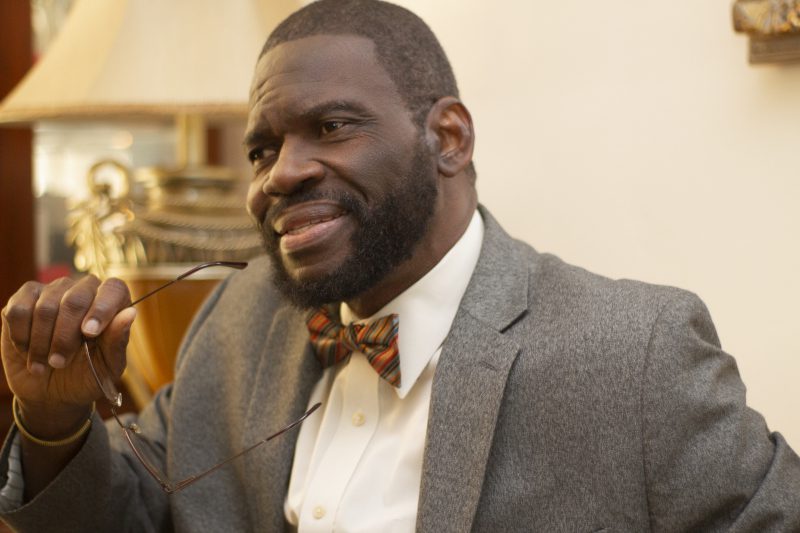
Psychologist John Egbeazien Oshodi
Professor John Egbeazien Oshodi is an American psychologist, educator, and author specializing in forensic, legal, and clinical psychology, cross-cultural psychology, police and prison sciences, and community justice. Born in Uromi, Edo State, Nigeria, he is the son of a 37-year veteran of the Nigeria Police Force—an experience that shaped his enduring commitment to justice, security, and psychological reform.
A pioneer in the field, he introduced state-of-the-art forensic psychology to Nigeria in 2011 through the National Universities Commission and Nasarawa State University, where he served as Associate Professor in the Department of Psychology. His contributions extend beyond academia through the Oshodi Foundation and the Center for Psychological and Forensic Services, advancing mental health, behavioral reform, and institutional transformation.
Professor Oshodi has held faculty positions at Florida Memorial University, Florida International University, Broward College, where he also served as Assistant Professor and Interim Associate Dean, Nova Southeastern University, and Lynn University. He is currently a contributing faculty member at Walden University and a virtual professor with Weldios University and ISCOM University.
In the United States, he serves as a government consultant in forensic-clinical psychology, offering expertise in mental health, behavioral analysis, and institutional evaluation. He is also the founder of Psychoafricalysis, a theoretical framework that integrates African sociocultural dynamics into modern psychology.
A proud Black Republican, Professor Oshodi advocates for individual empowerment, ethical leadership, and institutional integrity. His work focuses on promoting functional governance and sustainable development across Africa.





















You must be logged in to post a comment Login