
Forgotten Dairies
No Profession Is Safe: AI Will Replace Millions Faster Than You Think: Fear, Survival, and the Reshaped Future of Human Work -By Daniel Nduka Okonkwo
The central question is no longer whether AI will transform society because that transformation is already underway. The real question is whether governments, corporations, and workers can adapt quickly enough to ensure that the benefits of AI are shared fairly rather than concentrated in the hands of a few powerful institutions.

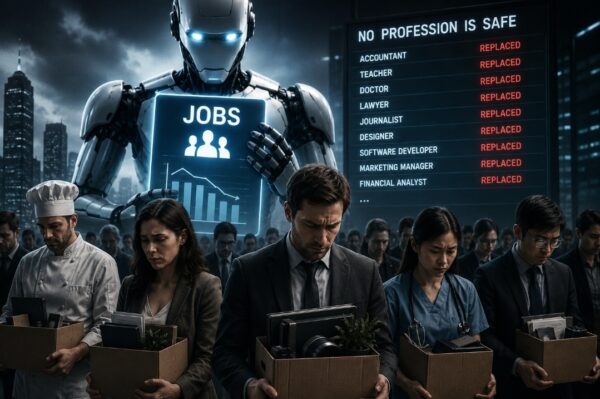
Artificial Intelligence (AI) is rapidly transforming the foundations of modern labor. Defined as a branch of computer science that enables machines to simulate human intelligence through learning, reasoning, problem-solving, and decision-making, AI is no longer a futuristic concept but a present reality. Across the globe, this innovation is sparking both excitement and anxiety. Tech visionaries like Bill Gates imagine a world of abundant leisure, where AI drives productivity to such heights that goods become cheaper and workweeks shrink. Yet workers and labor unions warn of displacement, wage stagnation, and the psychological strain of competing with machines.
Africa, standing at the frontier of development, cannot afford to remain a passive observer in this revolution. The continent must do everything possible to integrate AI into its systems, industries, and governance. To resist is to risk irrelevance; to embrace is to unlock unprecedented opportunities. In today’s economy, refusing to incorporate AI is not merely hesitation. It is a direct path toward obsolescence. If this transformation is neglected, many jobs may eventually disappear under the pressure of technological progress.
Meanwhile, legal systems worldwide are beginning to push back against unchecked automation. Courts in China, regulators in the European Union, and labor authorities in the United States are drawing boundaries to ensure that workers are not sacrificed in the pursuit of corporate efficiency. This signals a future shaped not by total automation or absolute restriction, but by compromise, where AI augments human labor and laws evolve to ensure that productivity gains are shared more fairly.
The global rise of Artificial Intelligence has triggered one of the most significant technological transformations in modern history. Across industries, governments, and households, AI is quietly reshaping how people work, communicate, travel, learn, and even survive. Yet beneath the excitement surrounding this technological revolution lies a growing global debate: will AI empower humanity or gradually replace it?
From Silicon Valley to Beijing, from African tech hubs to European regulatory chambers, the world is witnessing a collision between rapid innovation and the urgent need to protect human labor. Tech visionaries such as Bill Gates envision a future where AI handles repetitive and complex tasks, reducing human workloads and creating what some describe as a “free intelligence” society. In that future, productivity could become so efficient that goods and services grow cheaper while humans enjoy shorter workweeks and more leisure time.
However, workers, labor unions, and economists increasingly question whether society is prepared for the social and economic consequences of such a transformation. Concerns over job displacement, wage stagnation, economic inequality, and psychological pressure continue to intensify as corporations adopt automation at an unprecedented pace.
Artificial Intelligence, a branch of computer science designed to simulate human intelligence, enables machines to learn, reason, solve problems, recognize patterns, and make decisions using data rather than rigid programming. Unlike traditional software that follows fixed “if-this-then-that” instructions, AI adapts and improves over time through machine learning and continuous exposure to information.
Today, AI already powers much of daily life. Virtual assistants such as Siri, Alexa, and Google Assistant use Natural Language Processing (NLP) to interpret voice commands. Streaming platforms like Netflix, YouTube, and Spotify rely on AI algorithms to recommend personalized content, while social media feeds on Instagram and TikTok are curated through machine-learning systems designed to maximize engagement. Navigation platforms analyze real-time traffic data to recommend faster travel routes, and generative AI tools such as ChatGPT, Claude, and DALL·E can now produce text, code, and images within seconds.
Yet as AI becomes more integrated into society, major corporations are increasingly using it to reduce operational costs and streamline labor-intensive processes. In some industries, automation has already reduced workloads dramatically, replacing repetitive human tasks with algorithms capable of operating continuously without fatigue.
This growing dependence on AI has sparked legal and political reactions around the world.
A notable example emerged in China, where the Hangzhou Intermediate People’s Court reportedly ruled that businesses could not use AI implementation as a loophole to evade labor obligations or unfairly terminate workers. The judgment reinforced the principle that adopting AI is a voluntary business decision, meaning companies must also bear the financial and operational consequences rather than shifting the burden entirely onto employees.
Globally, governments are beginning to establish regulatory frameworks to manage AI’s influence on employment. The European Union has introduced the landmark AI Act, which places strict regulations on high-risk AI systems used in recruitment and workplace management, emphasizing transparency and human oversight. In the United States, labor authorities have intensified scrutiny of algorithmic management systems, particularly regarding worker surveillance, union activities, and automated decision-making.
Despite growing fears, AI is not necessarily replacing entire professions overnight. Instead, it is gradually automating specific tasks within jobs. Data entry, report generation, scheduling, customer service inquiries, boilerplate programming, and repetitive administrative duties are increasingly handled by AI systems capable of operating at extraordinary speed.
For now, AI often functions more as a “co-pilot” than a total replacement. It allows humans to focus on higher-level responsibilities requiring creativity, emotional intelligence, negotiation, leadership, ethics, and strategic thinking. However, many experts believe this balance may not remain stable indefinitely.
Military operations are already incorporating AI-driven systems, while countries such as China have experimented with AI-powered robots for traffic control and public operations. The rapid development of humanoid robotics has intensified speculation about whether machines could eventually perform not only intellectual labor but also physical work traditionally considered resistant to automation.
Professions involving manual dexterity and unpredictable environments, including plumbing, electrical work, and technical repairs, were once viewed as relatively safe from AI disruption. Yet advances in robotics and machine perception are beginning to challenge those assumptions. Some analysts argue that once AI-powered androids achieve more refined movement, environmental awareness, and independent reasoning, even physically demanding occupations could face automation pressures.
At the center of this debate lies a broader philosophical concern: what becomes of human identity and economic survival in a world where machines outperform people in both mental and physical tasks?
Some experts warn that everything humanity has built, including careers, industries, and economic systems, could fundamentally transform if societies fail to adapt quickly enough to AI’s rapid growth. Others argue that resisting technological progress is unrealistic and that adaptation is the wiser strategy.
Increasingly, professionals are learning to integrate AI into their workflows rather than compete directly against it. Prompt engineering, AI-assisted research, automation management, and hybrid human-AI collaboration are emerging as valuable skills in the modern labor market.
Analysts suggest that workers who focus on uniquely human strengths may remain more resilient in the coming decades. Skills such as cross-cultural communication, empathy, negotiation, leadership, ethical judgment, and highly specialized expertise continue to be areas where human capability retains an advantage over current AI systems.
At the same time, AI itself remains deeply imperfect. AI systems are trained on historical datasets that often contain human biases, meaning algorithms can unintentionally reproduce discrimination or inaccurate conclusions. Generative AI tools are also known to produce false or misleading information, commonly referred to as “hallucinations,” despite presenting responses confidently. Concerns surrounding privacy, surveillance, misinformation, and algorithmic accountability continue to grow as AI expands into critical sectors.
Nowhere is AI’s transformative potential more visible than in medicine.
AI-powered systems can analyze X-rays, MRIs, and CT scans with remarkable speed and precision, helping clinicians detect diseases such as cancer and cardiovascular conditions earlier than traditional diagnostic methods. Algorithms are increasingly capable of identifying microscopic abnormalities that human eyes might overlook.
AI is also accelerating drug discovery by helping researchers predict how chemical compounds may interact with diseases while reducing the time and cost associated with pharmaceutical development. In hospitals, AI systems assist with administrative documentation, patient triage, and predictive monitoring, allowing medical professionals to devote more attention to direct patient care.
Personalized medicine has similarly advanced through AI’s ability to analyze genetic information and patient histories, enabling more tailored treatment strategies. Yet healthcare professionals continue to stress that human oversight remains essential because of ethical concerns, diagnostic risks, and data privacy challenges.
Across the continent, AI-powered mobile applications are helping smallholder farmers predict weather conditions, optimize irrigation, and identify crop diseases through smartphone imaging tools. African technology startups are developing localized solutions to address healthcare shortages, infrastructure limitations, and agricultural inefficiencies.
In Ghana, companies such as MinoHealth AI Labs are using AI-assisted diagnostic systems to accelerate medical imaging analysis. Drone technologies powered by AI are also being used to deliver essential medical supplies to remote communities with limited infrastructure access.
However, Africa faces unique challenges in the global AI race.
Many dominant AI systems are trained primarily on Western languages and datasets, limiting their effectiveness in African linguistic and cultural contexts. In response, researchers and developers are increasingly embracing what is known as “Frugal AI,” smaller and more specialized AI systems designed to function efficiently within low-bandwidth environments while supporting local languages and regional realities.
The continent’s focus is gradually shifting from merely importing foreign AI systems to building technologies specifically designed for Africa’s rapidly evolving economies and social structures.
Artificial Intelligence can generally be categorized into four major types: Reactive Machines, Limited Memory AI, Theory of Mind AI, and Self-Aware AI. While Reactive and Limited Memory systems already exist and dominate current applications, Theory of Mind and Self-Aware AI remain theoretical concepts that raise profound ethical and existential questions about machine consciousness and autonomy.
Ultimately, the future of AI may not result in either total human replacement or complete resistance to automation. Instead, the world appears headed toward a heavily regulated compromise in which humans and machines coexist within evolving economic structures.
The central question is no longer whether AI will transform society because that transformation is already underway. The real question is whether governments, corporations, and workers can adapt quickly enough to ensure that the benefits of AI are shared fairly rather than concentrated in the hands of a few powerful institutions.
In the end, humanity may discover that survival in the age of Artificial Intelligence will depend not on competing with machines, but on redefining what it truly means to be human.
Daniel Nduka Okonkwo is a Nigerian investigative journalist, publisher of Profiles International Human Rights Advocate, and a policy analyst whose work focuses on governance, institutional accountability, and political power. He is also a human rights activist and advocate, with a strong commitment to justice and transparency.
His reporting and analysis have been featured in Sahara Reporters, African Defence Forum, Daily Intel Newspapers, Opinion Nigeria, African Angle, NewsBreak (local.newsbreak.com), Vanguard Newspaper, Daily Trust Newspapers, and other international media platforms.
He writes from Nigeria and can be reached at dan.okonkwo.73@gmail.com.




























You must be logged in to post a comment Login