Forgotten Dairies
Portable Vs Okocha: When Celebrity Boxing Turned ‘Yeyebrity’ -By Isaac Asabor
The lesson from the Portable-Okocha encounter is therefore unmistakable. Nigeria can build a vibrant celebrity boxing industry capable of attracting international recognition, commercial investment and public admiration. But that future will not be secured through rowdiness masquerading as entertainment or wrestling presented as boxing.

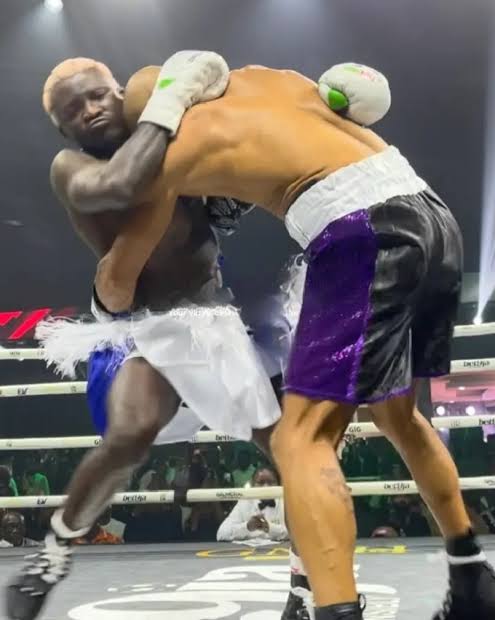
There is a world of difference between “celebrity” and “yeyebrity.” One evokes class, influence and admirable public appeal; the other, in Nigerian street parlance, describes behaviour that is loud, crude, disorderly and devoid of decorum. Sadly, anyone who watched the recent celebrity boxing rematch between Portable and Charles Okocha would be forgiven for concluding that what was advertised as celebrity boxing ultimately degenerated into “yeyebrity.”
That is unfortunate because celebrity boxing is a concept that deserves to succeed in Nigeria. Across the world, celebrity boxing has become a thriving sports entertainment business. Musicians, actors, influencers and former athletes step into the ring, not merely to exchange punches, but to entertain within the framework of a regulated sport. While the contests may not attain the technical brilliance of championship boxing, they still respect the rules, uphold sportsmanship and preserve the integrity of the game. That is precisely where the Portable-Okocha encounter fell short.
From the opening exchanges, the contest appeared less like a boxing match and more like an emotional confrontation struggling to disguise itself as sport. Instead of calculated punches, defensive movements and ring intelligence, spectators witnessed excessive grappling, clinching, pushing, wrestling and uncontrolled aggression. At several points, the distinction between boxing and a street fight became increasingly blurred. One was left wondering whether the participants came to compete or merely to settle personal scores.
The beauty of boxing lies not in violence but in discipline. Contrary to popular assumption, boxing is not about throwing the wildest punches or displaying the loudest bravado. It is a sport built on timing, balance, footwork, precision, defence, endurance and emotional control. The greatest boxers in history earned respect not because they fought recklessly but because they mastered the art of controlled aggression.
That fundamental lesson appeared to be absent throughout much of the contest. Celebrity boxing should never become an excuse for organized disorder. If anything, celebrities entering the ring should inspire greater professionalism because millions of impressionable fans are watching. Every contest sends a message about what boxing represents. When those contests descend into chaos, the sport itself suffers reputational damage.
Indeed, the greatest casualty of the Portable-Okocha spectacle was not either contestant. It was the image of celebrity boxing in Nigeria. Many Nigerians who watched the event for the first time may now wrongly assume that celebrity boxing is nothing more than a noisy exhibition where rules exist only in theory. That perception is dangerous because it undermines years of efforts by genuine boxing stakeholders striving to grow the sport.
This is particularly disappointing because celebrity boxing holds enormous promise. It has the potential to attract sponsors, television audiences, tourism, youth participation and fresh commercial opportunities for boxing promoters. It can introduce younger audiences to a sport that has produced legendary Nigerian champions and inspire future generations of disciplined athletes. But none of these possibilities can be realized if organizers continue to confuse controversy with credibility.
There is an unfortunate tendency within parts of Nigeria’s entertainment industry to equate chaos with success. Once videos trend on social media, some promoters assume the objective has been achieved. It is a dangerous mindset. Viral moments generate temporary attention; professionalism builds enduring institutions.
The Portable-Okocha bout certainly dominated conversations across social media platforms. Clips circulated widely. Arguments erupted online. Memes flooded the internet. But popularity should never be mistaken for quality.
History remembers sporting excellence far longer than it remembers viral disorder. The organizers also have serious questions to answer. Celebrity boxing cannot continue to rely solely on celebrity names while paying insufficient attention to technical preparation and strict officiating. Every participant must undergo adequate boxing training before entering the ring. Referees must be empowered to enforce the rules firmly without fear or favour. Promoters must understand that entertainment reaches its highest value when supported by professionalism.
Regulatory authorities equally have an important responsibility. Any event presented as boxing should comply with accepted boxing standards. Medical protocols, competent officiating, safety measures and disciplinary mechanisms should never be compromised simply because the contestants are entertainers rather than professional fighters. Otherwise, the line separating boxing from an unruly brawl becomes dangerously thin.
The totality of the views expressed in the foregoing paragraphs are not to suggest that celebrity boxing should lose its entertainment appeal. On the contrary, colourful personalities, lively weigh-ins, dramatic entrances and verbal exchanges are all part of the attraction. Fans expect excitement, humour and theatrics. Those elements enrich the spectacle. But the theatrics must end the moment the opening bell sounds.
Once inside the ropes, every contestant should submit to the discipline of the sport. The boxing ring is not a theatre for uncontrolled rage. Neither is it a wrestling arena. It is certainly not a venue for settling personal grudges under the guise of sporting competition.
The Portable-Okocha rematch should therefore serve as a turning point rather than a template. If Nigerian celebrity boxing is to earn lasting respect, it must distance itself from disorder and embrace the values that have made boxing one of the world’s most respected combat sports.
Celebrity boxing must never become synonymous with “yeyebrity.” The distinction matters because credibility, once lost, is difficult to regain.
The lesson from the Portable-Okocha encounter is therefore unmistakable. Nigeria can build a vibrant celebrity boxing industry capable of attracting international recognition, commercial investment and public admiration. But that future will not be secured through rowdiness masquerading as entertainment or wrestling presented as boxing.
The choice before promoters, regulators and participants is simple. They can elevate celebrity boxing into a respected sporting enterprise or reduce it to an annual carnival of chaos.
If they choose the latter, they should stop calling it celebrity boxing. They should simply admit that what Nigerians are being offered is “yeyebrity.”
For the sake of boxing, one hopes wisdom prevails before the next bell rings.