Forgotten Dairies
Who Will Tell Omokri That Survival Is Not Living? -By Isaac Asabor
The distinction is not academic. It is the difference between asking Nigerians, “How little can you survive on?” and asking, “How much should Nigerians earn to live decently?” The first question measures endurance. The second measures development. Nigeria should be interested in the second. Because Nigerians deserve more than an economy in which the greatest evidence of success is their ability to survive another day. They deserve an economy in which they can wake up not merely asking, “How will I survive today?” But asking, “What can I do today to be part of the ongoing nation building?” That is the difference between surviving and living. And somebody needs to tell Omokri.

Who will tell Reno Omokri that struggling to survive and striving to live are two different things? Who will tell him that there is a world of difference between asking whether a Nigerian can somehow make N3,000 last through a day and asking whether N3,000 is enough to live a decent, dignified and sustainable life? This distinction matters because Omokri, Nigeria’s ambassador-designate to Mexico, recently stirred controversy with his claim that an average Nigerian can survive on N3,000 a day.
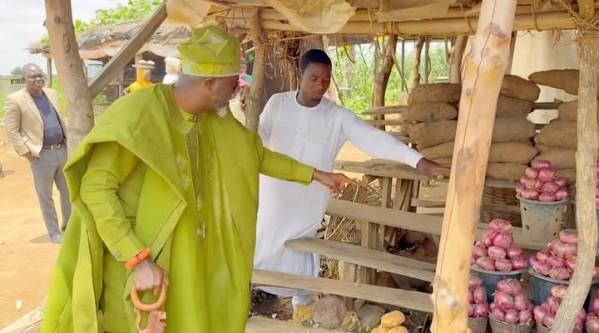
Speaking on a live television programme, Omokri said he had visited a market with a journalist, checked the prices of commodities such as yam, rice, maize and fruits, and concluded that N3,000 could enable an average Nigerian to live for a day. He also argued that poverty benchmarks should be understood within the economic realities of individual countries.
Perhaps Omokri has a point if the question is narrowly framed as: “Can a person find something to eat with N3,000?” But that is not the same question as: “Can the average Nigerian live on N3,000 a day?” And therein lies the problem. A human being does not live on yam, rice, maize and fruits alone.
The average Nigerian wakes up in the morning needing transportation to work or business. There is rent to worry about. There is electricity. There is water. There is cooking gas. There are toiletries. There are school expenses for those with children. There are medical bills. There are communication costs. There are clothes to buy. There are unexpected emergencies. Then there are those little expenses that appear insignificant individually but become a mountain when added together.
So, if a Nigerian manages to eat on N3,000 today, what happens tomorrow when the child falls sick? What happens when the landlord comes knocking for neighbourhood security bill, not to talk of house rent? What happens when transport fares rise? What happens when the electricity bill arrives? What happens when the gas cylinder becomes empty? What happens when school fees become due?
Life does not operate like a market excursion where one prices a few food items, adds them together and declares that the economic problem has been solved.
This is where the difference between “survival and living” becomes important. A man can survive without eating a balanced meal. He can survive by walking several kilometres because he cannot afford transport. He can survive by postponing medical treatment. He can survive by wearing the same pair of shoes for years. He can survive by sleeping in an overcrowded room. He can survive by borrowing from friends and relatives. He can survive by eating less so that his children can eat more. But should any of these be presented as evidence that life has become affordable? Certainly not.
The ability of Nigerians to endure hardship is not proof that hardship has become cheap. In fact, Nigeria’s National Bureau of Statistics maintains separate measures for food, core inflation, energy, services and other components of household consumption precisely because the economic life of a country cannot be reduced to the price of a handful of food items. The NBS’s rebased Consumer Price Index covers 934 product varieties across 13 divisions. That is the part of the argument that appears to be missing.
Omokri’s market exercise may demonstrate that selected food items can be bought within N3,000 under particular circumstances. It does not, by itself, establish the total daily cost of living of an average Nigerian.
There are other uncomfortable questions. Who exactly is the “average Nigerian”? Is he a single young man living alone? Is he a civil servant with three children? Is he a trader supporting a family? Is he a pensioner? Is he a Lagos worker commuting from the outskirts of the city? Is he a farmer who produces some of his own food? The circumstances are different.
A person who walks to work because he cannot afford transport may spend less cash that day. But transportation has not suddenly become affordable. A person who eats from his farm may spend less money on food. But producing that food still requires land, labour, inputs and time. A young Nigerian living in his parents’ house may pay no rent. But that does not mean housing is free. A patient whose medical bill is paid by relatives may personally spend nothing. But the cost of healthcare has not disappeared. Someone else is simply carrying it. This is why cash expenditure and the actual cost of living are not always the same thing.
Perhaps this is what somebody needs to tell Omokri. “Nigerians are not merely trying to remain alive. They are trying to live.” There is a dignity attached to living that goes beyond filling the stomach for one day. Living means being able to feed oneself and one’s family reasonably well. Living means being able to move around without spending half the day’s income on transportation. Living means being able to seek medical attention when sick. Living means having somewhere reasonably decent to live. Living means being able to educate one’s children. Living means having enough income to respond when life throws an unexpected bill at you. And, perhaps most importantly, living means having something left after meeting basic needs. That is where survival ends and living begins.
The irony is that Nigerians have become so extraordinarily skilled at surviving hardship that their resilience can sometimes be mistaken for evidence that the hardship is not severe. But resilience is not prosperity. A mother who skips a meal so that her children can eat is resilient. A worker who walks home after work to save transport money is resilient. A trader who keeps reinvesting shrinking capital because there is no alternative is resilient. A family that raises money from relatives to pay hospital bills is resilient. But their resilience does not make their circumstances comfortable.
It merely shows how much Nigerians are willing to endure. And perhaps this is the greatest danger in arguments built around survival: they can unconsciously change the standard by which economic success is measured. Instead of asking whether Nigerians are earning enough to live decently, we begin asking how little they can survive on. Instead of asking whether purchasing power is improving, we begin celebrating the ingenuity with which citizens stretch shrinking incomes. Instead of asking why people are struggling, we begin lecturing them on how to survive the struggle.
The foregoing attitude to governance cannot be the destination of Nigeria’s economic conversation. Nobody should need to prove that Nigerians are capable of surviving hardship. History has already proved that. The more important question is whether the economy is creating conditions in which Nigerians can move beyond survival.
Omokri is right about one thing: context matters. But if context matters, then the Nigerian context must include the entire Nigerian household experience, not merely the prices of yam, rice, maize and fruits in a market. It must include rent. It must include transportation. It must include energy. It must include healthcare. It must include education. It must include communication. It must include the unpredictable emergencies that routinely knock on the doors of ordinary families. Above all, it must include dignity.
So, who will tell Omokri that survival is not living? Someone should tell him gently but firmly that “a Nigerian who manages to survive on N3,000 has demonstrated the strength to endure, not necessarily the affordability of life.” The distinction is not academic. It is the difference between asking Nigerians, “How little can you survive on?” and asking, “How much should Nigerians earn to live decently?” The first question measures endurance. The second measures development. Nigeria should be interested in the second. Because Nigerians deserve more than an economy in which the greatest evidence of success is their ability to survive another day. They deserve an economy in which they can wake up not merely asking, “How will I survive today?” But asking, “What can I do today to be part of the ongoing nation building?” That is the difference between surviving and living. And somebody needs to tell Omokri.