
Forgotten Dairies
The Human Cost Of Xenophobia: When South Africa’s Violence Tears Families Apart -By Isaac Asabor
The time for diplomatic niceties has passed. African nations must demand accountability from South Africa. The South African government must confront the political and economic drivers of xenophobia rather than indulging them. And the international community must recognize that what is happening is not merely “unrest” or “tensions”, it is the systematic destruction of migrant lives and families, one burned shop and one separated family at a time.

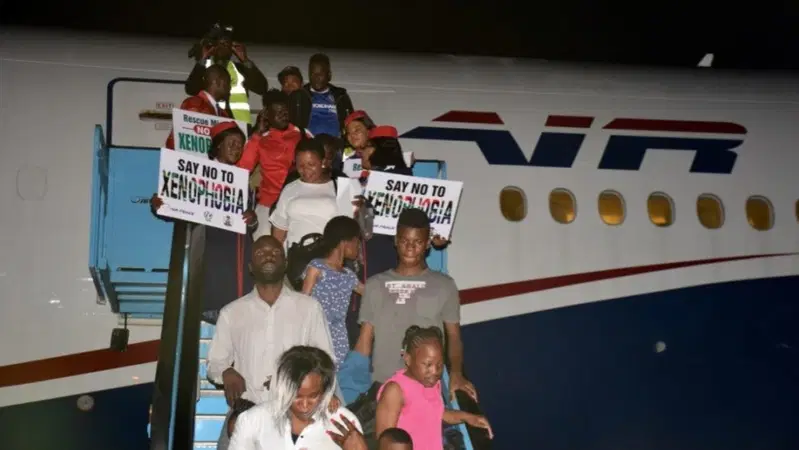
There is a particular cruelty in being forced to flee a place you have called home for decades, leaving behind not just property and livelihood, but the people you love most. For hundreds of Nigerians recently repatriated from South Africa, this is not a hypothetical scenario, it is the devastating reality of xenophobic violence.
Recently, the federal government says it has repatriated 1,490 Nigerians from South Africa following an uptick in xenophobic violence in the country. The repatriation exercise began on June 11 and ended on Wednesday. Nigerian nationals, mostly women and children, at every point of evacuation, landed at Lagos’s Murtala Mohammed International Airport, evacuated from a country where many had built lives spanning years, even decades. They came with little more than the clothes on their backs and a 23-kilogramme bag each. Some had lived in South Africa for 11 years, others for nearly 30. They left behind homes, businesses, and in painful cases, children born to South African mothers. One returnee, Justin Chukwu, who had lived legally in South Africa for almost 30 years, described leaving his children behind with the grim clarity of survival: “I have to save my life first.”
This is what xenophobia does at its most intimate. It does not just burn shops or displace communities, it fractures families across borders, leaving parents separated from children and spouses torn apart by violence they did not create.
The scale of this crisis is staggering. According to the Xenowatch Project, which has systematically tracked xenophobic violence in South Africa since 1994, there have been at least 873 documented incidents resulting in 612 deaths, over 122,000 people displaced, and more than 6,300 shops and properties looted or damaged. These numbers represent human beings, mothers, fathers, entrepreneurs, students, who came to South Africa seeking opportunity and found instead a society increasingly hostile to their presence.
The pattern is not new. In 2008, xenophobic attacks swept across South Africa, killing more than 50 people and displacing thousands, including many Nigerians in Gauteng alone. In 2015, violence erupted again following inflammatory remarks by Zulu King Goodwill Zwelithini. In 2019, riots in Durban and Johannesburg targeted foreign-owned businesses, and 640 Nigerians signed up for free evacuation flights back to Nigeria. The violence has become so routine that South Africa averages 59 xenophobic incidents per year since 2008.
What makes the current wave particularly disturbing is its organized nature. Groups like Operation Dudula and the Dudula Movement have emerged as vigilante forces, conducting door-to-door intimidation, raiding refugee centres, and marching through communities demanding that undocumented foreigners leave. The rhetoric has seeped into political discourse. In 2019, President Cyril Ramaphosa’s campaign pledge to crack down on undocumented foreigners was cited by migrant representatives as inflaming xenophobic sentiment.
The result is a climate where even documented, long-term residents live in fear. Emilia Godwin, who cooked and sold Nigerian food in South Africa for 11 years, captured the bitter irony: “They like eating our food, but they don’t like us.” She left all her possessions behind. Others, like Millie, who moved to South Africa at age six and had never known another home, returned to a country she barely remembered, her children in tow, uncertain of what awaited.
For those who built families across national lines, the violence creates impossible choices. A Nigerian father with South African children cannot simply pack up his entire family if his partner lacks documentation, resources, or the willingness to leave her homeland. The result is separation, children growing up without a father, marriages strained by distance and trauma, and the psychological wound of knowing that the country where your children live is no longer safe for you.
This is not merely a South African problem, nor is it solely a Nigerian one. It is a continental crisis that demands a continental response. The African Union’s silence has been deafening. While individual nations like Ghana, Mozambique, and Malawi have repatriated their citizens, and Nigeria has organized evacuation flights and promised financial support to returnees, there has been little coordinated pressure on South Africa to address the root causes of this violence.
South Africa’s government bears the heaviest responsibility. The country’s unemployment rate exceeds 30 percent, and economic frustration is real and legitimate. But scapegoating foreign nationals, particularly black African migrants, for systemic failures of governance and economic policy is not only morally bankrupt; it is dangerous. When political leaders frame undocumented migrants as security threats akin to terrorism, when police routinely harass and extort foreign nationals, and when the state processes repatriated Nigerians as “undesirable persons” banned from re-entry for five years, the message to citizens is clear: these people are not welcome, and their suffering is not our concern.
The cost of this indifference is measured in broken families. A father who hasn’t seen his South African-born children in months. A mother explaining to her children why they can no longer attend the school where teachers were “very biased” against them. A couple who built a life together, now separated by violence, bureaucracy, and the impossibility of choosing between safety and togetherness.
Nigeria’s government deserves credit for evacuating its citizens and providing financial support. But evacuation is a response to crisis, not a solution. In fact, following the July 2026 voluntary evacuations from South Africa, state governors such as Edo State’s Monday Okpebholo and Imo State’s Hope Uzodimma pledged or provided ₦1 million ($730) to each returning indigene to help with accommodation and resettlement.
In a similar vein, corporate and NGO Assistance: Private organizations and charities stepped in to help bridge the gap. For example, MTN Nigeria provided ₦50,000 worth of pre-loaded SIM cards and ₦100,000 cash to each returnee, while various religious bodies and foundations offered temporary accommodation, food, and vocational training
The foregoing monetary and material gifts extended to the returnees cannot replace businesses built over a decade, homes filled with memories, or the daily presence of a parent in a child’s life.
The deeper tragedy is that this violence undermines the very idea of African unity. South Africa, a nation that once inspired the continent with its struggle against apartheid, now treats fellow Africans with a hostility that echoes the exclusion it once fought. The “rainbow nation” was meant to be a beacon of inclusive democracy; instead, it has become a place where armed mobs march through streets demanding that black Africans from the north “go home.”
For the Nigerians who have returned, and for those still in South Africa living in fear, the question is not just whether they will rebuild their lives, but whether the continent will allow this to keep happening. Family separation is not an abstract policy consequence; it is a lived trauma that scars generations. When xenophobia forces a father to choose between his safety and his children, everyone loses.
The time for diplomatic niceties has passed. African nations must demand accountability from South Africa. The South African government must confront the political and economic drivers of xenophobia rather than indulging them. And the international community must recognize that what is happening is not merely “unrest” or “tensions”, it is the systematic destruction of migrant lives and families, one burned shop and one separated family at a time.
Until then, the human cost will continue to mount. And the children growing up without their Nigerian fathers, the wives left behind in a country that no longer welcomes them, and the returnees starting over with nothing in a homeland they barely know will bear the weight of a continent’s failure to protect its own.



















You must be logged in to post a comment Login