National Issues
The Trouble With Tinubu’s Fixation On Lagos Ports -By Pius Mordi
If the military government saw the wisdom in building news ports across Nigeria’s vast coastline, it is implausible why President Tinubu thinks Lagos should remain the main theatre for international trade. In this day and age pragmatism more than politics and primordial considerations should be determining factor in major economic decisions.

In the euphoria of having successfully prosecuted the fracticidal civil war that ended in January 1970 without any external borrowing, the victorious Yakubu Gowon regime embarked on a grand reconstruction of the limited and destroyed infrastructure in the country. Cement was the major instrument for the post-war reconstruction with the federal government duly entering into several contracts for the massive importation of the commodity.
The contract spree saw the arrangement for the importation of over 20 million tonnes of cement, 16 million tonnes of which was for the Ministry of Defence alone. This huge consignment was supposed to be delivered within 12 months. At the time the combined annual cargo handling capacity of all the ports was just 6.5 million tonnes of general cargo and with up to 455 ships, about 300 of them laden with cement alone, arriving within a short period, the chaos that resulted was monumental.
Ships had to wait for an average of 180 days, that is six months, before they could secure berthing space and discharge their consignments. And did Nigeria pay dearly for it!
The massive port congestion resulted in the imposition of freight surcharges ranging from 30 to 100 percent. Demurrage on the vessels averaged $4,100 per day for each of the ships for delay in excess of 10 days. If ships had to wait for up to six months before they could berth and if up to 455 vessels were queuing for berthing space at a point during the congestion, it can only be imagined the humongous costs in foreign currency Nigeria incurred at the time.
But as the country was awash with petro-dollars at the time, the federal government duly bore the costs without the proverbial batting of an eyelid. It was never determined or revealed how much Nigeria lost to the fiasco. All the ship and cargo congestion happened at Apapa Port which was the destination for most of the vessels. However, the military government of the time had seen enough to know that using one port tucked in one corner of a country with an 853 kilometres coastline was a recipe for chaos and nightmare.
In its Second National Development Plan of 1970-1974, the government unveiled a comprehensive plan to rehabilitate and build new ports across Nigeria’s expansive coastline.
The plan acknowledged the illogicality of utilising only one seaport to conduct international trade in a country with a vast coastline. Between the 1970-1974 Second National Development Plan and the third in 1975-1980, a network of new ultra-modern ports had been built. Apart from Tin Can Island in Lagos that became operational in 1977, new wings were built in Warri, Calabar and Port Harcourt ports.
Unfortunately, all Nigeria’s ports are located inland, requiring extensive navigation on river channels for vessels to access berthing facilities. Here, Lagos ports enjoy significant advantage over other ports. While the distance to Lagos ports from the fairway buoy is just 7.4 kilometres, that of Warri is 96 kilometres, Calabar is 83 and Port Harcourt Port 76 kilometres. Invariably, each port requires extensive pilotage services to guide ships to the berths.
Given the distance to the berths, the channels require regular maintenance dredging to maintain the advertised depth. Again, unfortunately, while the channel to Apapa and Tin Can Island ports are dredged often, those outside Lagos were allowed to silt up and severely hamper the coming of bigger ships. Herein lies the sticking point. The limited depth of the channel in other ports made the use of Lagos ports the default destination port for users of shipping services, notwithstanding the final destination of the consignments.
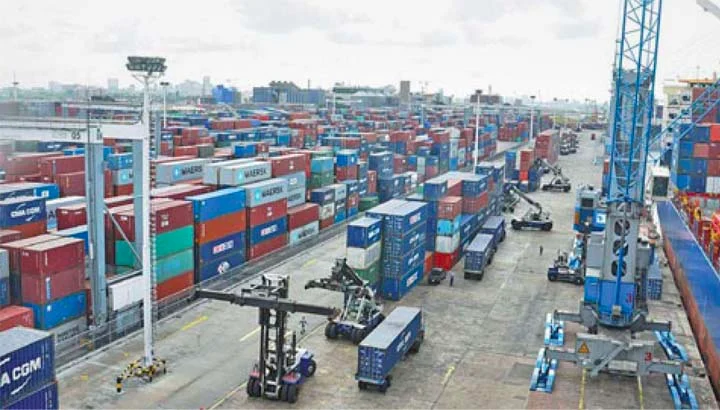
During his state visit to Britain, President Bola Tinubu secured a deal with the United Kingdom for the rehabilitation of Lagos ports of Apapa and Tin Can Island. The deal is put at £746 million (N1.36 trillion) to redevelop and modernise the two principal ports. Ordinarily, it is a welcome development that Apapa Port, the oldest of the lot, is about to be upgraded. However as the two Lagos ports have dominated ship and cargo traffic in Nigeria, they both have a common denominator – persistent poor cargo delivery process and intermittent ‘port congestion’, the result of nightmarish cargo clearing that have made the ports uncompetitive with those in neighbouring countries, especially Benin, Ghana and Cote d’Ivoire.
Every cycle of port congestion, always avoidable, unleashes extra burden on shippers through the resultant freight surcharge and demurrage on ships. And the costs are always passed on to consumers.
While port congestion has become a permanent feature of our ports, experts have been calling for the decentralisation of port services to other parts of the country. This was what inspired the Ibom Seaport project by Akwa Ibom State government. The immediate reaction of operators in the port industry to the UK deal is that part of the £746 million loan from Britain could have been ploughed into completion of Ibom Deep Seaports and for dredging the channels to the Delta ports of Warri, Koko and Sapele as well as Port Harcourt Port.
When the deal with Britain is actualised, Apapa and Tin Can Island’s patronage by shippers will be enhanced. The level of utilisation of the ports outside Lagos diminish further and congestion will become a permanent feature of the privileged ports.
If the military government saw the wisdom in building news ports across Nigeria’s vast coastline, it is implausible why President Tinubu thinks Lagos should remain the main theatre for international trade. In this day and age pragmatism more than politics and primordial considerations should be determining factor in major economic decisions.