Africa
When Bulldozers Are Rolled Out Without Mercy, Urban Renewal Wears Inhuman Face -By Isaac Asabor
Urban renewal is necessary. But it must never forget the humans whose lives give cities meaning. Without that recognition, planning becomes punishment, authority becomes impunity, and governance becomes something endured rather than believed in.

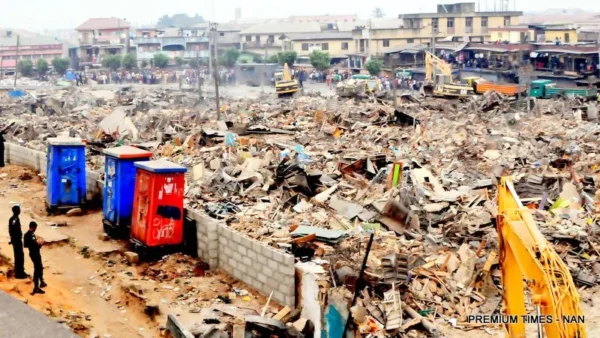
Across Lagos, Benin City, Anambra and other urban centers of Nigeria, a disturbing pattern is unfolding with unsettling regularity: homes, shops, and community spaces are being torn down with executive force that appears increasingly indifferent to human consequence. Authorities call it urban renewal. Officials describe it as the restoration of order. But for thousands of ordinary citizens, what they experience is sudden displacement, economic devastation, and a growing belief that development has turned into a campaign against the very people it is supposed to serve.
Urban renewal is not the problem. Cities must evolve. Infrastructure must be modernized. Planning laws must be enforced. Environmental risks must be addressed. No serious society can function without periodically reorganizing its physical space. The problem arises when enforcement loses proportion, when urgency replaces empathy, and when state authority begins to look less like governance and more like punishment. The problem lies in the fact that when Bulldozers are rolled out without mercy, urban renewal wears inhuman face.
What is unfolding today is not merely the removal of illegal structures; it is the normalization of executive impunity, or rascality, if you like. Notices appear abruptly. Deadlines are unrealistic. Appeals rarely delay action. Bulldozers arrive with the finality of verdicts already executed. Compensation is uncertain, relocation is vague, and due process often feels theoretical rather than real. The speed of enforcement outpaces the possibility of justice.
If examples are needed, they are everywhere. In Lagos, Governor Babajide Sanwo-Olu has faced widespread criticism as enforcement drives leave many residents effectively homeless in the name of restoring urban order. In Edo, Governor Monday Okpebholo has overseen demolitions of buildings alleged to belong to suspected criminals, actions that raise profound legal and moral concerns when carried out without prior judicial determination. In Anambra, Governor Charles Soludo is currently presiding over the clearance of sections of the Onitsha Main Market, threatening the livelihoods of traders who depend on the market’s daily activity for survival. And in the Abuja FCT, Minister Nyesom Wike is pursuing similar demolition campaigns under the banner of restoring planning discipline. Different jurisdictions, different justifications, but one troubling consistency: enforcement that advances faster than due process, and renewal that seems increasingly detached from human impact.
It will be recalled in this context that the UN has urged Nigeria to halt “ruthless” demolitions and uphold human rights protections. The plenipotentiary body has urged Nigeria to immediately halt a ‘ruthless’ campaign of home demolitions and forced evictions in waterfront settlements in Lagos, independent human rights experts in the Office of the United Nations High Commissioner for Human Rights (OHCHR) have said.
In 1967, the UN established a system to promote and protect human rights around the world, selecting independent experts and giving them a mandate to report and advice on specific human rights issues.
“Demolitions must never lead to homelessness of the evicted persons, who should have access to adequate alternative housing, resettlement and compensation for lost property,” the experts said in a statement.
The core issue is not whether cities should be reorganized; it is how that reorganization is pursued. Development ceases to be development when it destroys livelihoods without offering alternatives. Governance loses legitimacy when citizens experience the state primarily through coercion. Planning loses credibility when it disregards the human realities it is meant to improve.
Nigeria’s urban disorder did not emerge overnight, nor did it arise from individual defiance alone. It is the product of rapid population growth, chronic housing shortages, inconsistent planning enforcement, and economic structures that have pushed millions into informal arrangements simply to survive. Informal settlements, roadside trading hubs, and improvised commercial clusters are not merely violations of planning codes; they are evidence of systemic policy gaps. To address these outcomes exclusively through demolition is to treat symptoms while ignoring causes.
Behind every demolished structure stands a human story. A family that invested its savings into a modest home. A trader who built a customer base over decades. A community that created its own support network where formal systems failed. When bulldozers erase these realities overnight, the loss is not merely physical. It is economic, social, and psychological. Urban renewal that ignores these human dimensions risks becoming social dislocation disguised as progress.
The economic implications are severe and immediate. Small businesses form the backbone of Nigeria’s urban economy. When markets are dismantled without viable transition arrangements, local commerce contracts. Supply chains weaken. Youth unemployment expands. Household resilience declines. A policy that undermines economic survival cannot credibly claim to promote sustainable urban growth.
Defenders of aggressive enforcement argue that strict action is necessary to restore order. They point to planning regulations that have long been ignored. They insist that the rule of law must be respected. This argument contains truth. Laws cannot exist only on paper. But enforcement gains legitimacy not through force alone, but through fairness, transparency, and proportionality. Authority that demands obedience must demonstrate justice. But have our leaders forgotten that governance in Nigeria has ceased from being driven by the system called “Kakistocracy?”
Urban renewal must wear a human face. That principle is not sentimental; it is practical. Humane governance produces compliance. Arbitrary power produces resistance. A development policy with a human face begins with consultation rather than surprise. It provides adequate notice and realistic timelines. It distinguishes between criminal enterprise and survival-driven informality. It ensures fair and timely compensation where displacement is unavoidable. It creates pathways for relocation rather than leaving citizens to fend for themselves.
There are tested alternatives to mass demolition that preserve both order and dignity. Participatory planning invites affected communities into decision-making processes, transforming resistance into cooperation. Incremental upgrading transforms informal settlements into structured neighborhoods without forced displacement. Transparent compensation frameworks mitigate hardship and reinforce legitimacy. Public communication grounded in respect fosters trust and reduces conflict.
Transparency is especially crucial. Citizens are more likely to accept difficult decisions when they understand the rationale behind them. Clear documentation of violations, public disclosure of redevelopment objectives, and independent oversight mechanisms would strengthen public confidence. When rules are applied consistently and without favoritism, enforcement becomes governance rather than domination.
At stake is more than physical infrastructure. It is the moral character of governance. A state that exercises power without empathy risks eroding the social contract upon which stability depends. Citizens who perceive government as indifferent to their survival begin to withdraw trust. When trust declines, compliance weakens. When compliance weakens, enforcement intensifies. The cycle feeds itself, producing a governance environment defined by confrontation rather than cooperation.
Property rights, though subject to regulation, are fundamental safeguards against arbitrary power. When structures are destroyed without meaningful access to judicial review, constitutional protections become symbolic. The law must be more than a procedural formality invoked after irreversible actions have already occurred. Justice delayed is often justice denied, but justice bypassed is governance discredited.
Compassion in policy is not weakness. It is foresight. Cities thrive when citizens feel secure in their place within them. Development that displaces without rehabilitation may produce impressive skylines but fragile societies. Progress measured solely in physical transformation is hollow if it deepens inequality and alienation.
Nigeria stands at a defining moment in its urban evolution. Its cities are expanding rapidly, its population is youthful, and its economic pressures are intense. These realities demand thoughtful planning, not impulsive enforcement. Bulldozers can remove structures; they cannot build legitimacy. Concrete can reshape landscapes; it cannot repair broken trust.
The warning is urgent but constructive: executive authority must not harden into executive impunity. Urban renewal must not resemble a war against the people. Development must be anchored in dignity, consultation, and fairness. Governments must remember that citizens are not obstacles to progress but its purpose.
The path forward is clear. Engage communities early. Provide viable alternatives before displacement. Enforce rules consistently and transparently. Compensate fairly and promptly. Subject executive action to meaningful oversight. Above all, recognize that development is not measured by how quickly structures fall, but by how securely citizens stand afterward.
Nigeria’s future cities must be modern, orderly, and functional. But they must also be humane. A nation cannot bulldoze its way to legitimacy. Progress that leaves citizens homeless, voiceless, or economically shattered is not renewal; it is regression in administrative disguise.
Urban renewal is necessary. But it must never forget the humans whose lives give cities meaning. Without that recognition, planning becomes punishment, authority becomes impunity, and governance becomes something endured rather than believed in.