Opinion
Amid Economic And Political Influence, BRICS Gears For Summer Games in Kazan, By Kestér Kenn Klomegâh
Russian Federation Council Speaker Valentina Matviyenko noted during the meeting that BRICS already makes up over one third of global Gross Domestic Product (GDP) and almost a half of the planet’s population. It has developed a firm tradition of equal dialogue, with mutual respect and obligatory consideration of each other’s interests playing the key role.

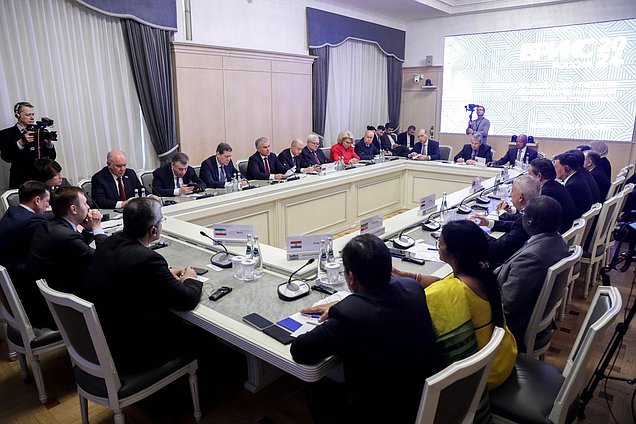
BRICS, an informal association comprising Brazil, Russia, India, China and South Africa together with its five new members, during a special meeting with the heads of BRICS parliamentary committees on international affairs, have outlined some details about the forthcoming BRICS Summer Games which aims at establishing traditional interactive attitudes especially among the youth of its members.
The 2024 BRICS Summer Games will be held in Kazan, capital of the Republic of Tatarstan, June 12-23 and will feature various events in 25 different sports. Deputy Head for Social Affairs of the Republic of Tatarstan Guzel Sagitova informed that as many as 74 countries will take part in the BRICS Games in the Russian city of Kazan, the Republic of Tatarstan. In mid-May 2023, Russian President Vladimir Putin instructed the government to submit proposals for organizing and holding the 2024 BRICS Games in Russia.
“The capital of Tatarstan has extensive experience in holding sporting events at the international and all-Russian level, as most recently Kazan successfully hosted the first-ever ‘Games of the Future’ competition,” Russian Sports Minister Oleg Matytsin said earlier before the BRICS parliamentary meeting. Matytsin however emphasized that the BRICS Games are not meant to rival any other competitions and will not interfere with the international sports calendar as well as with the IOC-approved calendar of events.
Vyacheslav Volodin, Chairman of the State Duma and parliamentarians of the BRICS member states discussed important questions necessary for enhancing inter-parliamentary cooperation between Russia and other member states. According to the made available, the heads of BRICS parliamentary committees arrived in Moscow to take part in such a meeting for the first time. They interacted with the chairs of both chambers of the Russian Federal Assembly of the Russian Federation. The parliamentarians and diplomats from China, South Africa, Brazil, India, as well as from the United Arab Emirates, Egypt, Iran and Ethiopia at the meeting with Vyacheslav Volodin emphasized that the role of BRICS in the world has significantly increased and the intention to form a multipolar world order.
“The expansion of BRICS speaks of its growing authority in the world and its ability to influence the development of global decisions. For our part, we will do everything possible to facilitate the harmonious integration of new participants into all formats of the association’s activity, including within the parliamentary dimension,” Volodin said, and further noted the fact that BRICS has more and more supporters and counterparts: about thirty states have already declared their intention to join the association in one format or another.
Russian Federation Council Speaker Valentina Matviyenko noted during the meeting that BRICS already makes up over one third of global Gross Domestic Product (GDP) and almost a half of the planet’s population. It has developed a firm tradition of equal dialogue, with mutual respect and obligatory consideration of each other’s interests playing the key role.
“Overall, the Russian presidency aims to take the BRICS partnership to a new, higher level. We believe that the people of our countries must be the main beneficiaries of this cooperation,” Matviyenko said. “This year, new states joined BRICS as fully-fledged members – Egypt, Iran, the UAE and Ethiopia. Undoubtedly, this is an important milestone in the history of our association. Such expansion is the best, in my view, demonstration of the strengthening and growth of BRICS’ authority in the international arena, its wide capability to affect global decision-making,” the speaker said during the meeting, organized ahead of the BRICS Parliamentary forum, which will kick off in St. Petersburg on July 11.
Russian Foreign Minister Sergey Lavrov paid an official visit to China, where he stated that the 2024 BRICS Games and the following World Friendship Games in Russia would be organized based on the principles enshrined by International Olympic Committee (IOC) Charter. According to him, Russia sees the growing interest from countries of the global South in the association as logical and natural. “It seeks to promote the processes in every possible way, the interests of all member countries, as well as those countries that want to interact with BRICS,” Lavrov underscored at a meeting with legislators from BRICS states’ parliamentary committees on international affairs.
Lavrov further emphasized that BRICS is founded on the principles of “equal dialogue, respect for each country’s choice to its own development path, consideration for each other’s interests and focus on the collective search for solutions to all problems of the time.”
Chairman of the Committee on International Relations and Cooperation of the National Assembly of the Parliament of the Republic of South Africa, Supra Obakeng Ramoeletsi Mahumapelo said: “We in South Africa agree that we need to strengthen the strategic importance of BRICS, strengthen the role of this organization. It is very important to build cooperation on the principles of mutual respect and respect for each other’s sovereignty and on the principles of multipolarity.”
The Ambassador Extraordinary and Plenipotentiary of Ethiopia to the Russian Federation, Cham Ugala Uriat, expressed gratitude to the Russian Federation for being at the forefront of protecting the association’s interests and promoting this principle of multipolarity.
Initially referred to as BRIC (Brazil, Russia, India and China) established in 2006, later expanded in 2011, when South Africa joined the four and was titled BRICS. By the decisions arrived at the Johannesburg’s 15th BRICS summit, under Russia’s presidency five new members (Egypt, Ethiopia, Iran, the United Arab Emirates and Saudi Arabia) formally became full-fledged members of the BRICS association in January 2024.


![Human rights groups are concerned about further arrests amid continuing raids in the occupied West Bank [File: Jaafar Ashtiyeh/AFP]](https://www.africansangle.com/wp-content/uploads/2023/10/Human-rights-groups-are-concerned-about-further-arrests-amid-continuing-raids-in-the-occupied-West-Bank.webp)