
Breaking News
Apapa Traffic Crisis Deepens as Articulated Trucks Choke Mile 2 Corridor, NPA Faces Blame
Traffic along the Mile 2-Wharf-Apapa corridor worsened after hundreds of trucks blocked the port access road, disrupting transport, businesses and port operations amid calls for urgent intervention.

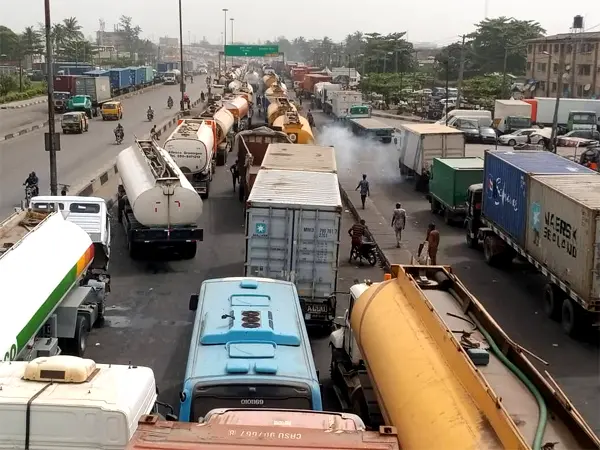
Persistent traffic congestion returned to the Mile 2–Wharf-Apapa corridor on Thursday after hundreds of articulated trucks occupied the major port access road, leaving commuters, residents and businesses trapped for several hours.
The gridlock extended from the Berger/Kirikiri area to Apapa, disrupting commercial activities and forcing many motorists to either abandon their journeys or turn back after spending hours in traffic.
Residents blamed the increasing number of container terminals along the Berger/Kirikiri corridor, alleging that trucks carrying empty containers to the facilities now dominate the road and make free movement almost impossible.
They also faulted the Nigerian Ports Authority (NPA), Nigeria Customs Service, the Police and traffic management agencies for failing to provide a lasting solution despite the recurring congestion.
One motorist, who requested anonymity, said traffic deteriorated after container terminals were established opposite the Catholic Church along the Berger/Kirikiri road.
“There is nothing else causing this traffic other than the terminals opposite the Catholic Church. Before they came here, this road was free. Today, you have three different terminals receiving containers and all the trucks are heading there,” he said.
He explained that trucks waiting to gain access to the terminals occupy large portions of the expressway, resulting in traffic queues stretching several kilometres.
According to him, although personnel from the Nigerian Navy, LASTMA, FRSC and other security agencies are regularly deployed to manage traffic, the sheer number of trucks has continued to overwhelm the corridor.
Reacting to the development, the National Council of Managing Directors of Licensed Customs Agents (NCMDLCA) accused the Nigerian Ports Authority of failing to effectively manage the port access roads.
Council President Lucky Amiwero said the roads fall under the NPA’s jurisdiction and maintained that the authority should be held accountable for ensuring unobstructed access to the ports.
He said the congestion reflects poor coordination of activities within the port corridor and urged the authority to take immediate action to restore order.
The Association of Maritime Truck Owners (AMATO) also expressed concern over the worsening situation.
Its General Secretary, Sani Mohammed, said the congestion has disrupted supply chains, affected port operations and forced some businesses to suspend operations.
Mohammed alleged that petroleum tankers now occupy multiple lanes instead of observing the single-lane arrangement, making access to the port increasingly difficult for other road users.
He added that transport fares have risen significantly because commercial buses spend longer hours in traffic and appealed to the Federal Government and Lagos State Government for urgent intervention.
Meanwhile, Traffic Transit Point (TTP) said petroleum tankers are not covered under the existing electronic call-up system.
The company’s General Manager, Corporate and Strategic Communications, Nancy Nnamdi, explained that although TTP has advocated for tankers to be included in the platform, implementation depends on government approval and enforcement.
She stressed that without official backing, the company cannot regulate tanker movement and said the current traffic situation should not be attributed to the electronic call-up system.
The Nigerian Ports Authority had earlier stated that it is collaborating with stakeholders to address the persistent gridlock along the port corridor.
Africans Angle News

























You must be logged in to post a comment Login