
Breaking News
Hijab Removal Request at Osun Polling Unit Reignites Debate Over BVAS Accreditation Rules, By Abdulazeez Toheeb Olawale
The distinction Nigerian courts have drawn between government-run institutions bound by constitutional religious-freedom guarantees, and private bodies with greater latitude to set their own rules — is directly relevant to the Osun voting controversy. INEC is a federal government agency, not a private institution. If the legal reasoning applied in the schools cases extends to electoral administration, it suggests INEC officials would have limited grounds to demand hijab removal as a blanket requirement, particularly where fingerprint verification remains available and functioning.

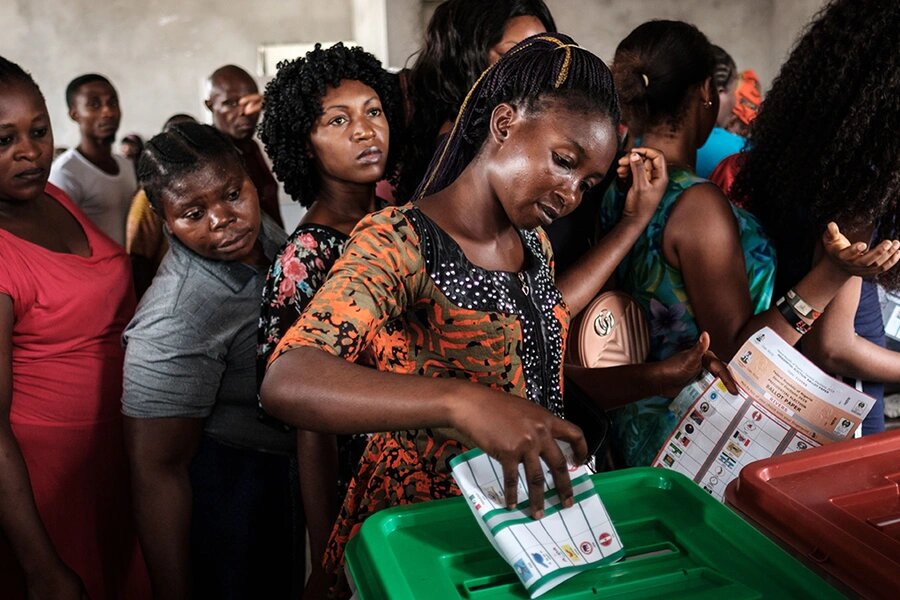
OSOGBO, OSUN STATE — A voter’s account of being asked to remove her hijab before completing biometric accreditation has stirred debate online, raising questions about how Nigeria’s electoral technology accommodates religious dress and what the law actually requires of institutions like INEC.
The Incident
Speaking to journalists on Saturday, voter Saka Sekina said she had waited more than six hours at Ward 8, Polling Unit 9 in Osogbo Local Government Area during the Osun State governorship election before officials asked her to remove her hijab for biometric capture. She had spent more than six hours at the polling unit before reaching the accreditation stage and described the demand as unfair and an infringement on her religious and personal rights. According to Sekina, officials specifically asked that her ears be exposed during the verification process, a request she declined.
“It is my civic right to vote,” she said. “This is my religion, and I have rights to my religion.”
How BVAS Actually Works
The Bimodal Voter Accreditation System (BVAS) is built around two independent verification methods — fingerprint and facial recognition, precisely so that no voter depends on either method alone. If one method fails, the second provides a reliable fallback, improving the chances of successful authentication and reducing delays and disputes at polling units.
This dual-mode design is central to the controversy. An Osun INEC spokesperson, speaking on the same election, clarified that accreditation can be completed through either fingerprints or facial capture, and that if a voter fails one method, the other remains acceptable. In principle, a voter’s fingerprint alone should suffice for accreditation, without requiring facial capture — unless the fingerprint scan fails or returns unreadable results, at which point officials may turn to facial verification as a backup.
Data from election observers supports this reading. In earlier BVAS testing, Yiaga Africa found that officials generally attempt fingerprint verification first, resorting to facial authentication mainly when fingerprints fail, and that facial capture in fact performs more reliably than fingerprint scanning in many polling units. This context matters: it suggests hijab removal or ear exposure should, under standard procedure, only become necessary after fingerprint accreditation has already failed for a given voter — not as a routine first step.
Wider Technical Problems on Election Day
Sekina’s case surfaced amid broader reports of BVAS malfunctions across Osun State on election day. Osun State Deputy Governor Kola Adewusi criticised INEC after the BVAS machine at his own polling unit developed technical faults, saying the malfunction slowed the process and left many people unable to vote. Separately, a 55-year-old voter, Sharafa Lasisi, said repeated attempts to complete facial verification failed due to network problems, despite being a longtime registered voter. Yiaga Africa had warned ahead of the election of possible BVAS failures among other concerns.
These reports suggest the friction voters experienced on Saturday was not isolated to religious-dress cases, but part of a wider pattern of accreditation delays linked to device and network performance.
The Wider Debate
Sekina’s account has drawn two broad reactions online. One camp argues that facial-capture requirements, applied without flexibility, effectively penalise Muslim women for practicing hijab — a core tenet of their faith and amount to indirect disenfranchisement. Others argue that some visual verification is a reasonable requirement for any voter, regardless of religion, given the need to guard against impersonation and multiple voting.
What the evidence suggests is that INEC’s own stated procedure does not require facial capture as a first resort — it is a fallback for when fingerprint verification fails. Whether that procedure was followed uniformly at Sekina’s unit, or whether officials defaulted to facial capture out of caution or a misunderstanding of the rules, is the central factual question her account raises. INEC had not issued a detailed public response specific to the incident at the time of writing.
Nigeria’s Legal and Religious Freedom Framework
The question of whether Muslim women can be compelled to remove religious coverings in public institutions is not new to Nigeria. It has been tested repeatedly in the courts, with rulings that consistently favor religious freedom in state-run spaces — even as the picture in private institutions remains more contested.
Nigeria’s 1999 Constitution, under Section 38, guarantees every citizen the right to freedom of thought, conscience and religion, and Section 42(1) protects citizens from discrimination on religious grounds. These two provisions underpin nearly every hijab-related ruling in the country’s courts.
The most significant precedent came from the Supreme Court in 2022, in a case concerning Muslim students in Lagos State public schools. The apex court held that wearing the hijab was an Islamic injunction and an act of worship required of Muslims, and that banning female Muslim students from wearing it violated their fundamental rights to freedom of thought, conscience, religion, dignity, and freedom from discrimination. That ruling established hijab-wearing as a protected constitutional right rather than a mere cultural preference — a distinction that matters legally, since Nigerian courts generally extend stronger protection to practices tied to religious obligation.
The principle was reaffirmed just weeks ago. In July 2026, the Oyo State High Court ruled in favor of Muslim students seeking to wear the hijab in government-owned public schools, including those historically run as missionary institutions. The court declared that government-owned schools must remain secular, impartial and free from religious bias, regardless of the historical names those schools carry, and ordered the state government to formally circulate the ruling to all public schools.
Not every case has gone the same way, and the exception is instructive. In a separate, long-running dispute involving a private school in Ibadan — the International School, University of Ibadan (ISI) — the Court of Appeal ruled that private schools may enforce their own dress codes even where they conflict with students’ religious preferences, overturning an earlier High Court decision in the students’ favor. The appellate court reasoned that ISI, as a privately funded institution, was not bound by Supreme Court precedents that apply specifically to publicly funded schools, and that students had effectively agreed to the school’s code of conduct upon enrolment.
That ruling was split 2-1, and Muslim rights groups have vowed to challenge it further at the Supreme Court.
The distinction Nigerian courts have drawn between government-run institutions bound by constitutional religious-freedom guarantees, and private bodies with greater latitude to set their own rules — is directly relevant to the Osun voting controversy. INEC is a federal government agency, not a private institution. If the legal reasoning applied in the schools cases extends to electoral administration, it suggests INEC officials would have limited grounds to demand hijab removal as a blanket requirement, particularly where fingerprint verification remains available and functioning.
That said, none of the rulings cited above deal directly with biometric or security-verification contexts, where courts in other jurisdictions have sometimes permitted narrower exceptions, such as brief, private identity confirmation by an official of the same sex. Nigeria’s courts have not yet ruled specifically on hijab use during biometric voter accreditation, meaning the Osun case sits in genuinely unsettled legal territory.




















You must be logged in to post a comment Login