Politics
Obi, Kwankwaso and the Politics of Movement: Strategy, Survival, or a Leap into the Unknown? -By Usman Muhammad Salihu
Ultimately, this move will be judged by one metric: conversion rate. How many Obidients and Kwankwasiyya become NDC members, not just in spirit but on the ballot? If the answer is “most,” then history will call it strategy. If the answer is “some,” then it was survival. If the answer is “few,” then it was a miscalculation dressed as ambition. The voters are watching, and their silence right now is louder than any endorsement. For Obi and Kwankwaso, the real campaign did not start in Abuja. It starts the day a trader in Aba and a farmer in Gaya can point to the NDC logo and say, “That is us.”

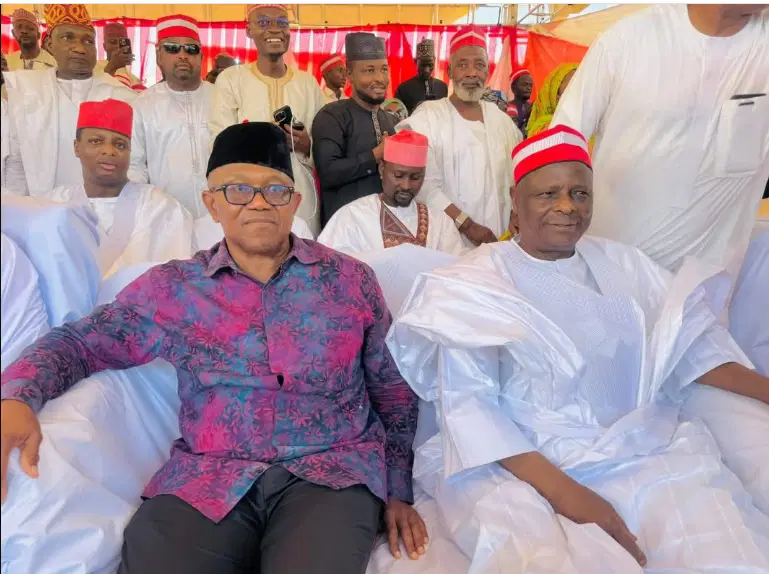
In Nigerian politics, defections are no longer surprising. What is surprising now is how quickly they happen, and how easily political actors move from one platform to another.
The recent defection of Peter Obi and Rabiu Musa Kwankwaso from the African Democratic Congress (ADC) to the Nigeria Democratic Congress (NDC) is not just another political adjustment. It is a bold move. But bold does not always mean safe.
At first glance, the decision appears strategic. Internal crises within the ADC, legal uncertainties, and the pressure of electoral timelines make stability a priority. From that angle, shifting to a new platform may seem like a necessary step, an attempt to secure political ground ahead of a highly competitive 2027.
There is also strength in the alliance itself. The coming together of Obi and Kwankwaso brings national attention, regional balance, and an existing base of supporters. On paper, that is not just movement, it is potential consolidation.
But politics is not played on paper. It is played among the people. And this is where the real challenge begins.
The Nigeria Democratic Congress is still largely unfamiliar to many Nigerians. Beyond political circles and elite discussions, its presence at the grassroots remains limited. For a significant number of voters, especially at the lower levels, NDC is not yet a known political identity.
And in Nigerian elections, familiarity matters. Voters do not just choose candidates. They choose what they recognize. They choose what they trust. They choose what they understand. That is the gap this move must overcome.
Beyond the issue of visibility, there are also emerging concerns around the stability of the platform itself. Reports suggest that the Nigeria Democratic Congress may be grappling with internal legal disputes. If proven true, this introduces an even more delicate risk. Moving from one troubled platform to another does not resolve instability, it simply transfers it. And in politics, uncertainty is a cost few can afford at this level.
Because this is no longer just about transferring political influence, it is about building voter awareness from the ground up, and doing so within a limited time frame. That is not a small task. It is one thing to move with loyalists. It is another thing to move with the electorate. And history has shown that the two do not always align.
There is also a deeper concern. Frequent political movement, no matter how strategic, begins to raise questions of consistency. When platforms change too often, voters begin to look beyond the movement itself and ask a more difficult question: What exactly is constant? Is it ideology? Is it vision? Or is it simply positioning?
These questions matter, because today’s voter is not as passive as before. There is growing awareness, growing scrutiny, and a growing expectation for clarity. So while this move may be necessary from a political standpoint, it is also risky from a public perception angle.
Because speed in politics can be a double-edged sword. Move too slowly, you lose relevance. Move too quickly, you lose trust. And right now, this move feels fast. Perhaps calculated. Perhaps unavoidable. But still fast.
So, is this strategy or survival? It is arguably both. Strategy, because the timing aligns with political realities. Survival, because unstable platforms leave little room for hesitation.
From another angle, this move is not just strategy or survival, it is a gamble. A calculated one, no doubt, but a gamble nonetheless. It rests on the assumption that political influence can be transferred faster than voter trust can be built. And in a system where recognition often shapes voting decisions, that assumption may prove too optimistic.
But beyond both lies a more uncomfortable possibility: That this could be a leap into a platform that has yet to fully exist in the minds of the people. Because in the end, political strength is not measured by alliances alone, it is measured by acceptance. And acceptance cannot be transferred overnight.
So while the move may look bold in Abuja, its real test will come far away from strategy rooms, in markets, in villages, and at the polling units. Where names are remembered, where symbols are recognized, and where unfamiliar platforms are often rejected.
And if that gap is not closed in time, then what appears today as strategy may tomorrow be seen as miscalculation. Because in Nigerian politics, you can move ahead of the system, but you cannot move ahead of the people. And when that gap exists, even the most calculated move can quickly turn into a costly gamble.
Ultimately, this move will be judged by one metric: conversion rate. How many Obidients and Kwankwasiyya become NDC members, not just in spirit but on the ballot? If the answer is “most,” then history will call it strategy. If the answer is “some,” then it was survival. If the answer is “few,” then it was a miscalculation dressed as ambition. The voters are watching, and their silence right now is louder than any endorsement. For Obi and Kwankwaso, the real campaign did not start in Abuja. It starts the day a trader in Aba and a farmer in Gaya can point to the NDC logo and say, “That is us.”
Usman Muhammad Salihu was among the pioneer fellows of PRNigeria, and writes from Jos.
muhammadu5363@gmail.com