National Issues
Of The Troubling Symbolism Of Russian Flags At #EndBadGovernance Protests In Nigeria, by Isaac Asabor

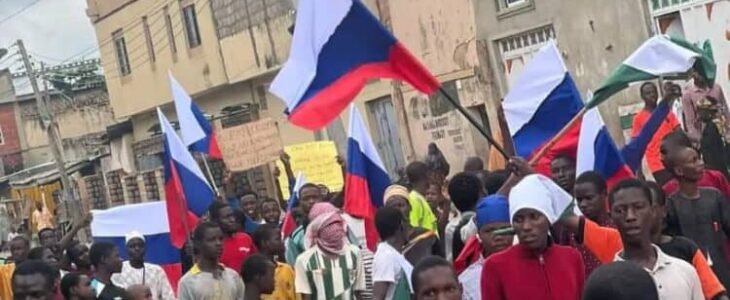
In recent days, the #EndBadGovernance protests in Nigeria have taken an unexpected turn with some demonstrators proudly displaying the Russian flag. While the protesters’ intentions may stem from a desire to invoke international solidarity against corruption and mismanagement, this display raises urgent concerns about the implications and symbolism behind such actions.
The reasons for expression of concern by not just this writer, but by the Chief of Defence Staff (CDS) General Christopher Musa, the leadership of the Russian Embassy in Nigeria and other Nigerians who are no doubt highly informed about the implications that are inherent in waving Russian flags by some Nigerians amid protests in Nigeria, specifically in Kano.
Unarguably deepening the collective fear which the action has already instilled in not a few Nigerians is that Russia has been increasingly active across Africa, often stepping into internal crises with military support and political maneuvering. From Libya to the Central African Republic, the Kremlin has cultivated alliances that enable regimes to cling to power and suppress dissent. Russian mercenaries, particularly the Wagner Group, have become notorious for their roles in exacerbating conflicts, undermining local governance, and even committing human rights abuses. As these patterns emerge, the significance of waving Russian flags in a country like Nigeria, where governance issues are rampant, cannot in any way be overlooked.
To some protesters, waving the Russian flag may symbolize a call for alternative support against entrenched power structures. However, such a gesture blurs the line between seeking accountability and courting an external power with a track record of opportunism in Africa. Countries like Sudan and the Central African Republic have found themselves drawing closer to Russia, often with detrimental consequences for their internal stability and governance.
In fact, Nigeria, with its rich resources and vibrant population, should be wary of positioning itself as a willing partner to a foreign power that thrives on chaos. The history of Russian involvement in other African nations reveals a pattern: alliances formed in the name of support often lead to deeper entrenchment of problems rather than solutions.
Without a doubt, the consequences of engaging with Russia can be dire. In Libya, the Russian presence has transformed the conflict landscape, complicating peace efforts and leading to further bloodshed. Similarly, the Central African Republic, racked by violence and instability, has seen its governance deteriorate under Russian influence. This historical context serves as a cautionary tale for Nigeria, where governance issues are already severe.
As frustration mounts among the Nigerian populace regarding corruption and poor leadership, embracing any external force, even under the guise of support, can have long-lasting repercussions. Therefore, the pursuit of better governance should be rooted in the empowerment of local voices and institutions, rather than looking to foreign powers whose interests may not align with the long-term stability of the nation.
As the #EndBadGovernance movement seeks to rally public support against mismanagement, it is crucial that its leaders foster a narrative that prioritizes national sovereignty, accountability, and genuine reform. While international solidarity is essential, Nigeria must navigate these waters carefully, ensuring that it does not inadvertently court influences that could lead to further unrest and conflict.
In fact, the flag-waving at protests should serve as a moment for reflection, not celebration. Nigeria’s path to recovery and governance reform must come from within, championing local solutions while remaining cautious of external influences that have historically complicated African governance crises.
Moreover, the displaying of the Russian flag at Nigerian protests is not just a harmless symbol of discontent; it is a reminder of the dangers that foreign interference can pose. Therefore, against the backdrop of the foregoing view, it is germane to opine that as Nigeria grapples with its internal issues, the focus must remain on building a resilient, self-sufficient nation, free from the shadows of imperialism and external interference.
To buttress the fact that the development is unarguably concerning and worrisome, it is expedient to recall in this context that the Russian Embassy in Nigeria has exonerated itself from the display of Russian national flag in Kano.
The Embassy in a statement in Abuja says the government of the Russian Federation as well as any Russian officials are not involved in these activities and do not coordinate them in any way, even as it emphasized that Russia does not interfere in the domestic affairs of foreign states, including Nigeria.
The Embassy added that Russia respects Nigerian democracy and believes that peaceful demonstrations in conformity with Nigerian law are a manifestation of democracy.
It further declares that the intentions of some protesters to wave Russian flags are personal choices of individuals, and they do not reflect any official position or policy of the Russian Government on the issue.
In the same vein, the Nigerian military has condemned the activities of the protesters, warning that such actions are treasonable and punishable by death.
General Christopher Musa, Chief of Defence Staff, issued the warning on Monday after a security meeting with President Bola Tinubu at the Presidential Villa.
He said, “We have all seen foreign flags being flown within the sovereignty of Nigeria, which is totally unacceptable. We are issuing a clear warning, and the President has also instructed us to convey this: we will not tolerate anyone, any individual, flying a foreign flag in Nigeria. That is a treasonable offence, and it will be treated as such. No one should allow themselves to be used by any individual.”
“We wanted to brief Mr. President on the situation on the ground, and we know that since the riots began, all the security agencies have been working together. Initially, when the riots started, they were described as peaceful, but we have realized that there are individuals who are willing to take advantage of the situation to cause mayhem. And we can clearly see what has happened since it began: criminals have taken over, with a lot of looting, stealing, and all sorts of criminal activities occurring,” Mr. Musa added.
Reiteratively put, the issue has sparked significant concern among citizens and observers alike, highlighting the need for the federal government of Nigeria to conduct a thorough investigation into the circumstances surrounding this act. Such displays can have far-reaching implications for national security and public sentiment, especially considering the current geopolitical climate. It is essential for the government to understand the motivations behind this act, whether they stem from political affiliations, ideological support, or external influences, to address any potential threats to Nigeria’s unity and integrity.
Despite the fact that the State Security Service (SSS) has announced the arrest of several tailors who allegedly sewed the Russian flags that were distributed and waved during the #EndBadGovernance protest in Kano state, it is not a misnomer in this context to urge the federal government to go beyond the arrest of tailors who may not know what was behind and beneath the sewing of the flags other than making money for themselves amid the toothy economy that is biting every Nigerian.
Without resort to sounding Patriotic-Than-Thou in this context, it is expedient for every Nigerian to understand that the waving of a foreign flag in any part of the nation raises important questions about loyalty and the influence of international entities within Nigeria. Therefore, the Russian flag, in particular, could symbolize support for controversial policies and actions that may not align with Nigeria’s democratic values or foreign relations.
Against the backdrop of the foregoing view, there is no denying the fact that an investigation is crucial, not only to ascertain the individuals or groups involved but also to evaluate the broader implications of such actions. This will also help in reassuring citizens of the government’s commitment to maintaining national sovereignty and addressing any undercurrents of dissent that could destabilize Nigerian democracy.
Finally, transparency in this investigation will foster trust between the government and its citizens. It is vital for the federal government to communicate openly about its findings and respond adequately to any identified issues. By actively engaging with the public and taking firm action against any entities promoting divisive foreign ideologies, the government can work towards a more united Nigeria. Upholding the rule of law and reinforcing the nation’s commitment to its core values is paramount in ensuring that actions such as waving foreign flags do not undermine our collective identity and stability.

![Human rights groups are concerned about further arrests amid continuing raids in the occupied West Bank [File: Jaafar Ashtiyeh/AFP]](https://www.africansangle.com/wp-content/uploads/2023/10/Human-rights-groups-are-concerned-about-further-arrests-amid-continuing-raids-in-the-occupied-West-Bank.webp)