Forgotten Dairies
Security Is Your Job, Not Ours: An Open Letter to Air Marshal Sunday Kelvin Aneke -By Vitus Ozoke, PhD
The true test of leadership is not how effectively responsibility is shifted onto victims. It is how effectively responsibility is accepted by those entrusted with power. Before asking Nigerians to take ownership of security, perhaps those who lead the nation’s security institutions should first take ownership of the insecurity that has become one of the defining tragedies of our time.

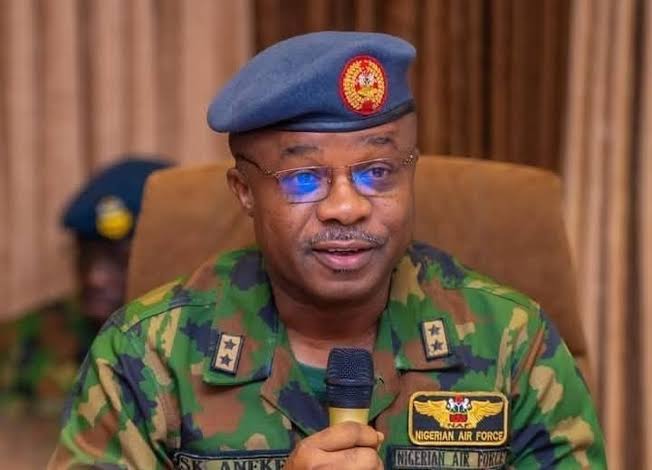
Dear Air Marshal Sunday Kelvin Aneke,
I read your recent admonition urging Nigerians to “take ownership of their security,” and I must confess I found it both troubling and deeply revealing. It was troubling because it reflects a growing tendency among public officials to shift responsibility for government failure onto the very citizens who are suffering from it. It was revealing because it inadvertently exposed the tragic state of security in Nigeria today.
With due respect, Sir, one fundamental question immediately comes to mind: Ownership of what? You cannot take ownership of what does not exist. Security, in any meaningful sense, is absent across large swaths of Nigeria. What Nigerians experience daily is not security but insecurity – persistent, pervasive, and often deadly. Communities are overrun by bandits. Farmers fear going to their farms. Travelers pray before embarking on routine journeys. Schoolchildren are abducted from classrooms. Villages are attacked in the dead of night. Kidnapping has become a thriving industry. Terrorists continue to operate in parts of the country with alarming audacity.
So, when you urge Nigerians to take ownership of their security, one is compelled to ask whether you actually mean they should take ownership of the insecurity that has become the defining reality of life for millions of citizens. After all, insecurity is the one thing Nigerians encounter everywhere.
Perhaps you misspoke. Perhaps you meant to say that Nigerians should take responsibility for their security. Even then, the statement raises serious concerns. What exactly are Air Marshals, Generals, Admirals, Police Chiefs, intelligence agencies, and the entire security architecture of the Nigerian state being paid to do? What is the purpose of government if ordinary citizens must assume primary responsibility for their own security?
The most basic justification for the modern state is the protection of life and property. Citizens surrender certain freedoms, pay taxes, and submit to governmental authority in exchange for security and public order. That is the social contract. Security is not a favor the government does for citizens. It is its foremost obligation. If Nigerians must now become the principal guarantors of their own safety, what exactly remains of that social contract?
And how, precisely, are citizens expected to fulfill this responsibility? With unemployment? With poverty? With hunger? With crushing inflation? With crumbling infrastructure? With unsafe schools? With hospitals that barely function? With roads that have become hunting grounds for kidnappers?
What tools do Nigerians possess that the state itself does not? What weapons are they permitted to carry? What intelligence networks do they command? What air assets do they control? What military resources are available to the average farmer in Benue, the trader in Zamfara, the teacher in Katsina, or the commuter traveling between Abuja and Kaduna? The average Nigerian has neither the means nor the constitutional authority to perform functions that belong to the state. That is why your statement appears dangerously backward, meaningless, misconceived, and misguided.
The responsibility for security cannot be placed primarily on citizens who are themselves victims of insecurity. The burden belongs first and foremost to those who hold power and authority. It belongs to the political leaders who set security policy. It belongs to the security agencies that receive enormous annual budgetary allocations. It belongs to the officials entrusted with defending Nigeria’s territorial integrity and protecting its citizens. Most importantly, it belongs to the political elite who preside over the institutions of state.
Interestingly, whenever discussions about security responsibility arise, the focus is almost always on ordinary Nigerians. Rarely do we hear stern public lectures directed at the political class that has overseen decades of institutional decay. Do the Nigerians you referenced include politicians who corruptly divert public resources meant for security? Do they include officials who profit from corruption while soldiers fight with inadequate equipment? Do they include those who treat security votes as private accounts? Do they include those who look away as criminal networks expand across the country? Do they include the powerful individuals whose convoys enjoy layers of armed protection while ordinary citizens are left exposed? If responsibility is to be discussed honestly, that conversation must begin there.
The Nigerian elite are among the most heavily protected people on the African continent. They travel with armed escorts, live behind fortified walls, and move in convoys. They enjoy layers of security funded by the public purse. Meanwhile, the ordinary Nigerian – the person your statement appears to target – often has only prayers, luck, and hope.
It is therefore profoundly insensitive and unfair to lecture the vulnerable about taking responsibility while the powerful remain insulated from the consequences of the insecurity they have helped create or failed to prevent.
Air Marshal Aneke, Sir, Nigerians do not need reminders about security. They live with its absence every day. What they need are results. They need safe roads to travel. They need schools where children can attend without fear of abduction. They need farms where farmers can work without paying protection money to criminals. They need communities where gunfire does not interrupt sleep. They need a government that treats security not as a public-relations talking point but as a sacred obligation.
The true test of leadership is not how effectively responsibility is shifted onto victims. It is how effectively responsibility is accepted by those entrusted with power. Before asking Nigerians to take ownership of security, perhaps those who lead the nation’s security institutions should first take ownership of the insecurity that has become one of the defining tragedies of our time.
Until then, appeals for citizens to secure themselves will sound less like leadership and more like an abdication and a dereliction of duty, and a loud admission of gross state failure.
Respectfully,
Vitus Ozoke
(A Concerned Nigerian who refuses to accept ownership of security.)
Dr. Vitus Ozoke is a lawyer, human rights activist, and public affairs analyst based in the United States. He writes on politics, governance, and the moral costs of leadership failure in Africa.