Africa
Tinubu’s Gun and the Fatal Ricochet of El-Rufai’s Pistol -By Festus Adedayo
The PDP will seem to be the recipient of the cruelest blows from the witch. While the witch’s hatchet man claims he is not holding the party’s throat down for the witch to suck its blood, on a daily basis, we see PDP’s throat held down. The vulture is draining the last of its blood. With the judgement of an Ibadan court on Friday, it is obvious that the PDP convention baby has been birthed already and anyone who wants to kill it will be committing murder. The president and his anvil should have aborted it before its birth.

Published
2 hours agoon
At that moment, the president was the elephant. In a famous track sung by Yoruba evergreen Juju musician, Ebenezer Obey, he had philosophized: “If the elephant enters a forest and eats its grass without being belly-full, the joke is on the forest and not the elephant”. In Obey’s original Yoruba rendition, the line reads, “B’érin bá je tí ò yóo… ìgbé l’ojú ò tì”. Not to worry. The president is belly-full. His elephant’s tummy is filled with castrated manhood of opposition figures. You needed to see joy enveloping his face. Feeling reinforced and impregnable, that night, the president must have sang that evergreen line of Obey. The analogy of death and gun even further reinforce the thesis. He must have felt like the world was in his pocket. Or like a rookie soldier who just won a tombola.
My mind tells me that Tinubu’s deployment of the imagery of death and gun was not a happenstance. It approximates his feeling of invincibility. To be fair to him, it does feel exactly so. The Electoral Act 2026 is a harvest of carefully curated clauses that will enthrone any king for as many times as they desire. INEC’s timetable too, in the words of the ADC Publicity Secretary, Bolaji Abdullahi, is an Asiwaju coronation leaflet. As we speak, the president has moved with the speed of the cheetah into 2027. Ahmadu Fintiri, ex-VP Atiku Abubakar’s home state governor, had just become the 30th Nigerian governor to port into his pouch. And as the quiver firmly holds arrows as sheath, the president is not about to let his captives out. As I write this, Bauchi State governor, Bala Muhammed, charged by the Tinubu Nigerian state for terrorism financing, was reported to have held a private meeting with him at the Villa. Tinubu cannot imagine the impossibility and imponderability of not being in the Villa a second time.
Just to be sure, the president must have asked for an old tune of Yusuff Olatunji as icing on the cake of his double assurance. A Yoruba Sakara music genre of traditional music, in his Vol 16, after spending sometime serenading the late Alake of Egbaland, Oba Folorunso Lipede; the Osile, Adedamola; Agura, Adeosun; the Olowu, Ajibola as well as the chiefs of Egbaland, which range from the Apena, Toye Coker; Sowemimo; Adegbenro; Seriki Amodemaja and others, the Sakara music great then dwelled upon cosmic-ordained impossibilities. Though it can die by anything else, a fish trap, traditionally constructed by fishermen and made of wire or palm materials, will not kill a grasscutter. Nor will a metal trap kill a fish in the sea, Olatunji sang. To the delight of the president, Olatunji seemed to have assured him that the war was already won. The spike fiddle goje of Olatunji, also known as Baba L’egba, twanged submissively like an accomplice. A traditional bowed string musical instrument commonly associated with the Hausa, the goje is almost like the South African banjo. The president probably sucked in the twinging goje, just as he allowed a cigarette clutched between his left hand burn away joyously and admirably. In his mellifluous voice, the Sakara musician sang about these cosmic impossibilities thus: “Ìgèrè ò ní p’ewújù, tàkúté ò ní p’eja ò e”.
In deploying the gun and death imagery, Tinubu merely chose not to be grandiloquent. He has not been using gun to kill the Nigerian opposition, he said. But, in all material particular, he is the African witch. Africa believes witches have mystical powers which makes them bringers of death and destruction. In my people’s chanting of the witch’s cognomen, she is the famous lord of nocturnes who kills without bow, arrow or gun. Upon unaliving her victim, the witch does not need vultures to eat the carrion.
Perhaps, by claiming he didn’t have a gun, the president was merely following in the footsteps of his Yoruba people. Rather than refer to witches in their very names, they rather shroud the witch’s prowess in imagery. Witches are clothed in respectful, dreaded or euphemistic cognomen that shields their deadly strikes. The euphemism however still emphasizes the witch’s destructive power and mystery. If you ask the Nigerian opposition today, they would tell you that Tinubu is the witch who eats the head while pretending to be concentrated on masticating the hand; one who eats the heart right from the liver. In all this, you will never see blood on the lips of the witch. That is the witch in Aso Rock.
Of a truth, the president has persistently insisted that he does not have a hand in the sucking of the blood of the opposition, especially the rank of the Nigerian governors. However, the situation on ground is that of the bee and the wasp in firm denial of responsibility, yet the farmer’s face is terribly swollen. A God-knows-who has criminally stung the farmer. Aso Rock is generally believed to be the culprit of this gradual hemorrhage. Yet it says it has no gun. Multipartism and multiplicity of electorate’s choices are dying in Nigeria as we move towards the general elections. No thanks to Tinubu. Yet, the one who kills without a dagger, the wasp and bee rolled into one, is in outright denial. Labour Party is comatose, NNDP is fractious and APGA is in intensive care unit.
The PDP will seem to be the recipient of the cruelest blows from the witch. While the witch’s hatchet man claims he is not holding the party’s throat down for the witch to suck its blood, on a daily basis, we see PDP’s throat held down. The vulture is draining the last of its blood. With the judgement of an Ibadan court on Friday, it is obvious that the PDP convention baby has been birthed already and anyone who wants to kill it will be committing murder. The president and his anvil should have aborted it before its birth.
As the president is busy wriggling his waist to Baba L’egba’s music of a cosmic-ordained impossibility of his political enemies defeating him, on the other side of the coin is Nasir El-Rufai, who currently lies lonely inside the detention house of the Nigerian law. It takes me back to the philosophy of life. Tribulations and human life are Siamese. It is a certainty that no man can live their lives divorced from the ups and downs of life. In the 1970s, when his soaring musical glory had just gained altitude, Yoruba primus inter pares musical behemoth, Chief Ebenezer Obey, who prided self as Commander of the musical cult, faced a huge social turbulence that almost downed his smooth-sailing musical flight. At some point, almost like a choreography, virtually all the crème de la crème of high society whose panegyrics he sang to high heavens, began to meet their existential waterloo. One of them was Ile-Oluji, Ondo State-born industrialist, Henry Fajemirokun.
By the early 1970s, Fajemirokun had succeeded in boring deep hole into the sand of time. He was an economic high-flyer. Fajemirokun established and built one of the foremost indigenous private sector business concerns of his time. Chief among these was the Henry Stephens Group of Companies, which he founded and became its chairman. He was also its largest shareholder. To celebrate this icon, Obey painted the dancehall red with his famous hagiographic line proclaiming immortality for Fajemirokun. In his Adventure Of Mr Wise 1973 album, he sang, “Ikú ò ní pa é o, Fajemirokun; àrùn ò ní se é o, Fajemirokun…” Not long after this vinyl hit the music stand, on February 15, 1978, aged 52, Fajemirokun suddenly slumped and died in Abidjan, Cote d’Ivoire. He was leading a trade delegation to the country when the calamity occurred.
Earlier came Jimoh Ishola, a.k.a Ejigbadero. A notorious land-grabber whose infamy was a legend in the Alimoso area of Lagos, virtually all Yoruba musicians of the early 1970s, in competition for Ejigbadero’s heart, idolized this land baron. Yusuff Olatunji also did. Obey, too, joined the bandwagon. As inscrutable as it is to find out how the liquid inside the coconut pod got therein, so was it for Ejigbadero’s traducers to locate the sources of his wealth, sang the Juju music lord. Not long after, the Nigerian State unveiled the riddle of Ejigbadero’s wealth. In 1975, while investigating the cause of the killing of Raji Oba, one of Alimosho villagers, Ejigbadero’s wickedness and criminal wizardry were detected. In August, 1976, he was sentenced to death for killing Oba. After an affirmation of the lower court’s death sentence by the Supreme Court, Ejigbadero was executed by firing squad in 1979 at the Kirikiri maximum prison gallows.
In a society driven by belief in black magic and man’s propensity for manipulating human destiny by sorcery, the short-end-of-the-stick fates suffered by “victims” of Obey’s panegyrics must have been as a result of his magical tweak, it was held. One after the other, Obey’s long list of high society clientele began to dwindle. Persuaded by the nuggets in the traditional belief that with a stroke of one’s hands, one can redirect one’s rail-roading destiny, Obey immediately issued a rebuttal in the form of a musical rendition. “Ayé o, k’áyé ma bà’ràwò mi jé, ayé o k’áyé má pà’ràwò mi dà,” – Wicked world, don’t destroy my destiny, he sang. Then, one after the other, he began to mention the names of those he sang their praises who were still at the top of their games. One of them was Titilola Edionseri, alias Cash Madam. Rather than these ones’ destinies plummeting, they soar high, Obey sang, rendered in Yoruba, according to his musical lines, thus, “Kàkà ké’wé è re’lè, pípele l’ón pele si.” What Obey meant to convey was that the fates of Fajemirokun, Ejigbadero and others’ were a mere puddle in an ocean.
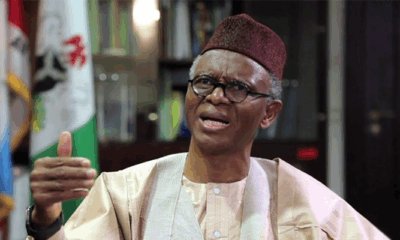
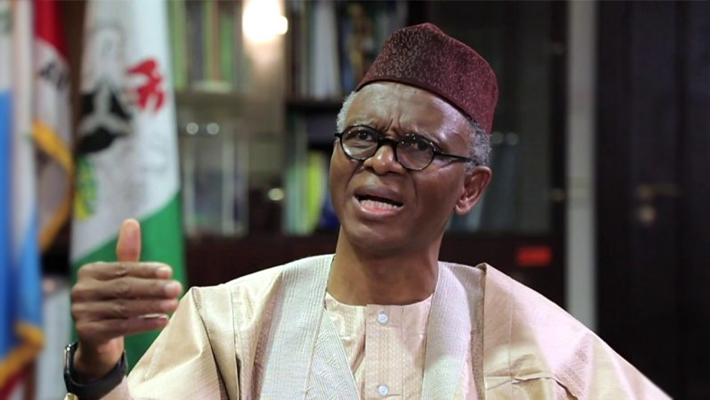
Nigeria’s political enfant terrible, Nasir El-Rufai, is today at that melancholic intersection where Obey was in the 1970s. Since his emergence as the Director General of the Bureau of Private Enterprises (BPE) and later, a major active participant in Nigerian politicking, El-Rufai has gained notoriety for acting in an unconventional, outspoken, or shocking manner. He has broken tradition for his atypical nature and his boldness to defy social norms, often in an embarrassing manner. His eight years governance of Kaduna State, though laced with achievements acknowledged by global financial institutions, also reveal him as dictatorial, undemocratic and deadly. Those who know him romanticize his brilliance, capacity to bite the bullet and his boldness to pick naked fire-encrusted faggot with his bare hand.
But, as native wisdom teaches, wisdom kills the wise. It is a paradox of human existence. Human, or worldly wisdom ultimately fails, leading to man’s eclipse. Ultimately, the graveyard of the wise is an affirmation that human, mortal brilliance cannot escape immortal authority. Many a time, worldly “wise” strategies get trapped by worldly cleverness. The wise man, in the process of exhibiting wisdom, could die like the fool, revealing the ephemeral nature of earthly wisdom and its inability to sustain the wise.
El-Rufai’s current fate in the hands of Tinubu can also be likened to the unexpected fatal ricochet of a dane gun. Even good shots prepare for a day when the gun could ricochet. It is an awkward moment when the hunter or one prepared to aim their shots suddenly finds out that the bullets or shotgun pellets come back, not from the eye of the gun but its buttocks. For El-Rufai, how does a man whose political adversaries dreaded for his serpentine wizardry, ability to outmanoeuvre his assailants, a razor-sharp tongue and calculative permutation, fall like an unwise?
In Ìrèmòjé, the Yorùbá poetic dirge sung at funerals of hunters, bards often gather, in total submission to the omnipotent. In their chants, they acknowledge that no armour is strong enough to shield fate. To capture this, they employ the imagery of the hunter’s pouch, which the English call the quiver, but which the Yoruba hunter calls the apó. Mourning bards lament that Death kills the hunter like one without the apó. Death kills a sick Babalawo like one whose vestry isn’t full of curative barks and roots. It is rendered as, “Ikú pa ode bí eni tí ò l’ápó, ikú pa onísègùn bí eni tí ò l’óògùn“. To reinforce this, Yoruba again say that what will be the death of the hunter lurks right inside his quiver, the apó. Inside the apó is a pot-pourri, from charms in aid of sudden disappearance, to multiple types of powder which, if leaked, make the hunter invincible to forest forces.
But, literally, death seems to have eventually caught up with El-Rufai, a man who, up until now, seemed to share cognomen with the Alaafin of Oyo as the son of Death who death could not kill. It will seem that wisdom eventually killed the wise. For, how did that criminal word of wire-tapping come out of the lips of a man as wise as the Kaduna ex-governor? How could he claim he harangued Umaru Yar’Adua to death? Having fallen on his own sword, the witch came in to drain El-Rufai of his blood. Then, last week, an alleged crime which ordinarily should admit him to bail has had the court rejecting his plea, followed by his arraignment to as far as April. Then, the gadfly got remanded in prison. Talk about blood seldom seen on the witch’s lips.
El-Rufai should rest assured that indeed, wisdom sometimes kills the wise. Not for him alone but even his traducers. The holy writ says when they think it is peace and safety, a sudden destruction. Electoral Act tweaked. Governors tweaked. Judiciary tweaked. INEC tweaked. But, can they tweak God? Can they tweak over 200 million Nigerians’ fates? It is why even the gun in Tinubu’s hand could ricochet. In 2011, this same Tinubu was docked before the Code of Conduct Tribunal (CCT) in Abuja over allegations of operating multiple foreign bank accounts while serving as the Lagos State governor. Who could imagine that a man that down could end up being the Nigerian president? Life is not as curve-less as the rod of a dane gun. The tragedy is that Nigerian politicians don’t learn from the repetitive thesis of life.