
National Issues
Remembering Anthony Enahoro -By Abiodun Komolafe
Today, we remember Enahoro, a pioneering figure who dared to dream of independence for Nigeria. We honour not only his significant contributions to Nigeria’s history but also his untiring commitment to democracy, self-determination and human rights. As we remember him and his dogged commitment to federalism and the quest for social justice, it is in our best interest to recreate the ethos and the spirit which created him and people like him.

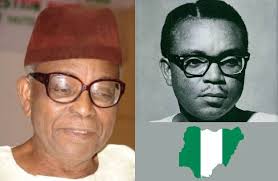
It is a settled fact that Anthony Eromosele Enahoro (July 22, 1923 – December 15, 2010) was an outstanding product of Nigeria’s pre-independence era. Enahoro moved one of the motions for independence and there’s a lot for us to look at in the context of the life he lived and the political firmament that brought him up. Therefore, remembering this Father of Nigerian Nationalism is to reminisce about an era where courage and conviction were the currencies of change.
As a pioneering journalist, politician and champion of independence, Enahoro’s unwavering commitment to Nigeria’s self-rule has left an enduring legacy that continues to inspire generations. His remarkable story is a testament to the transformative power of leadership, perseverance and the unrelenting pursuit of freedom.
Building on his legacy as a champion of independence, Enahoro went on to serve in various capacities, including as Minister of Information and Labour. He was later tried alongside Obafemi Awolowo and others for treasonable felony, a trial that became infamous in Nigerian history. Although convicted, Enahoro was later released and continued to play a significant role in shaping Nigeria’s political landscape.
Enahoro was an outstanding nationalist and a principled person, and this was evident in his involvement with the National Democratic Coalition (NADECO). Of course, there was no need for him and Alfred Rewane to have been involved in the struggle for the enthronement of democracy, particularly in the aftermath of the annulled June 12, 1993 presidential election won by MKO Abiola as they had too much to lose!. But they risked everything to fight for popular democracy, Although Rewane ultimately lost his life in the struggle, Enahoro was fortunate to have escaped the same fate.
Despite the risks and challenges, Enahoro remained unbending in his convictions, refusing to waver even in the face of adversity. As a gifted individual, he recognized that the issue at hand was not just about the violation of an individual’s rights, but an affront to democracy and national sovereignty. He, along with Alfred Rewane and others fought for principles, not personalities. This commitment to principle was evident in their diverse backgrounds: Enahoro was a Christian from Uromi in Edo State, with Esan extraction; Rewane was a Christian of Urhobo descent from Delta State; and Abiola, whose rights they fought for, was a Muslim Yorubaman, from Ogun State. Unlike some NADECO members who howled with the wolves and bleated with the sheep for convenience, Enahoro was not duplicitous. Unlike the crop of Janjaweeds who now populate our political landscape, he remained steadfast, refusing to compromise his values.
Olajumoke Ogunkeyede, a close ally of Enahoro, described him as “a man with a seriously fantastic sense of humour.” Ogunkeyede, fondly called JMK, shared several instances of Enahoro’s ability to bring joy to those around him. His humorous takes on serious issues, such as “the demons in Abuja”, showcased his wit. Moreover, his clever commentaries, including his defence of now-President Bola Tinubu’s aspirations, and his ingenious use of allegories and analogies, like ‘Ogbuefi’ and ‘Ogbueniyan’, collectively attested to the capacity of his wit and charm.
When writing about individuals like Enahoro, Rewane, Herbert Macaulay, Awolowo, Aminu Kano, Maitama Sule, and others, it’s essential to consider the context in which they lived. This context is bittersweet, as they represented an era where political activism was rooted in philosophical positions and guided by principles. People during this time held strong convictions and were willing to make sacrifices for their beliefs. That’s why society was more orderly in their time, and it achieved proper sustainable development, unlike today where what we have is largely ‘growth without development’, to be polite, or, if we want to be impolite, ‘the development of underdevelopment’. Amidst this, our leaders continue to sing the same old, worn-out refrain while satiating a vacuous idolatry that elevates an ego bereft of substance, a hollow monolith that stands on feet of clay.
If we look at people like Enahoro and Adegoke Adelabu, their lives exemplified a paradox that underscored the tenuous relationship between knowledge and credentials. This was because, despite lacking university degrees, they possessed a profound intellectual depth that eluded many of their contemporaries who boasted an array of impressive certifications, forgetting that it is not the parchment that confers wisdom, but the depth of one’s inquiry, the rigour of one’s thought and the breadth of one’s understanding.
Enahoro became the youngest editor of Nnamdi Azikiwe’s newspaper, the Southern Nigerian Defender, in 1944 at the age of 21 while Peter, his younger brother, became the editor of The Morning Star at the age of 23. The older Enahoro also worked with other publications, including Daily Comet and West African Pilot before parting ways with Azikiwe, whom he always referred to as his chairman, while Awolowo was his political leader. The reasons behind this preference are intriguing, but that’s a story for another time.
These early experiences laid the foundation for Enahoro’s later involvement with the Action Group (AG), a political party that shared his vision of ‘making life more abundant.’ Enahoro and the AG represented an understanding that the process of economic development must be structured and based on a philosophical thrust. In contrast, what is absurdly described as ‘politics’ today is terribly bad and basically transactional; and it’s driven by a “cash-and-carry” mentality, where individuals seek to outdo one another in a “chop-and-quench” political economy! No unity! No discipline! No structure! For them, any goose can cackle and any fly can find a sore place!
Looking at the plane, Enahoro’s life and career epitomized the complexities of Nigeria’s struggle for independence and democracy. His life and work embodied the intersection of individual agency and structural forces that steered the trajectory of nations. As a prominent anti-colonial and pro-democracy activist, he played a pivotal role in the country’s transition from colonial rule to independence. The Adolor of Uromi and the Adolor of Onewa was a vocal critic of authoritarianism and a strong advocate for human rights. His perseverance in the face of resistance, setbacks and imprisonment demonstrates the dedication required to bring about transformative change.
In moments of emotions and situations, we often discover our true strength and resilience. Enahoro has gone to the ages but his legacy continues to inspire, much like Abraham Lincoln’s. In simpler terms, he was a brave soul who dared to challenge the colonial powers. So, his legacy should serve as inspiration and role model for future generations, demonstrating the potential for excellence that exists within individuals and communities. In fairness to fate, Enahoro and his contemporaries were well-prepared for the liberation movement, thanks to their involvement in the West African Students Union (WASU) and their time at King’s College, Lagos. This institution, attended by Enahoro and Chukwuemeka Odumegwu Ojukwu, was a hotbed for political activism and discourse. To truly reboot, Nigerians must remember the personal histories of pioneers like Enahoro.
Today, we remember Enahoro, a pioneering figure who dared to dream of independence for Nigeria. We honour not only his significant contributions to Nigeria’s history but also his untiring commitment to democracy, self-determination and human rights. As we remember him and his dogged commitment to federalism and the quest for social justice, it is in our best interest to recreate the ethos and the spirit which created him and people like him.
May Anthony Enahoro’s spirit soar on the wings of eternal peace!
May his memory continue to serve as a testament to the enduring impact of individual agency on the course of national history!
May the Lamb of God, who takes away the sin of the world, grant us peace in Nigeria!
*KOMOLAFE wrote from Ijebu-Jesa, Osun State, Nigeria (ijebujesa@yahoo.co.uk)






















You must be logged in to post a comment Login