
Forgotten Dairies
The Cost of Casual Threats in Nigeria’s Political Culture -By Jeff Okoroafor
Analysis of Nyesom Wike’s “I would have shot him” comment and what it reveals about political culture, intimidation, and shrinking space for free expression in Nigeria.

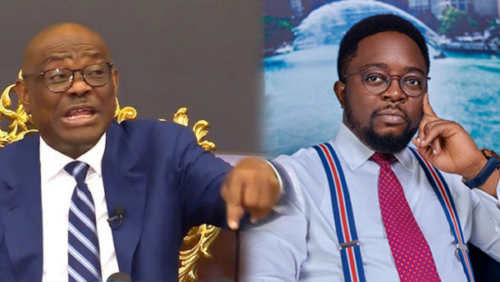
In Nigeria, political language often operates without consequence—until it doesn’t.
When Nyesom Wike said he “would have shot” broadcaster Seun Okinbaloye over a television discussion, the remark was quickly absorbed into the familiar rhythm of public outrage. Some dismissed it as typical political bluster. Others condemned it. Then, as is often the case, attention began to drift.
But statements like that are not disposable. They accumulate. And over time, they shape the boundaries of what a political system is willing to tolerate.
The exchange itself was unremarkable in its origin. On Politics Today, Seun Okinbaloye raised concerns about the concentration of political power and the possibility—real or perceived—of Nigeria edging toward a one-party system. It was an analytical point, one that fits squarely within the responsibilities of the press in any democracy.
What followed was not a rebuttal. It was a rupture.
Rather than contesting the claim, Mr. Wike introduced the language of violence into what should have remained a political argument. Even framed as exaggeration, the statement carried a different kind of weight because of who said it—and because of where it was said.
In countries where institutions are fragile and political loyalty can turn kinetic, metaphors of violence rarely stay metaphorical for long.
Mr. Wike’s response is consistent with a political identity he has cultivated for years. His rise within the People’s Democratic Party (PDP) and later prominence on the national stage have been marked by a willingness to dominate conversations rather than negotiate them.
During internal party disputes, he did not merely oppose rivals; he ridiculed them, questioned their legitimacy, and framed dissent as betrayal. That approach proved effective in consolidating influence, but it also normalized a style of engagement where disagreement is treated as something to be crushed rather than debated.
As governor of Rivers State, his tenure was frequently accompanied by accusations from opposition figures of intimidation and political suppression. Elections in the state were often tense, with reports of clashes and heavy security presence reinforcing the perception of a zero-sum political environment. While such dynamics are not unique to one actor, Mr. Wike became one of their most visible embodiments.
His rhetoric has also extended beyond partisan politics. Traditional rulers, political allies, and public institutions have at various times been addressed in tones critics describe as dismissive or combative. The effect is cumulative: a steady lowering of the threshold for what counts as acceptable public speech.
What makes statements like “I would have shot him” consequential is not simply their content, but their context.
Nigeria’s media landscape operates under persistent pressure. Journalists navigate legal risks, economic constraints, and, at times, direct intimidation. In that environment, the words of senior political figures are not neutral. They function as signals—sometimes subtle, sometimes explicit—about how far criticism can go.
When a figure with Mr. Wike’s profile invokes violence, even rhetorically, it can embolden supporters who interpret such language as permission rather than performance. It can also force journalists into quiet recalculations: which questions are worth asking, which angles are worth pursuing, and which risks are worth taking.
This is how self-censorship takes root-not through formal prohibition, but through accumulated pressure.
Perhaps the more troubling issue is not the statement itself, but the ease with which it can be dismissed.
Nigeria’s political culture has developed a tolerance for what might be called “excess language”—statements that would provoke sustained institutional backlash elsewhere but are treated locally as part of the terrain. Over time, that tolerance shifts expectations. What was once shocking becomes routine. What was once unacceptable becomes debatable.
This normalization has consequences. It coarsens public discourse, reduces accountability, and gradually redefines the relationship between power and criticism.
There was nothing inevitable about Mr. Wike’s response. He had alternatives.
He could have challenged the premise of Seun Okinbaloye’s analysis with evidence. He could have reframed the conversation around political plurality or offered assurances about democratic competition. He could have used the moment to demonstrate confidence in the very system under discussion.
Instead, the response redirected attention—from the question of Nigeria’s political future to the temperament of one of its key actors.
That redirection matters. It reveals how power is exercised, not just in policy, but in tone.
The broader concern is not about a single exchange between a politician and a journalist. It is about the environment such exchanges create.
If the language of violence continues to seep into routine political communication, the effects will not be immediate, but they will be cumulative. Journalists may grow more cautious. Public debate may narrow. Political actors may become more insulated from scrutiny.
And when that happens, the cost is not borne by individuals alone, but by the democratic system itself.
The reaction to Mr. Wike’s comment suggests there are still boundaries Nigerians are willing to defend. But those boundaries require reinforcement, not just reaction.
Accountability in this context does not necessarily demand punishment. It can begin with acknowledgment-a recognition that certain lines, once crossed, carry implications beyond intent.
Because ultimately, political language is not just expressive. It is formative. It shapes expectations, influences behavior, and defines the limits of participation.
Nigeria’s democracy does not depend on the absence of strong personalities. But it does depend on the presence of restraint.
And restraint, in moments like this, is precisely what is being tested.

Jeff Okoroafor
Jeff Okoroafor is a social accountability advocate and a political commentator focused on governance, accountability, and social justice in West Africa.
















You must be logged in to post a comment Login