
Forgotten Dairies
Lavrov Highlights Security and Development with the Confederation of Sahel States -By Kestér Kenn Klomegâh
Following the July 8th meeting, the parties signed a Memorandum on Consultations between the Foreign Ministries of Russia and the Confederation of Sahel States and adopted a Plan of Inter-ministerial Consultations for 2026–2027. The priority areas for future cooperation are set out in the Joint Statement signed by the parties.

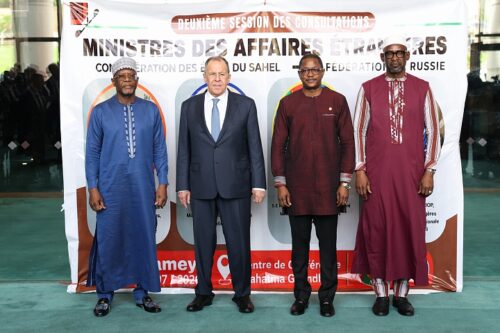
Russian Foreign Minister Sergey Lavrov visited Sahel region in West Africa, officially participated in the Russia-Confederation of Sahel States (Burkina Faso, Mali and Niger) forum, marking another milestone in their bilateral relations and more significantly acting Russia’s policy of deepening partnership with regional integration. It also serves as symbol of priority, addressing peace initiatives and engaging the Confederation of Sahel States in sustainable development.
Reports from the Lavrov’s pre-summit tour indicated that Russia and the West African countries making up the Confederation of Sahel States have pledged to strengthen military cooperation as jihadist insurgents gain ground in the region. According to a joint statement issued, after talks in Niger’s capital, with his Foreign Affairs counterparts, Burkina Faso, Mali and Niger, Lavrov has acknowledged the three Francophone West African States, have been facing serious security and development issues and consequently turned to Moscow. In addition, Burkina Faso, Mali and Niger have been enlisting for support after breaking with France and other Western allies.
The officials, during the discussions, welcomed “growing military and military-technical cooperation,” including assistance from Russia’s paramilitary Africa Corps. That however, Russia confirmed its intention to continue helping to strengthen the armed forces of the Confederation of Sahel States and of their “Unified Force,” the official statement said.
In April, the regional al-Qaeda affiliate and a Tuareg-led separatist group staged attacks across Mali and killed the country’s defense minister. Early July, they attacked numerous army posts, which the joint statement alleged that “external state actors,” including Ukraine and France, were involved in attacks in the region. Both have denied such allegations.
Russia and Burkina Faso, in April 2026, finalized documents that forms the bedrock of their bilateral partnership. It was an agreement indicating their joint pursuit of concrete directions in delivering on the understanding reached by both leaders, including those during the official visit to Moscow in May 2025 by President Vladimir Putin and President Ibrahim Troare.
Undoubtedly, the Russia-Confederation of Sahel States opened that new chapter, which the Russian Foreign Ministry described as aiming at finding appropriate pathways in fighting jihadist insurgencies that has spread across the region south of Sahara. “The Moscow meeting represents an important step in establishing strategic, pragmatic, dynamic and supportive cooperation and partnership relations in areas of common interest between the the Confederation of Sahel States and Russia.”
With recognition of the the Confederation of Sahel States as an organization, Russia could therefore boost military ties, strengthen the combat capability, train their troops, and supply weapons and equipment. Further, Russia would help to form a joint military force by offering “consultative services” and station in the region military instructors. In this connection, Burkina Faso, Mali and Niger, have expressed readiness to barter their natural resources, in exchange, for economic and security support.
Basic research shows that besides instability, these three Sahel countries are engulfed with various socio-economic development problems, primarily due to their own poor and uncoordinated policies toward economic development. At least, Russia has supported in uprooting French domination and pledged tremendous partnership assistance to reshape their economy.
Analysts say Russia’s courtship is a larger push to raise and consolidate influence across Africa, leveraging anti-Western sentiments to build alliances at the United Nations and access strategic natural resources. Moscow presents itself as a reliable friend and a partner for ensuring Africa’s political and economic sovereignty.
Following the July 8th meeting, the parties signed a Memorandum on Consultations between the Foreign Ministries of Russia and the Confederation of Sahel States and adopted a Plan of Inter-ministerial Consultations for 2026–2027. The priority areas for future cooperation are set out in the Joint Statement signed by the parties.
Russia-Confederation of Sahel States (Burkina Faso, Mali and Niger) was created, in September 2023, and formalized as a confederation in 2024, emerged after a string of military coups. Lavrov launched what is referred to as “Russia-AES Ministerial Consultations” that focuses on regular annual political dialogue, reviews counterterrorism issues and coordinates on bilateral investment plans in the Sahel region in West Africa.

















You must be logged in to post a comment Login