Politics
The Man Who Restructured Faces at Wadata House -By Patrick Iwelunmor
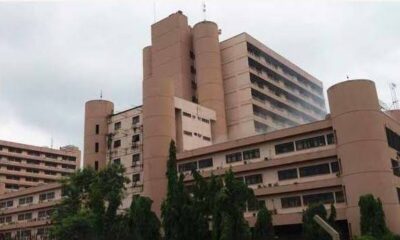
The incident at Wadata House was comical, but the comedy is laced with sorrow. For every cheek that received unwanted rearrangement that day, Nigeria’s democratic image absorbed a bruise far more consequential. The laughter comes, but it halts halfway in the throat, weighed down by the knowledge that the nation deserves far better than what unfolded beneath the fading pillars of Wadata House.


There are days when Nigerian politics becomes a tragicomedy authored by someone who has long abandoned any hope of rational characters. And then there are days when it discards dignity altogether and staggers into a joke. The fracas at Wadata House, the national headquarters of the Peoples Democratic Party, belongs in the latter category. What should have been a home of deliberation and democratic maturity instead transformed into a breeding ground for theatrics, shouting matches, and the kind of chaos that turns a political disagreement into a boxing audition. At the centre of this disorder emerged one unforgettable character, a man whose contribution to the political drama was not rhetorical finesse or ideological clarity but the swift and unapologetic deployment of his palms. He slapped with commitment. He slapped with accuracy. He slapped as though summoned by some ancient covenant between politics and physical persuasion.
He was no ordinary wielder of open hands. He moved with the assurance of someone convinced that cheeks were optional accessories. In another era, he might have been a ceremonial drummer; in today’s politics, he has become something of an enforcer, the Michelangelo of unsolicited facial rearrangement. While factions argued over legitimacy, he opted for the most primitive form of arbitration. Not the open hand of reconciliation, but the open hand of correction. Watching him, one could almost believe that an invisible authority had appointed him the unofficial Minister of Facial Realignment, empowered to redistribute jawlines whenever tempers rose above constitutional limits.
Yet his performance did not arise in a vacuum. It was made possible by the PDP’s persistent inability to resolve its internal conflicts. A party that once boasted of being the largest in Africa has become a theatre of quarrels, unable to settle disputes that require even the most elementary organisational discipline. Factions have hardened into tribes, ambitions have swollen into rival armies, and the centre has lost its grip on both order and credibility. The Wadata House spectacle was not an unfortunate accident; it was the predictable harvest of a political institution that has allowed internal rot to advance unchecked. When politics loses its compass, chaos becomes an invited guest. And when chaos arrives, men with expressive palms take centre stage.
Standing alongside this internal decay is an equally troubling factor: the Nigerian Police. Their massive presence at Wadata House raises uncomfortable questions. How is it that security operatives mobilise effectively when politicians quarrel, yet vast communities across the country remain at the mercy of bandits, kidnappers, and marauders? Why does the police force appear most efficient when it is required to settle political rivalries, but becomes elusive when ordinary citizens cry out for rescue? The contrast is not merely disappointing; it is a damning indictment of priorities. Nigeria suffers from vast unpoliced spaces, yet officers swarm a partisan conflict with remarkable enthusiasm. It suggests not only institutional misdirection, but a troubling intimacy between law enforcement and political power brokers. The police seem available for political errands, yet absent where security is genuinely needed.
And then there was the woman, a large and assertive figure who attempted to make her way through the chaos before encountering the slap that momentarily reset her cognitive coordinates. It was an unacceptable act of violence against women. Her size or confidence granted no licence for brutality. In a political environment already saturated with aggression and machismo, her humiliation stands as a stark reminder of how easily women become targets in the crossfire of male-dominated power contests. Her experience should not be lost in the humour of the moment. It must be condemned unequivocally as abuse, a violation that speaks to the deeper disrespect for women embedded in our politics.
The entire episode offers a painful reflection on the state of Nigerian democracy. Wadata House became a mirror, reflecting an environment where institutions shake, discipline collapses, and disputes migrate from dialogue to physical confrontation. It revealed how quickly constitutional debate can devolve into primitive aggression when a political party fails to cultivate order within its own house. And it demonstrated how Nigerians have become disturbingly accustomed to public disgrace. Cameras recorded the slap procession as though it were a cultural performance.
The man who restructured faces will likely disappear without consequence. No panel will summon him. No disciplinary action will unfold. His victims will heal quietly, and the nation will move on to the next scandal with conditioned resignation. He may even tell the story with pride, convinced that he defended something sacred, though no one quite knows what that was.
But the deeper shame belongs not to him alone. It belongs to a political culture that rewards chaos, a party that has lost the discipline required for internal cohesion, and a police force that mistakes political conflicts for national emergencies. Until Nigerian politics reclaims the maturity to settle disputes without turning public buildings into arenas of disgrace, we will continue to produce individuals who believe their palms hold the authority that institutions lack.
The incident at Wadata House was comical, but the comedy is laced with sorrow. For every cheek that received unwanted rearrangement that day, Nigeria’s democratic image absorbed a bruise far more consequential. The laughter comes, but it halts halfway in the throat, weighed down by the knowledge that the nation deserves far better than what unfolded beneath the fading pillars of Wadata House.