Forgotten Dairies
Until The Lion Speaks: IBB’s June 12 Narrative And The Silence Of The Departed -By Isaac Asabor
Without a doubt, IBB’s book will undoubtedly spark debates, but it should not be allowed to stand unchallenged as the sole account of June 12. The real tragedy is that many of those who could have provided alternative perspectives are no longer here to do so. This reality underscores the importance of speaking one’s truth while still alive, rather than leaving the task to those who may seek to reshape it for personal gain.

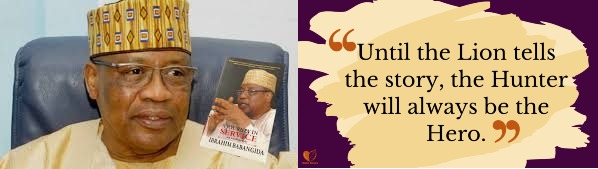
In the world of storytelling, there is an African proverb that holds timeless relevance: “Until the lion tells the story, the hunter will always be the hero.” This saying resonates deeply with historical narratives, particularly those shaped by political figures who write their own versions of events long after their contemporaries have passed. This appears to be the case with former military president, General Ibrahim Badamasi Babangida (IBB), who recently launched a book detailing his perspectives on Nigeria’s tumultuous June 12, 1993, presidential election annulment. However, the timing of this literary endeavor raises critical questions: Can history be trusted when key players are no longer alive to counter its claims? Is IBB’s account the final word, or merely a crafted attempt to cement his own legacy?
Given the foregoing backdrop, it is not a misnomer to opine that the launch of the book is bereft of critical voices. Without a doubt, the most glaring issue with the book is that it arrives at a time when many of the principal actors of the June 12 saga are no longer with us. Chief MKO Abiola, the presumed winner of the election, died under controversial circumstances in 1998 while in detention. His wife, Kudirat Abiola, was assassinated in 1996 for daring to speak truth to power. General Sani Abacha, who took over power after IBB’s exit and under whose regime Abiola met his tragic end, also died in 1998. Even other critical voices, activists, journalists, and politicians, who could have offered counter-narratives, have since passed on.
With these voices gone, Babangida’s book stands unchallenged in a way that would have been impossible if those he wrote about were still alive. A living Abiola could have called out inconsistencies. A living General Shehu Musa Yar’Adua, who also suffered imprisonment and died under suspicious circumstances, could have provided alternative insights. But in their absence, we are left with a single, dominant narrative, one that seeks to absolve IBB of blame and justify his controversial actions.
At this juncture, it is expedient to ask, “Is the book a carefully curated narrative? In as much as the answer to the foregoing question seems ambiguous, it can diplomatically be responded to by saying that for decades, Babangida has been haunted by the annulment of the June 12 election, widely regarded as the freest and fairest election in Nigeria’s history. This is as his decision to nullify Abiola’s victory plunged Nigeria into political chaos, leading to widespread protests, international sanctions, and the eventual military rule of General Sani Abacha. Against the foregoing backdrop, the narrative of the book can be understood.
In the years since, IBB has offered various explanations, ranging from concerns over national security to allegations of electoral irregularities, claims that many analysts and historians have dismissed as baseless. Now, with his book, Babangida seeks to retell the story, but can we trust a man who spent years dodging responsibility? Is this book an honest recollection of events, or is it merely an attempt to cleanse his tarnished legacy?
History has shown that those who wield power often rewrite it to suit their interests. The book’s release, at a time when political memory is fading and younger generations are less connected to the past, suggests an effort to reshape how history judges IBB. But Nigerians, especially those who lived through the trauma of June 12, must not allow this version of events to become the accepted truth without scrutiny.
Without a doubt, the book carries the burden of an unfinished story. If we accept the idea that history is fluid and that every story has multiple sides, then Babangida’s book should not be seen as the definitive account of June 12. It should rather be treated as one version, one that must be critically examined against other documented evidence, eyewitness accounts, and the broader political context of the time.
It is crucial to remember that June 12 was not just about an election. It was about the collective will of Nigerians, a moment when the people chose democracy over dictatorship. The annulment was a direct assault on this democratic aspiration, and no amount of revisionism can change that fact.
IBB may write his story, but he does not own history. History belongs to the people. And as long as Nigerians continue to remember June 12 for what it truly was, a moment of stolen democracy, the truth will persist, regardless of any book or belated confession.
In fact, not a few Nigerians, like this writer, since the book was launched are of the opinion that there is an urgent need for a balanced record of the June 12 debacle.
In fact, what this book’s publication highlights is the urgent need for more documented histories from multiple perspectives. While Babangida’s voice is significant, it should not be the only one. There is a need for historians, surviving journalists, and political analysts to counterbalance his narrative with facts, documented reports, and testimonies from those who witnessed the events firsthand.
There is also a lesson for Nigeria’s present and future leaders: If you do not document your own history, others will do it for you. And when they do, they may tell it in a way that suits them best. This is why it is important to encourage open discourse and the preservation of multiple viewpoints.
Beyond historical accuracy, there are political ramifications to Babangida’s revised account of June 12. If his book is allowed to stand unchallenged, future generations may grow up believing that the annulment was justified or that the election itself was flawed. This could have dire consequences for Nigeria’s democratic evolution, as it might serve as a precedent for future leaders to suppress the people’s will under the guise of national security or political expediency.
It is therefore the duty of political historians, scholars, and citizens to ensure that the true story of June 12 is preserved. Public debates, academic research, and archival documentation must be leveraged to counter any attempt to distort Nigeria’s history.
Without a doubt, IBB’s book will undoubtedly spark debates, but it should not be allowed to stand unchallenged as the sole account of June 12. The real tragedy is that many of those who could have provided alternative perspectives are no longer here to do so. This reality underscores the importance of speaking one’s truth while still alive, rather than leaving the task to those who may seek to reshape it for personal gain.
In fact, as Nigerians, we must remember that history is a shared responsibility. It is up to us to ensure that the story of June 12 is told in its fullness, not just by the hunter, but by the lion as well.
In the end, the battle over history is not just about the past, it is about the present and the future. If we allow those who annulled June 12 to now define its legacy, we risk repeating the same mistakes. It is up to us to ensure that the voices of the silenced remain alive in our collective memory, and that their struggle for democracy is never forgotten.
Against the backdrop of the foregoing views, it is not a misnomer to reiterate in this context that in the world of storytelling that there is an African proverb that holds timeless relevance: “Until the lion tells the story, the hunter will always be the hero.”