Africa
Yahaya Bello, Abuse of Power by Politicians, Complicit Citizens, an Overwhelmed EFCC, and Nigeria’s Judicial Collapse, by John Egbeazien Oshodi

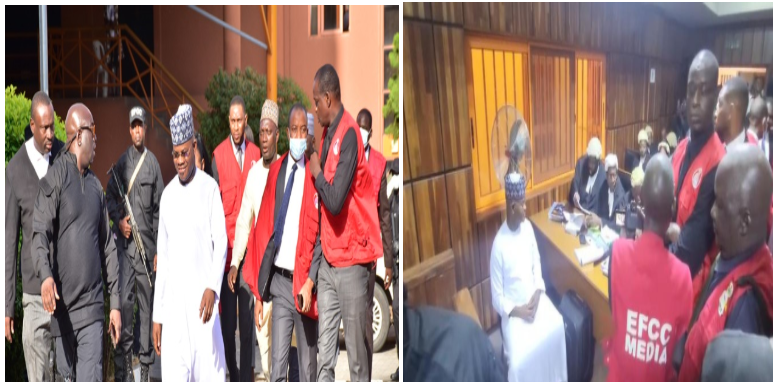
In April, Nigeria and the world were gripped by the chaotic, disgraceful drama surrounding former Kogi State Governor Yahaya Bello, a central figure in a high-profile corruption case involving the Economic and Financial Crimes Commission (EFCC). At the heart of the scandal lay an alleged N80.2 billion fraud before Justice Emeka Nwite—an astronomical sum that epitomizes the entrenched corruption crippling Nigeria’s progress. In a separate case before Justice Maryanne Anenih, Bello faced multiple charges of fraud, including the conversion of over N110 billion ($60 million) of Kogi State funds for personal use.
Yet, this saga transcends financial crimes. It reveals a nation paralyzed by abuse of power, overwhelmed anti-corruption agencies, citizens complicit in shielding corruption, and a judiciary whose weakness has emboldened impunity. The contrasting roles of Justice Nwite and Justice Anenih highlight the systemic rot and the urgent need for reform within Nigeria’s justice system.
The Early Stages: Legal Gymnastics and Media Manipulation
From the outset, Yahaya Bello refused to appear before Justice Nwite, opting instead to send his lawyers to argue his case while exploiting every legal loophole imaginable. In an audacious show of defiance, Bello petitioned to have his trial moved to Lokoja, the capital of Kogi State, where his political influence was deeply entrenched.
Bello avoided court appearances, choosing instead to wage a public relations campaign through the media. Articles emerged lauding him as a “young and visionary politician” and highlighting his purported role in securing Bola Tinubu’s presidential victory. These narratives, indirectly or directly orchestrated by Bello’s camp, called for judicial leniency, with insinuations that Tinubu should intervene to end EFCC investigations. Meanwhile, Bello branded himself as the “White Lion,” a self-styled hero clad in his signature white attire, all while remaining in hiding and defying court orders.
Justice Nwite’s response was disheartening. Rather than assert judicial authority, he repeatedly adjourned the case, creating a judicial stalemate that emboldened Bello’s defiance. After months of delays, the trial was postponed to January 21, 2025, solidifying public perceptions of a judiciary incapable of holding the powerful accountable.
Gunshots, Smuggling, and a Mockery of Justice
The dysfunction escalated in April when EFCC operatives attempted to arrest Bello at his Abuja residence. What should have been a straightforward enforcement of justice descended into chaos. Gunshots rang out as Governor Usman Ododo, Bello’s political ally and successor, allegedly orchestrated his escape. Leveraging his immunity as governor, Ododo reportedly “smuggled” Bello out of the residence in his official car, leaving EFCC operatives powerless to act.
Eyewitness accounts described a scene of lawlessness: Bello’s police security detail and private bodyguards formed a protective barrier, obstructing justice and transforming the arrest into a public farce. Despite being wanted for corruption, Bello retained full police protection—a glaring symbol of the impunity enjoyed by Nigeria’s elite.
The EFCC, left humiliated, petitioned the Nigeria Immigration Service to place Bello on a watchlist. Yet, this measure too proved ineffective. In an audacious move, Bello appeared at EFCC headquarters in September, accompanied by Governor Ododo, only to walk away untouched. This blatant mockery of justice left Nigerians questioning whether the rule of law was merely a suggestion for the powerful.
EFCC’s Growing Desperation: Watchlists and Judicial Failures
With each failed attempt to bring Bello to justice, the EFCC’s desperation deepened. Bello’s legal maneuvers escalated to the Supreme Court, which ultimately dismissed his appeals. Yet, even this judicial defeat failed to compel Bello to appear in court. Instead, he continued to exploit loopholes and the systemic inefficiencies of Nigeria’s legal framework.
EFCC prosecutor Kemi Pinheiro voiced frustration, stating, “We will invite the military if need be to produce the defendant in court. Immunity does not attach to a home; it attaches to a person.” Despite these bold declarations, the EFCC’s inability to compel Bello’s appearance exposed the broader weaknesses in Nigeria’s governance. Justice Nwite’s passive approach only deepened the perception of a broken judiciary where political influence and judicial ineffectiveness allowed corruption to thrive unchecked.
Justice Maryanne Anenih: A Bold and Resolute Stand
A turning point came when another case involving Bello—this time an alleged N110 billion fraud—was assigned to Justice Maryanne Anenih of the Federal Capital Territory High Court. Unlike Justice Nwite, Justice Anenih adopted a no-nonsense, by-the-book approach, determined to restore accountability. Recognizing Bello’s history of evasion, she ordered that hearing notices be served at his residence at No. 9 Benghazi Street, Wuse Zone 4, Abuja, and prominently displayed on the court’s notice board.
Justice Anenih set November 27, 2024, as the arraignment date, signaling her refusal to entertain further theatrics or delays. Her actions reflected a rare commitment to ensuring that the rule of law prevailed, regardless of political pressures.
On November 26, 2024, just 24 hours before the scheduled hearing, EFCC operatives arrested Bello in Abuja. Spokesperson Dele Oyewale confirmed that Bello was apprehended at 12:54 PM and taken into custody for interrogation. Despite the presence of his legal team, Bello was detained at the EFCC’s Abuja office, marking a rare victory for the embattled anti-corruption agency.
Courtroom Chaos: A Judge’s Courage Amid Disorder
The drama, however, reached its peak during Bello’s arraignment. A crowd of his supporters stormed the courtroom, creating a volatile and hostile environment. Justice Anenih, undeterred, initially entered the courtroom to oversee Bello’s plea on multiple counts of money laundering. However, faced with the overwhelming disruption, she made the decision to leave, announcing that she would not return until order was restored.
In an extraordinary display of dysfunction, it was Bello himself—not law enforcement—who attempted to calm the unruly crowd. This reversal of roles underscored the systemic breakdown of authority within Nigeria’s judicial and law enforcement system. In any functional democracy, it is the responsibility of law enforcement—not the defendant—to maintain courtroom decorum. Yet, in this case, the institutions tasked with upholding justice appeared to enable its erosion.
Despite these extraordinary challenges, Justice Anenih held her ground. She ordered that Bello remain in EFCC custody, denying him temporary freedom while she deliberated on his bail application. By reserving her ruling until December 10, 2024, Justice Anenih sent a clear message that she would not bow to chaos or external pressures. Her principled stance stood in stark contrast to the passivity that had previously allowed Bello to evade justice with impunity.
A Deep and Painful Conclusion: A Nation at a Crossroads
The Yahaya Bello saga is a harrowing reflection of systemic dysfunction, impunity, and abuse of power that have long plagued Nigeria’s governance and judiciary. At its core, this story reveals a nation grappling with the psychological toll of corruption and institutional failure. The contrasting approaches of Justice Nwite and Justice Anenih highlight two starkly different judicial philosophies: one that enabled Bello’s defiance and manipulation, and another that sought to restore accountability.
Psychologically, this saga has inflicted deep wounds on Nigeria’s collective psyche. The repeated failures to hold Bello accountable have fostered a dangerous belief: that power and wealth are shields against justice. This corrosive perception breeds apathy, undermines public trust, and erodes the moral fabric of society.
Yet, Justice Anenih’s resolve offers a glimmer of hope. Her bold actions demonstrate the potential for reform and accountability within Nigeria’s judicial system. However, this moment of integrity must not remain an exception. For Nigeria to heal from the scars of corruption and impunity, systemic reforms are imperative. Without such changes, the cycle of dysfunction will persist, leaving the nation trapped in a tragic loop of injustice and despair.

Professor John Egbeazien Oshodi, born in Uromi, Edo State, Nigeria, is an American-based police and prison scientist, forensic/clinical psychologist, public policy psychologist, and legal psychologist. He’s a government advisor on forensic-clinical psychological services in the USA and the founder of the Dr. John Egbeazien Oshodi Foundation for Psychological Health. With a significant role in introducing forensic psychology to Nigeria through N.U.C. and Nasarawa State University, he’s also a former Secretary-General of the Nigeria Psychological Association. He’s taught at esteemed institutions like Florida Memorial University, Florida International University, Nova Southeastern University, and more, and is currently an online faculty member at ISCOM University, Weldios University and Walden University.